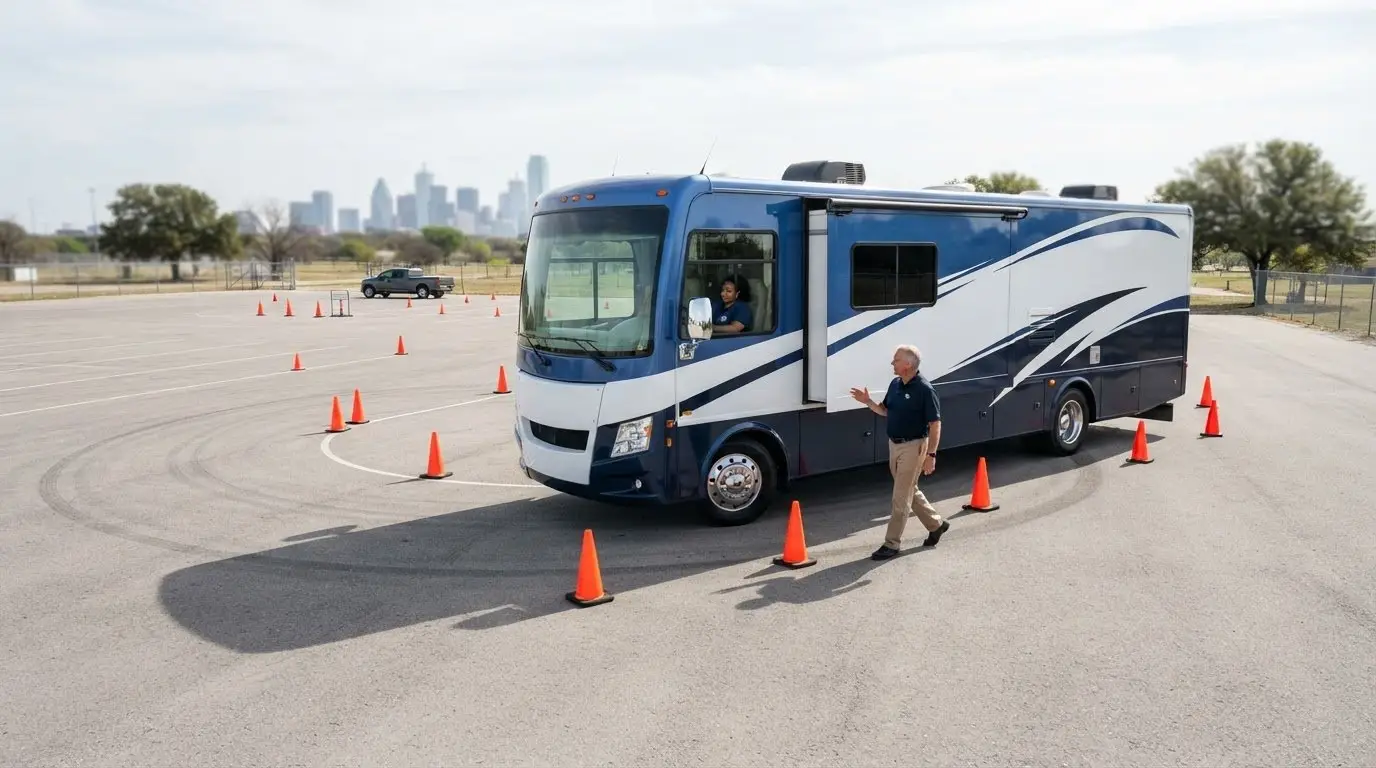
What if the biggest challenge in driving a Class A motorhome isn’t the road, but learning how the vehicle moves through it? Its size can make turns, lane positioning, stopping, and backing feel unfamiliar, especially on your first drive. The right Class A motorhome driving lessons near me should help you focus on practical handling and the situations you expect to face, not just the vehicle’s “Class A” label.
It’s also easy to confuse a Class A motorhome with a Class A CDL. They aren’t the same thing. In Texas, the license needed for personal RV use depends on the vehicle and how it is used, so a CDL isn’t automatically required. Keeping the vehicle category separate from the license category helps you focus on training that fits your motorhome and your goals.
This guide explains what useful RV instruction can help you work on, what to consider before choosing lessons, and how to prepare for a focused training conversation. Lone Star Truck Driving Academy provides RV driver training alongside its CDL programs. Whether you’re a new owner or returning to RV driving, use the steps below to identify your priorities and plan a practical next step.
Key Takeaways
- Clarify whether you need practical motorhome instruction or training for a commercial driving goal.
- List the situations you want to feel more confident handling, such as manoeuvring and judging available space.
- Use your goals to prepare for a focused first lesson and decide what you want to work on.
- When considering Class A motorhome driving lessons near me, look for instruction centered on RV driving, not just a similar license label.
- Lone Star Truck Driving Academy provides RV driver training for learners in Dallas, Mansfield, and Fort Worth.
Class A Motorhome Driving Lessons Near Me: What the Training Is For
For drivers looking for Class A motorhome driving lessons near me, the goal is practical instruction for handling a large motorhome with greater awareness and confidence. A Class A motorhome is a recreational vehicle designed as a single, self-contained motorized unit. The label describes the type of RV, not the driver’s license. A Class A CDL, by contrast, refers to a commercial license category. They answer different questions, so motorhome instruction and commercial truck training are not interchangeable.
A motorhome can feel very different from a car, even for someone who has driven for years. Its size affects how much room you need to turn, how you position the vehicle, and how you judge what is around you. A familiar road can present different decisions from behind the wheel of a larger vehicle. Guided practice gives you a chance to focus on those differences and talk through concerns before they come up during a trip.
Motorhomes fall under the broader category of recreational vehicles. The Recreational Vehicle overview offers general context on the range of vehicles people use for travel and recreation. For driving practice, the useful starting point is the particular motorhome you plan to operate and the situations you want to handle.
What Class A motorhome lessons can help a driver practise
Useful instruction starts with your experience and the parts of driving that feel least familiar. You might want to work on awareness of the vehicle’s position, judging available space, or manoeuvring where there is limited room. Think of these as possible goals to discuss with your instructor. They help you shape a focused conversation around the way you plan to use your RV.
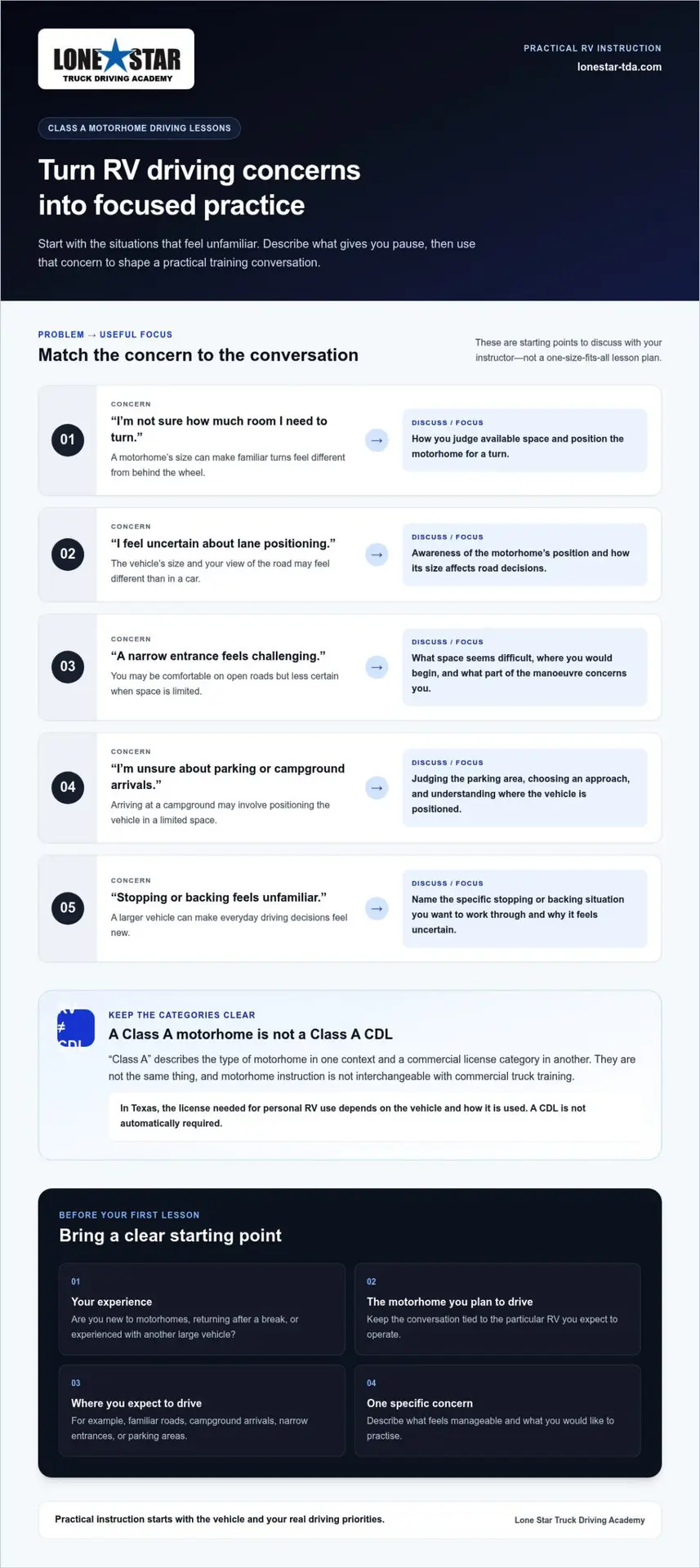
Be specific about what gives you pause. For example, you may feel comfortable on open roads but less certain when turning into a narrow entrance or positioning the motorhome in a parking area. Describe where you would begin, what space seems challenging, and what part of the manoeuvre concerns you. Naming the situation gives you and the instructor a practical place to start.
It can also help to separate what you know from what you want to practise. Perhaps you have experience driving a large vehicle but have never handled a motorhome. Or perhaps you have driven an RV before but want to feel more prepared for a particular type of turn or parking situation. A clear distinction keeps your training priorities tied to your real experience.
Who may benefit from RV driving instruction
First-time motorhome owners often need time to adjust to the view, feel, and space awareness involved in driving a larger vehicle. Drivers returning to RVs after a break may also want to rebuild familiarity before travelling again. Experience behind the wheel is valuable, but it doesn’t automatically make a different vehicle feel intuitive.
Instruction can also suit an experienced driver moving into a motorhome that handles differently from what they’re used to. You don’t need to be a complete beginner to have a worthwhile question. You might want to improve how you judge space, or talk through a manoeuvre before attempting it. Starting with that concern makes the learning process more personal and practical.
Before a lesson, consider what kind of driving you expect to do. A driver preparing for campground arrivals may have different priorities from someone who mainly wants to feel settled on familiar roads. Write down the situations you anticipate, then use them to guide the training conversation rather than trying to cover every possible scenario at once.
Build Confidence With the Size and Handling of a Class A Motorhome
Confidence grows when you understand how your motorhome occupies space and how its size affects everyday driving decisions. In a larger vehicle, your view, position on the road, and sense of clearance may differ from what you’re used to in a car. Developing that awareness is a useful starting point before focusing on the situations that feel most demanding.
Motorhome practice is different from car practice because it asks you to judge space and movement from the perspective of a larger vehicle. The best learning priorities depend on your experience, the motorhome you plan to drive, and the situations you expect to encounter. If you’re unsure where to begin, identify one moment when you feel least certain and explain what makes it challenging.
Match lesson priorities to your motorhome-driving concerns
Before instruction, write down the moments that make you hesitate. You might be concerned about positioning in a lane, manoeuvring in a tight area, or judging whether there’s enough room for a turn. These examples can guide a conversation. A clear goal, such as becoming more comfortable assessing space before a manoeuvre, is more useful than simply asking to become a better driver.
Think about where those concerns come up in your plans. A driver preparing for campground arrivals may want to discuss narrow entrances or placing the vehicle in a parking area. Someone planning to use familiar roads may have different questions about turns and positioning. Note what already feels manageable, too. This gives the instructor a clearer picture of where to concentrate and helps keep the discussion grounded in your needs.
When describing a concern, be as concrete as you can. Instead of saying “parking makes me nervous,” explain whether the challenge is judging the space, choosing an approach, or knowing where the vehicle is positioned. You don’t need technical language. A plain description of what you see and what you want to practise is enough to make the conversation useful.
Choose instruction that fits your experience
A new owner may want to build familiarity with the motorhome’s feel before travelling, while an experienced driver may have a narrower goal, such as adapting to a different vehicle. Share your driving background and the situations you expect to handle. That context helps make the instruction relevant without assuming that one approach fits every learner.
It may help to describe a specific scenario rather than use broad terms. For instance: “I’m comfortable on open roads, but I want to feel more prepared when space is limited.” That gives the instructor something practical to discuss. You don’t have to be starting from scratch to benefit from focused guidance.
As you prepare to drive around Dallas or elsewhere in North Texas, consider the kinds of roads and destinations you expect to encounter. Your usual routes, planned stops, and comfort level can help shape a useful conversation about RV instruction. Keep your focus on the motorhome you’ll drive and the situations you want to approach with more confidence.
Lone Star Truck Driving Academy provides RV driver training for people seeking motorhome-focused instruction. Bring your priorities to the conversation so you can discuss a useful starting point for your RV driving.
Class A Motorhome vs. Class A CDL: Choose the Right Kind of Training
The words “Class A” can point to two different things. A Class A motorhome is a vehicle category; a Class A CDL is a commercial driver’s license category. Seeing “Class A” in a motorhome lesson search doesn’t mean you automatically need CDL A training. First decide whether your goal is to become more comfortable driving a personal motorhome or to prepare for commercial driving.
Use this comparison to identify the kind of instruction that matches your purpose:
| Motorhome driving instruction | Commercial CDL A training |
|---|---|
| Focuses on practical driving confidence and handling a motorhome. | Prepares students for commercial driving requirements and responsibilities. |
| Is relevant to a driver seeking guidance for personal RV use. | Is relevant to someone pursuing a commercial driving goal. |
| Doesn’t become CDL training simply because the RV is called “Class A.” | Follows a separate commercial licensing pathway. |
What the motorhome label does, and does not, tell you
The RV’s class describes the vehicle. It doesn’t, on its own, tell you which license applies or what instruction you need. Licensing requirements can depend on the vehicle and how it’s used, so don’t assume every Class A motorhome driver needs a CDL. For personal-use questions in Texas, consult current Texas Department of Public Safety guidance. For federal information about the commercial pathway, review the FMCSA’s Commercial Driver’s License requirements.
Keep the questions separate: what kind of vehicle will you drive, what will you use it for, and what training will help you operate it with confidence? If you’re looking for Class A motorhome driving lessons near me, you’re likely seeking RV-specific practice, not necessarily commercial driver preparation.
When CDL training is a different goal
Commercial training and motorhome instruction serve different purposes. CDL preparation is for people working toward commercial driving, while RV driver training addresses the needs of motorhome drivers. Lone Star Truck Driving Academy offers CDL programs as well as RV driver training, so choose the program that aligns with your goal. One isn’t a substitute for the other.
If your aim is a commercial driving career, Lone Star’s CDL training programs provide context for that separate path. If you plan to drive a motorhome for personal use, start with current licensing guidance for your situation, then focus your training search on practical RV instruction. Sorting out your goal first helps you avoid spending time on training that doesn’t fit what you want to do.
Choose Local Motorhome Lessons and Prepare for Your First Session
Choosing a nearby lesson is only part of the decision. The instruction should fit the vehicle you plan to drive, the situations you want to handle, and the experience you already bring. Use this four-step framework to turn a general search for Class A motorhome driving lessons near me into a clear plan:
- Identify your concerns. Write down what feels unfamiliar, such as manoeuvring in a confined area, judging space, or positioning the motorhome.
- Define a practical goal. Choose a specific priority, such as feeling more prepared for a particular type of driving situation.
- Compare relevant instruction. Focus on RV-specific training, location convenience, and whether the instruction suits your experience, rather than relying on a broad lesson label.
- Plan your next step. Prepare questions, share your goals, and use current official sources for vehicle-specific licensing questions.
Compare lesson options by relevance to your needs
Lone Star Truck Driving Academy provides RV driver training for people seeking motorhome-focused instruction. As you consider the fit, keep the comparison practical: Is the instruction focused on RV driving? Is the location convenient for you? Does the conversation account for your experience and goals? These questions help you judge whether the training aligns with what you want to work on.
When comparing options, look beyond a label such as “Class A.” Check whether the training is for recreational vehicle handling or commercial licensing. Then consider the specific driving situations you want to discuss. A useful match is one that connects the type of instruction to your purpose, whether you’re a first-time owner or an experienced driver adjusting to a different motorhome.
Prepare your questions before training
Bring a short list of situations you want to feel more confident handling. Note whether you’ve driven a motorhome or another large vehicle before, and explain what you expect to use your RV for. For example, you can mention whether you’re most concerned about turns, positioning, or manoeuvring in a tight space. This context helps make the first training conversation more useful. Check current Texas Department of Public Safety guidance separately if you have questions about licensing for your vehicle.
A productive first training conversation starts with your experience, your intended use, and the driving situations you want to approach with greater confidence.
Lone Star Truck Driving Academy serves Dallas, Mansfield, Fort Worth, Arlington, and Denton. The academy also serves Greensboro, High Point, Winston-Salem, and Burlington in North Carolina. For drivers in the Dallas-Fort Worth area, these locations provide local context when considering RV instruction and planning how training fits into your routine.
Before taking the next step, make sure your notes distinguish between what you want to practise and what you need to clarify about licensing. That keeps the training conversation focused on your driving priorities, while official sources remain the place to resolve regulatory questions.
To discuss your priorities for RV instruction, contact Lone Star Truck Driving Academy.
Explore Class A Motorhome Driving Lessons With Lone Star
Lone Star Truck Driving Academy offers RV driver training for people who want instruction focused on driving a motorhome. Start by describing your experience, the situations you want to work on, and the vehicle you plan to drive. This gives the training conversation a practical focus and helps connect your goals to RV instruction.
If you’re comparing Class A motorhome driving lessons near me, keep the focus on RV instruction rather than assuming a motorhome lesson is the same as CDL A training. Consider what feels unfamiliar and explain it clearly. You might be a new owner, returning to RV driving, or adapting to a different motorhome. Those details help frame what you want from training and make it easier to identify useful priorities.
Find a local starting point in Texas or North Carolina
Lone Star serves Dallas, Mansfield, Fort Worth, Arlington, and Denton in Texas, as well as Greensboro, High Point, Winston-Salem, and Burlington in North Carolina. If you’re in Dallas, Mansfield, or Fort Worth, consider how location fits with your plans for RV instruction. The same decision applies in Arlington and Denton, and in the academy’s North Carolina service areas.
For a Dallas-area driver, proximity may be one part of the decision, but it shouldn’t be the only one. Think about the motorhome you intend to drive, the experience you bring, and the situations you want to approach with more confidence. That gives you a practical basis for deciding whether RV instruction fits your next step.
Take the next step toward more confident RV driving
Before reaching out, jot down what you’d like to discuss. Include any previous experience with motorhomes or other larger vehicles, the situations that concern you, and how you expect to use the RV. Specific context makes the first conversation more useful than a general request for driving help. If you have questions about licensing, consult current official guidance for your vehicle and circumstances.
Lone Star Truck Driving Academy’s RV driver training is a starting point for motorhome-focused instruction. You can describe your experience and goals and discuss what you want to practise. To talk through your RV training priorities, contact Lone Star.
Take Your Next Drive With a Clearer Plan
Your next step doesn’t have to be a long trip. Start by deciding what would help you feel more prepared behind the wheel, then use that goal to guide your training conversation. Clear priorities make it easier to focus on the driving situations that matter to you.
As you consider Class A motorhome driving lessons near me, think beyond simply getting familiar with the vehicle. Aim to approach each drive with a plan, a better understanding of your concerns, and a willingness to keep learning. Preparation and thoughtful practice can help you build familiarity at a pace that feels manageable.
Bring your questions and experience to the conversation. You don’t need to have every detail figured out before taking that step. If you’re ready to discuss your RV training goals, contact Lone Star Truck Driving Academy.
With a practical starting point, you can approach your next drive feeling more prepared and ready to build experience.
Frequently Asked Questions
Is a Class A motorhome the same as a Class A CDL?
No. “Class A motorhome” describes a type of recreational vehicle, while “Class A CDL” refers to a commercial driver license classification. The shared label doesn’t mean the training is interchangeable. Identify whether the motorhome is for personal or commercial use, then consult current Texas and federal guidance for licensing questions tied to that vehicle and use.
Do I need a CDL to drive a Class A motorhome in Texas?
Don’t determine your license requirements from the motorhome’s class label alone. The vehicle and how you use it can affect which rules apply. Check current Texas Department of Public Safety information and relevant federal guidance for your specific circumstances. Driving lessons can help you prepare to operate an RV, but they don’t determine your licensing eligibility or replace official guidance.
Are Class A motorhome driving lessons useful for new owners?
They can be useful if you’re adjusting to a motorhome and want a clearer plan before driving in unfamiliar situations. For example, note whether you’re concerned about manoeuvring into a campsite or positioning the vehicle in a parking area. Share those concerns before training so the conversation can start with your priorities, rather than assuming every new owner needs the same kind of instruction.
Can experienced drivers benefit from motorhome driving lessons?
Yes. Familiarity with a car or another vehicle doesn’t guarantee that a motorhome will feel natural right away. You might be an experienced driver who wants to adapt to a different vehicle or work through one specific concern. Explain what you’ve driven before and what you want to handle with more confidence. That context helps make the discussion relevant to your background.
How do I find Class A motorhome driving lessons near Dallas or Fort Worth?
Look for instruction specifically focused on RV or motorhome driving, then consider whether its location and focus suit your needs. Lone Star Truck Driving Academy provides RV driver training and serves Dallas, Mansfield, and Fort Worth. When you get in touch, share your location and the situations you’d like to practise so the conversation can start with your priorities.
What should I prepare before starting RV driving lessons?
Write down the situations you want to discuss, such as entering a fuel station or manoeuvring in an unfamiliar area. Add a short note about your previous experience with motorhomes or other larger vehicles. This gives the training conversation a practical starting point. Keep licensing questions separate, and use current official guidance to check requirements for your particular vehicle and circumstances.
Article by
Lone Star Truck Driving Academy Training Team
Lone Star Truck Driving Academy provides CDL training for students throughout Texas and North Carolina. Our training team specializes in Class A CDL training, Class B CDL training, CDL refresher programs, automatic restriction removal, third-party testing support, and workforce development partnerships designed to help students build successful careers in the transportation industry.
Training Information Notice
The information provided in this article is for general educational purposes only. Program availability, tuition, licensing requirements, testing procedures, endorsement requirements, and regulatory standards may change over time. Prospective students should contact Lone Star Truck Driving Academy directly to verify current program details, admissions requirements, and state-specific CDL regulations.