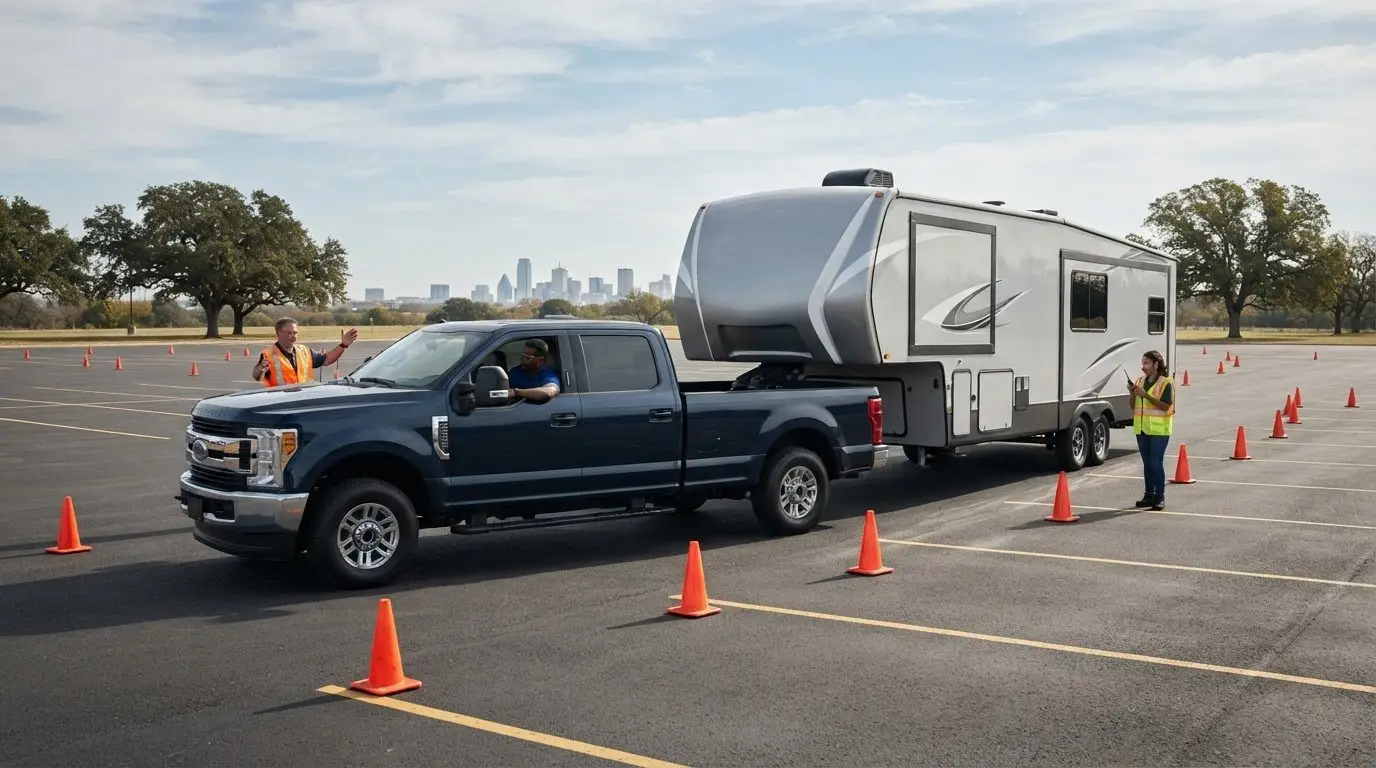
What if driving a large fifth wheel RV feels less intimidating when you stop trying to rush every decision? If you’re learning how to drive a large fifth wheel RV, it’s reasonable to feel unsure about wide turns, trailer swing, braking distance, and backing into a tight space. The rig responds differently from a regular vehicle, and it takes time to judge how much room you need.
A calmer drive starts before you reach the road. Use a consistent pre-trip check, choose a speed that fits the conditions, leave extra following distance, and plan your position before turning. You don’t need to master every maneuver at once, but you do need a routine you can rely on.
This guide explains how a fifth wheel changes your truck’s handling and offers practical steps for preparing, towing, turning, reversing, and parking. You’ll also learn how coached RV driver training can help you build skills through guided practice. With preparation and patience, each trip can help you make more confident, precise decisions.
Key Takeaways
- Understand how the fifth-wheel hitch, mounted in the pickup bed, affects the way the truck and trailer move together.
- Use a repeatable pre-trip check and follow the vehicle and trailer manufacturers’ setup and loading instructions.
- Learn how to drive a large fifth wheel RV with more space by slowing early, planning turns, and accounting for traffic and visibility.
- Make reversing more manageable by moving one step at a time, stopping when you lose sight or confidence, and agreeing on clear spotter signals.
- Build skill progressively through practice, and consider RV driver training for coached guidance with setup, maneuvering, and parking.
Understand How a Large Fifth Wheel RV Changes the Way You Drive
Towing a fifth wheel feels different from driving a pickup alone. A calm routine helps you make deliberate choices instead of reacting at the last moment. The combination includes the pickup and the trailer it tows. Unlike a conventional bumper-mounted trailer, a fifth-wheel hitch connects in the pickup bed. The fifth-wheel coupling explains the basic connection between the towing vehicle and trailer.
To understand how to drive a large fifth wheel RV, think of the truck and trailer as one combination that needs more room to move. You’re responsible for the truck’s position and the trailer’s path behind it. Allow for the full combination’s length when choosing a lane position, setting up for a turn, or deciding how much space to leave ahead. Weight, braking systems, loading, road surface, and conditions also affect how the combination responds, so handling can vary from one rig or trip to another.
What changes when you tow a fifth wheel?
The truck may clear an obstacle while the trailer still tracks close to it. A longer combination also takes more room to turn and more space to stop than the pickup alone. Before committing to a maneuver, assess the road, traffic, and available space.
Trailer swing is the trailer’s sideways movement relative to the tow vehicle as the combination turns or changes direction. How much room that movement needs depends on the specific truck, trailer, hitch setup, and maneuver. Keep checking where the trailer is tracking rather than assuming the pickup’s path tells the whole story.
Which dimensions should you know before leaving?
Before setting out, record the combined rig’s overall length, width, and height using the vehicle and trailer documentation. Keep the figures accessible in the cab. Know the measurements for the loaded setup you’re actually driving, and follow the manufacturers’ instructions for measuring, loading, and operating the combination. Don’t rely on a different trailer’s measurements or a rough visual estimate.
These dimensions affect route choices as well as parking. Height matters near bridges and overhead structures; width and length can limit which roads, lanes, or stopping areas are practical. Review posted clearances and route restrictions before travel, and plan an alternative rather than trying to judge a tight clearance at the last moment.
- Overall length: Helps you assess turning room and whether a stopping area can accommodate the combination.
- Width: Helps you account for lane space and narrow roads or entrances.
- Height: Helps you identify overhead clearance concerns along the route.
General awareness is useful, but it doesn’t replace the exact figures for your rig. Check the pickup and trailer documentation, and use the dimensions for your own combination when planning a trip. Preparation gives you a clearer picture of the space you need before the road asks you to make a quick decision.
Prepare the Fifth Wheel and Tow Vehicle Before Every Trip
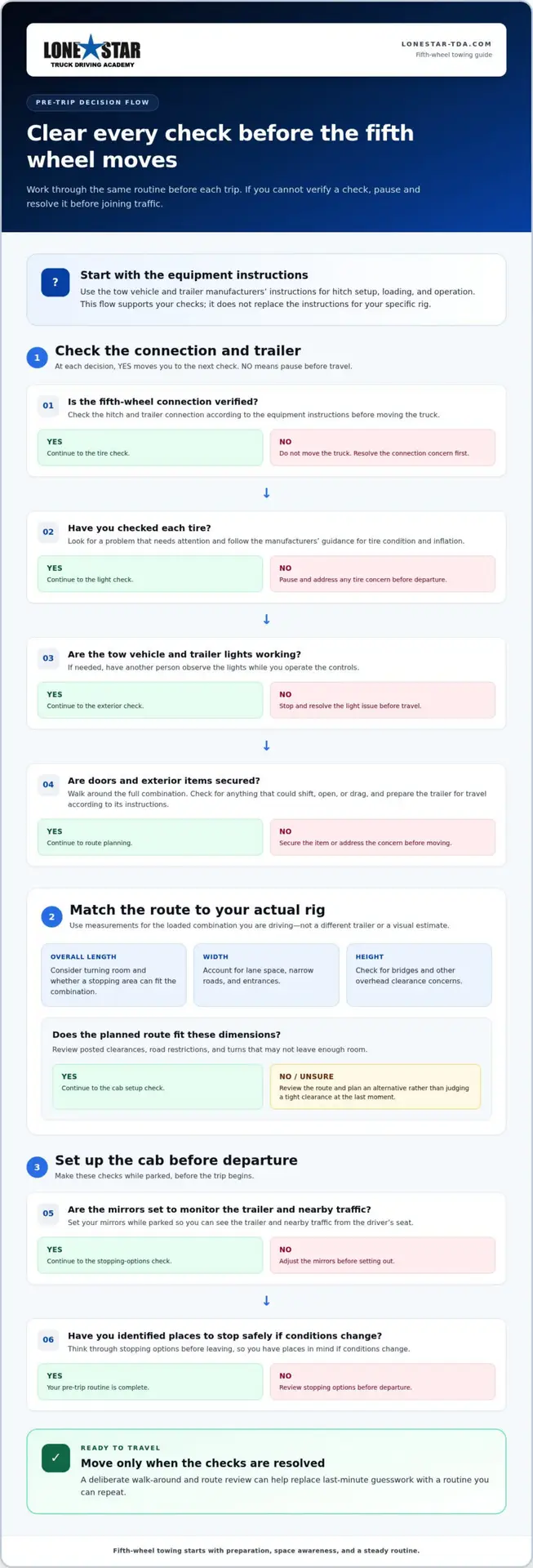
A consistent pre-trip routine takes guesswork out of getting underway. Use the same sequence each time, and pause to resolve anything you can’t verify. Follow the tow vehicle and trailer manufacturers’ instructions for hitch setup, loading, and operation. Those instructions apply to your specific equipment, so don’t substitute a general checklist for the required setup steps.
Check the hitch connection and trailer walk-around
Verify the fifth-wheel connection according to the hitch and vehicle instructions before moving the truck. Then walk around the full combination, checking the tires, lights, doors, and exterior items that could shift, open, or drag during travel. A pre-trip check can catch setup concerns before they become road decisions.
- Confirm the connection. Use the equipment instructions to check that the hitch and trailer are properly connected and ready for travel.
- Look over the tires. Check each tire visually for a problem that needs attention before departure, and follow the manufacturers’ guidance for tire condition and inflation.
- Check the lights. Confirm the trailer and tow vehicle lights are working. If you need help verifying them, have another person observe while you operate the controls.
- Secure the exterior. Check doors and anything outside that could move or open, then prepare the trailer for travel according to its instructions.
Keep the walk-around deliberate rather than rushing through it from memory. If you find something you can’t resolve, stop and address it before joining traffic. Get underway only when you’re satisfied that the combination is ready, not while you’re still wondering whether a connection or door is secure.
Plan the route and set up the cab
Before departure, compare your route with the actual rig’s height, width, and length. Look for posted clearances, road restrictions, and turns that may not leave enough room for your combination. A route that works for a car may not suit a large RV. If a regulation affects your trip, check current official guidance rather than relying on an old note or assumption.
- Set your mirrors while parked so you can monitor the trailer and nearby traffic from the driver’s seat.
- Review the route for clearance concerns, road constraints, and turns that may require extra planning.
- Identify stopping options before you leave, so you have places in mind to pull over safely if conditions change.
Make these checks before the trip, not while moving through a busy area. A clear view in the mirrors and a route suited to your combination give you more time to make measured decisions. Lone Star Truck Driving Academy provides RV driver training with coached practice in setup and maneuvering.
Handle Turns, Braking, and Highway Travel With More Space
A large fifth wheel rewards early, smooth decisions. Give yourself time to read the road, adjust speed, and make room before a turn or lane change. Sudden steering or braking can make the combination harder to manage, especially when traffic, wind, or road conditions shift. Smooth inputs help you stay deliberate and keep attention on both the pickup and the trailer.
Make turns without crowding the trailer
A longer trailer follows a different path through a turn than the tow vehicle. Set up with enough room for the combination to clear the corner, but don’t swing so wide that you enter another lane or put nearby traffic at risk. Watch the mirrors as you turn, checking the trailer’s position as well as the road ahead. If the path looks tight, stop in a safe place and reassess rather than forcing the turn.
Use this sequence for a planned turn:
- Observe: Read the intersection or entrance, traffic, signs, and available turning space.
- Create space: Position the truck early so the trailer has room to follow without crowding an obstacle or another vehicle.
- Signal: Communicate your intention in time for nearby drivers to respond.
- Turn deliberately: Move at a controlled pace, steering smoothly while checking the mirrors and the trailer’s path.
- Reassess: Once through the turn, confirm the trailer is tracking clear and the combination is settled in its lane.
Don’t focus only on the front of the truck. A curb, post, parked vehicle, or adjacent lane may be clear of the pickup but still close to the trailer. Leave room without making an abrupt correction, and pause if you can’t confidently judge the clearance.
Build a steady highway routine
On the highway, leave a generous following distance and increase it when visibility, traffic, or road conditions make it harder to respond. There’s no single distance that suits every combination and situation. Look well ahead, ease off the accelerator early when traffic slows, and brake progressively rather than waiting until a gap closes. Choose a speed that fits what you can see and the conditions around you.
Wind, rough pavement, congestion, and changing traffic can all call for a fresh assessment. Keep steering inputs smooth and avoid quick corrections. Before changing lanes, check that you can see the available space and account for the trailer as well as the truck. Signal, move steadily when there’s room, then check that the full combination is positioned safely in the lane.
These habits make how to drive a large fifth wheel RV less about reacting to surprises and more about planning each move. If conditions reduce your visibility or leave too little room, wait for a safer opportunity or choose a place to stop and regroup.
Reverse, Park, and Maneuver a Fifth Wheel One Step at a Time
Backing a fifth wheel takes practice. It’s normal to need more than one attempt, even when the space looks straightforward. Choose a spacious, low-pressure area where practice is permitted, and focus on small, controlled movements rather than trying to finish quickly. If you lose sight of your spotter, can’t judge the trailer’s position, or feel uncertain, stop. Reassess and reset instead of forcing the maneuver.
Use a repeatable backing routine
Before moving, get out and assess the space. Look for obstacles, the intended path, the trailer’s position, and a clear exit. If someone is spotting, agree on simple signals before either of you moves. Decide which signal means stop, and use clear, consistent directions. The spotter should stay visible to you and out of the vehicle’s path.
- Check the space. Identify where the trailer needs to go and what could interfere along the way.
- Agree on signals. Confirm how the spotter will direct you and how either person will call for a stop.
- Move slowly. Make small steering adjustments, then pause to check the trailer’s position in your mirrors.
- Stop if visibility changes. Don’t continue if the spotter disappears from view or you lose confidence in your clearance.
- Reset as needed. Pull forward or reposition only when you can do so safely, then reassess the path.
There’s no penalty for stopping to look again. A rushed correction can make a tight situation harder, while a pause gives you a chance to understand what the trailer is doing and decide on the next move.
Choose stops and parking spaces carefully
Evaluate a parking space before committing. Consider whether there’s room to enter, turn, and leave without hurried corrections. Check for overhead clearance, pedestrians, other vehicles, and obstacles near the trailer’s path. A space that appears open from the driver’s seat may still be difficult to exit once the full combination is positioned.
A pull-through space can simplify the maneuver when one is available and suitable for your rig. It still needs enough room for the complete combination and a clear route in and out. If a space feels too tight, choosing another one is a sound driving decision, not a failure.
To learn how to drive a large fifth wheel RV with greater control, practice in stages. Begin in a roomy area, repeat basic backing and parking maneuvers, then progress to more demanding spaces as your judgment improves. Lone Star Truck Driving Academy offers RV driver training for drivers who want coached practice with a large rig.
Explore RV driver training
Build Confidence Through Practice and RV Driver Training
Confidence grows when you can explain what you’re practicing and why. Set a clear goal for each session, such as keeping the combination positioned comfortably through a broad turn or recognizing when a maneuver needs a reset. Afterward, consider what you noticed and what still feels uncertain. This reflection makes each practice session purposeful instead of simply repeating the same drive.
Create a gradual practice plan
Begin in a spacious area where practice is permitted, and choose a time and setting that let you concentrate without feeling rushed. Focus on one skill at a time. Before adding a new challenge, ask yourself whether you can stay aware of the truck, trailer, and surroundings while managing the current task comfortably.
Keep the plan flexible. If a maneuver feels less controlled than expected, make the next session simpler rather than treating progress as a straight line. Familiarity develops at different paces, and changing conditions can make a practiced skill feel new again. The useful measure is whether you can make deliberate decisions, not how quickly you move to harder situations.
When can RV driver training help?
Coached practice may help if you’re preparing to tow for the first time or returning after a long break. It gives you a chance to focus on practical driving skills with guidance, especially if you’re unsure how to structure your practice or which areas need attention. That support can help you identify questions and make independent practice more intentional.
Think about the situations you want to handle more comfortably, then use those goals to guide your next step. Lone Star Truck Driving Academy provides RV driver training to help you work on practical skills with coached practice.
Take Your Next Drive One Step at a Time
Learning how to drive a large fifth wheel RV is a process, not a test of nerve. Let each trip build on what you’ve practiced, and pause when a situation feels unfamiliar. A measured decision is a useful skill behind the wheel, especially as you gain experience with your own rig.
Lone Star Truck Driving Academy provides RV driver training for drivers in Dallas, Mansfield, Fort Worth, Arlington, Denton, Greensboro, High Point, Winston-Salem, and Burlington. Coached practice can give you a focused next step as you work toward handling your fifth wheel with greater ease.
Practice at a pace that feels safe and manageable. With patience and preparation, you can approach each trip with clearer judgment and growing confidence.
Frequently Asked Questions
Is it difficult to drive a large fifth wheel RV?
It can feel challenging at first because the pickup and trailer respond as a longer combination, but difficulty varies with the rig, driver experience, and surroundings. Prepare by reviewing the truck’s towing guidance and the trailer’s operating instructions before your first trip. If possible, become familiar with the combination in a low-pressure setting before traveling somewhere unfamiliar or busy.
How do you turn with a fifth wheel trailer?
Allow for the trailer’s path as you choose where to position the truck before a corner. A driveway entrance, for example, may require a different setup from a broad road intersection. Check for vehicles, curbs, signs, and other obstacles that could restrict the full combination’s path. If the turn cannot be made without entering an unsafe space, wait or choose another route.
Can you back up a fifth wheel RV by yourself?
Yes, but backing alone means you don’t have another person outside the truck to help identify obstacles or judge the trailer’s position. Before relying on a solo maneuver, consider whether you can see the relevant area from the driver’s seat and whether the space leaves room to reposition. If visibility is limited or other people are nearby, choose a safer arrangement rather than relying on guesswork.
What should you check before towing a fifth wheel?
Along with the physical setup, review the pickup and trailer documentation for loading guidance and operating limits. Consider whether the current cargo and passengers match the planned trip, and avoid assuming last trip’s load is still representative. Check that your route suits the dimensions of the complete combination. If a concern comes up, use the manufacturer’s instructions or current official guidance to resolve it before departing.
How do you stop a large fifth wheel RV safely?
Stopping safely depends on conditions, load, and equipment, so there isn’t one universal distance to rely on. Learn the braking instructions for your truck and trailer, and allow extra room if the road is wet, visibility is poor, or traffic is unpredictable. On a descent, plan ahead and follow the vehicle manufacturer’s guidance for managing speed. Avoid waiting until a hazard is close before responding.
Do you need a special license to drive a fifth wheel RV in Texas?
A CDL isn’t required to operate a personal RV in Texas, but some combinations require a non-commercial license beyond a standard Class C. Texas guidance specifies a non-commercial Class A Exempt license when GCWR is 26,001 pounds or more and the trailer’s GVWR exceeds 10,000 pounds. Because license requirements depend on the specific ratings, verify your combination and current requirements with the Texas Department of Public Safety before driving.
Article by
Lone Star Truck Driving Academy Training Team
Lone Star Truck Driving Academy provides CDL training for students throughout Texas and North Carolina. Our training team specializes in Class A CDL training, Class B CDL training, CDL refresher programs, automatic restriction removal, third-party testing support, and workforce development partnerships designed to help students build successful careers in the transportation industry.
Training Information Notice
The information provided in this article is for general educational purposes only. Program availability, tuition, licensing requirements, testing procedures, endorsement requirements, and regulatory standards may change over time. Prospective students should contact Lone Star Truck Driving Academy directly to verify current program details, admissions requirements, and state-specific CDL regulations.