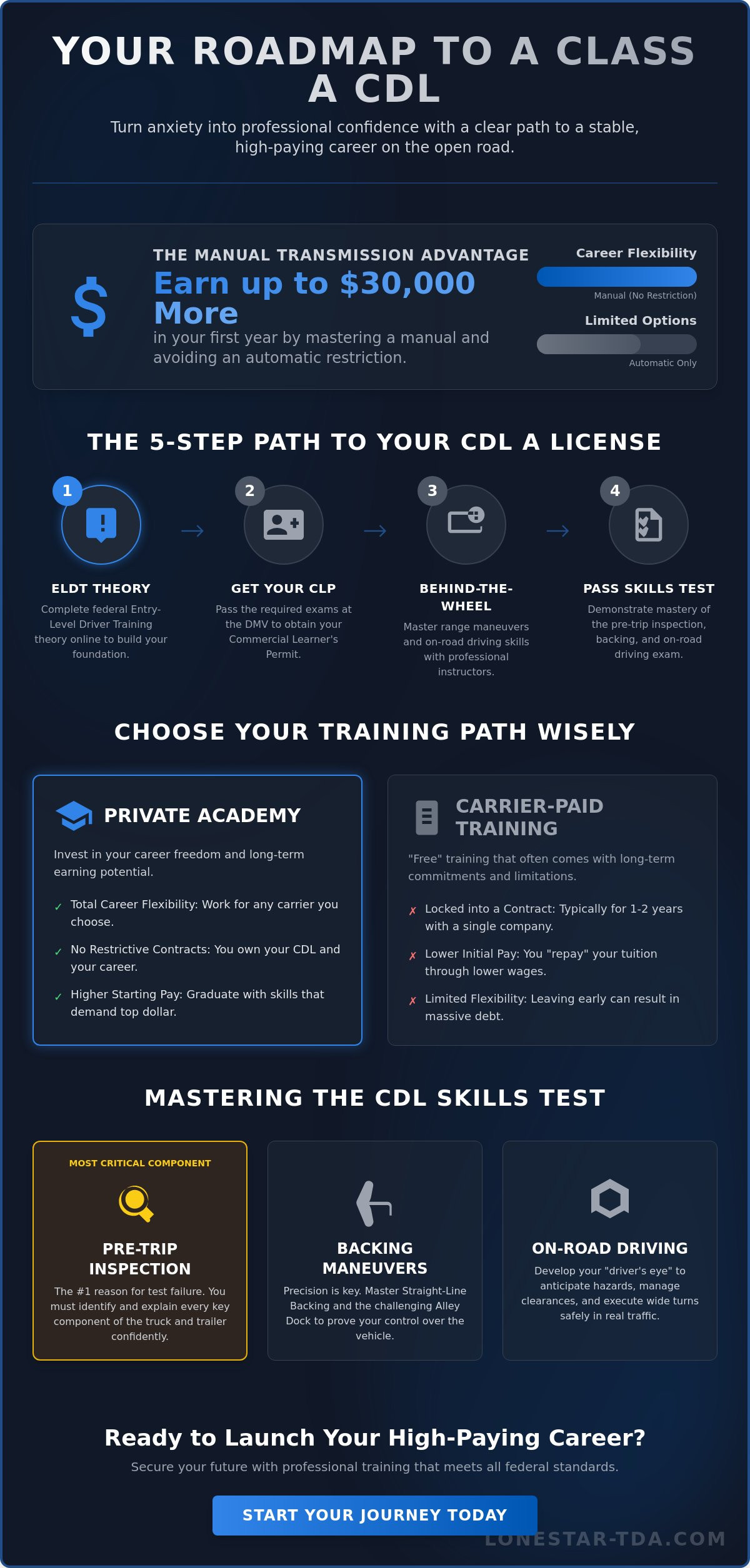
Did you know that drivers who master a manual transmission can earn up to $30,000 more in their first year than those with an automatic restriction? Choosing the right CDL A training program is about more than just getting behind the wheel; it’s about securing your financial future in a landscape of tightening FMCSA regulations and new standards like Dalilah’s Law. It’s completely normal to feel overwhelmed by long DMV wait times or the pressure of mastering complex backing maneuvers before your road test. You want a path that’s efficient, compliant, and designed to help you succeed on the first try.
We’re here to turn that anxiety into professional confidence by providing a clear, action-oriented roadmap to your commercial license. This guide walks you through the essential steps of modern driver education, from completing ELDT theory certification to the benefits of specialized paths like Hot Shot driver training. You’ll learn how to manage manual vs. automatic restrictions and utilize third party on-site testing to bypass typical DMV delays. Get ready to master the skills you need for a stable, high-paying career on the open road.
Key Takeaways
- Understand the federal ELDT requirements and how to navigate theory certification to secure your permit efficiently.
- Master the pre-trip inspection, the most critical component of the skills test, to ensure you walk onto the lot with confidence.
- Evaluate the long-term benefits of a private CDL A training program over carrier-paid options to maintain your career flexibility.
- Discover how removing automatic restrictions and exploring Hot Shot trucking can significantly expand your job opportunities.
- Learn the specific eligibility criteria and the mandatory 14-day waiting period required to transition from a learner’s permit to a full license.
What is a Class A CDL Training Program?
A CDL A training program is a structured, federal-standard curriculum designed to transform beginners into professional commercial drivers. It’s not just a series of driving lessons; it’s a comprehensive educational path that meets the Entry-Level Driver Training (ELDT) standards. Since February 7, 2022, the Federal Motor Carrier Safety Administration (FMCSA) has required all new applicants to complete this specific training through a registered provider. This ensures that every driver on the road has a baseline of safety knowledge and technical skill.
The distinction between Class A and Class B is vital for your career trajectory. A Class A license allows you to operate combination vehicles, such as tractor-trailers, with a gross vehicle weight rating (GVWR) of 26,001 pounds or more. Class B is generally limited to straight trucks like delivery vans or buses. Choosing a professional CDL training programs is significantly faster and safer than attempting to learn on your own. Professional instructors provide the oversight needed to master complex maneuvers without developing dangerous habits that could lead to accidents or test failures.
Expert guidance helps you navigate the technicalities of the law and the mechanical realities of the truck. While some try to study the manuals independently, the hands-on nature of a CDL A training program provides the real-world context that books simply can’t offer. To ensure you’re prepared for the maintenance side of the industry, you can discover Ms. Hydraulics LLC for specialized mobile hydraulic and heavy equipment repair. You’ll gain the confidence to handle a 70-foot vehicle in tight spaces and high-traffic areas, a feat that requires professional mentorship and hours of supervised practice.
The Core Components of Professional Training
Professional training is built on three essential pillars. You’ll start with classroom instruction, where you learn federal regulations, hours-of-service rules, and logbook management. Next, you’ll move to the range to master backing, docking, and parking maneuvers. Finally, you’ll head out for on-road experience. This phase involves driving in actual traffic under the watchful eye of an instructor who helps you refine your shifting, braking, and lane management skills.
Why Your Training Provider Registry (TPR) Status Matters
Your status on the Training Provider Registry is your ticket to the CDL road test. Under the ELDT mandate, the DMV will not allow you to test unless a registered provider has electronically filed your certificates of completion. We ensure your theory and behind-the-wheel records are submitted accurately to the DOT. Relying on an uncertified school or a private tutor puts your entire career on hold, as their “training” won’t be recognized by federal authorities.
Inside the Curriculum: ELDT Theory and Skills
The journey to your commercial driver’s license begins with a deep dive into the Entry-Level Driver Training (ELDT) regulations. This phase isn’t just a hurdle; it’s the foundation of your professional career. You’ll start by tackling the theory portion, which covers everything from vehicle systems to emergency maneuvers. Once you’ve mastered the material, you’ll head to the DMV to secure your Commercial Learner’s Permit (CLP). This document is your ticket to the next phase of your CDL A training program.
Mastering the pre-trip inspection is your next critical milestone. It’s the most common reason students fail their road test. You must be able to identify and explain the condition of every component, from the air brakes to the fifth wheel. After the inspection, you move to the range. Here, you’ll practice straight-line backing and the alley dock. These maneuvers require precision and patience. You’ll learn to use your mirrors effectively and understand how the trailer reacts to every steering input.
ELDT Theory: More Than Just Rules
Your permit preparation focuses on the specific requirements for Texas or North Carolina exams. We don’t just teach you to memorize answers. You’ll understand the “why” behind Hours of Service (HOS) and how to manage Electronic Logging Devices (ELD). For Class A drivers, understanding cargo securement and weight distribution is vital. Improperly loaded trailers can lead to rollovers or fines. We ensure you’re ready for these real-world challenges before you ever leave the classroom. If you’re ready to get started, our ELDT Theory Certification and Permit Prep can set your foundation for success.
Behind-the-Wheel: Range and Road Mastery
Backing maneuvers often separate the pros from the amateurs. It’s the “make or break” of the skills test. Once you’ve mastered the range, you’ll transition to Mansfield or Dallas street traffic. This is where you develop the “driver’s eye.” You’ll learn to anticipate hazards, manage overhead clearances, and execute wide turns without hitting curbs. If you’re evaluating CDL schools near Mansfield TX, understanding how programs structure this on-road phase is one of the most important factors in choosing the right fit. This CDL A training program phase is where your confidence truly grows as you learn to control a massive vehicle in real-world conditions.
The final stage involves advanced road skills like shifting through all gears smoothly and maintaining lane control in tight spaces. Shifting a manual transmission requires a specific rhythm that you’ll practice until it becomes second nature. Finally, you’ll face the three-part skills examination. This includes the pre-trip, basic vehicle control, and the on-road drive. Passing this test results in your license issuance, marking your transition from student to professional driver. It’s a challenging path, but it’s one that leads to incredible career stability.
Private Academy vs. Paid Carrier Training
Deciding how to fund your CDL A training program is the first major fork in your career path. You’ll likely see two main options: private academies or carrier-sponsored programs. While many mega-carriers advertise “free” tuition, it’s essential to look at the fine print. These programs are often structured as paid carrier training models where the company covers your upfront costs in exchange for a mandatory employment contract. This sounds convenient, but it can limit your earning potential and freedom during your first year on the road.
The “Contract Trap” is a reality for many new drivers. According to industry data from May 2026, these contracts typically last between 6 to 12 months. If you leave the company before the term ends, you’re often required to pay back the full tuition immediately. Private graduates enter the market as free agents. This freedom allows you to choose from various carriers, comparing sign-on bonuses and route types to find the best fit for your lifestyle. When you own your license, you own your career from day one.
The True Cost of “Free” Training
Carriers offering paid training often pay lower mileage rates to trainees to recoup their investment. Some trainees earn around $616 per week while training, while private school graduates can earn between $55,000 and $70,000 in their first year. By investing in your education upfront at an academy like Lone Star, you qualify for higher starting pay and better benefits. Most private graduates see a return on their investment within the first few months of full-time driving. You’re not just a number in a “driver mill”; you’re a professional in training with the power to walk away from a bad work environment.
Flexibility and Specialized Instruction
Private academies offer a level of customization that large carriers can’t match. If you’re interested in local Texas routes rather than being over-the-road (OTR) for weeks, private training allows you to seek out those specific employers immediately. You also get access to specialized instruction that fits your goals. If you want to enter the growing niche of Hot Shot driver training, a private academy provides the specific equipment and maneuvers needed for that field. Smaller class sizes mean instructors focus on your individual technical weaknesses, ensuring you’re ready for the road test and a long-term career.
Licensing Requirements and the Testing Process
Obtaining your commercial license requires more than just driving skill; it demands strict adherence to regulatory timelines and physical standards. Before you can even begin the practical portion of your CDL A training program, you must meet basic eligibility requirements. You must be at least 18 years old to drive within state lines (intrastate) or 21 years old to engage in interstate commerce. You’ll also need to pass a Department of Transportation (DOT) medical exam to prove you’re physically capable of handling a heavy vehicle safely.
Once you secure your Commercial Learner’s Permit (CLP), a mandatory 14-day waiting period begins. This time is designed for you to practice the skills you’ll need for the final examination. The test itself is divided into three distinct segments: the pre-trip inspection, basic vehicle control maneuvers, and the on-road driving test. Failing any single part usually means you cannot proceed to the next, which is why thorough preparation is non-negotiable. We’ve seen that students who treat the pre-trip inspection with the same focus as the driving portion have much higher success rates.
Bypassing the DMV with Third-Party Testing
Wait times at state DMV offices can often stretch into weeks or even months, stalling your career before it starts. Lone Star serves as an authorized on-site testing facility in Texas, allowing you to bypass these frustrating delays. Third party CDL testing at our facility means you’ll use the same vehicle you operated during your CDL A training program. This familiarity significantly reduces test-day anxiety, as you already know the truck’s shifting patterns and braking feel. You won’t have to navigate an unfamiliar testing route in a different city; instead, you’ll demonstrate your mastery in a supportive, familiar environment.
Medical and Document Readiness
Walking into the DMV without the right paperwork is a recipe for frustration. You’ll need your valid driver’s license, proof of US citizenship or lawful permanent residency, and your DOT medical card. The DOT physical is a health assessment performed by a certified medical examiner that remains valid for up to two years. Certain conditions, like uncontrolled high blood pressure or specific vision impairments, can disqualify you or require a shorter certification period. We recommend completing your physical early to ensure there are no surprises during your enrollment. If you’re ready to schedule your exam without the DMV headache, explore our Third Party Testing services to get on the road faster.
Specialized Training: Hot Shot and RV Mastery
Your journey doesn’t have to end with a standard tractor-trailer. While many drivers start their CDL A training program with visions of 53-foot dry vans, the industry offers lucrative niches that provide more flexibility and independence. Specialized training allows you to pivot into areas like high-priority freight or luxury vehicle transport, often with equipment that’s easier to manage in urban environments. Beyond traditional logistics, local arborist services like We Love Trees often look for drivers with CDL credentials to safely operate specialized equipment across Central Texas. Whether you’re looking to become an owner-operator or simply want to maximize your earning potential, these advanced paths set you apart from the average driver.
Mastering these specialized skills is about more than just variety; it’s about career insurance. For those who have been out of the driver’s seat for a while, a CDL refresher course provides the necessary update on modern safety regulations and technical maneuvers. Similarly, for those moving into the recreational space, RV driver training ensures that handling a massive luxury coach becomes second nature rather than a source of stress. These programs bridge the gap between basic licensing and true professional mastery. Drivers based in North Carolina will find that the best truck driving school in the Piedmont Triad offers the same commitment to professional mastery, with high standards maintained across every location and training phase.
The Hot Shot Advantage
Hot shot trucking has become a powerhouse in the Texas economy. This niche involves using heavy-duty dually trucks and gooseneck trailers to deliver time-sensitive, smaller loads that don’t require a full semi-truck. Because these setups often exceed a combined GVWR of 26,001 pounds, a Class A license is federally required. Our Hot Shot driver training focuses on the unique logistics of these high-priority shipments. You’ll master the specific backing techniques required for gooseneck trailers and learn how to manage weight distribution for diverse cargo types. It’s a popular choice for drivers who want to run their own business without the overhead of a traditional big rig.
Removing the Automatic Restriction
If you tested in an automatic vehicle, your license likely carries an “E” restriction. This prevents you from legally operating any commercial vehicle with a manual transmission. It’s a significant hurdle, as learning manual transmission can open up roughly 40% more job opportunities, particularly in specialized heavy-haul and vocational sectors. Our automatic restriction removal service is designed to eliminate this barrier in just a few days. You’ll learn the rhythm of double-clutching and gear synchronization, instantly increasing your marketability. Investing in this skill during your CDL A training program ensures you never have to turn down a high-paying job because of a simple license limitation.
Choosing to specialize is the fastest way to increase your value in the 2026 job market. Whether you’re eyeing the freedom of the Hot Shot world or the technical challenge of heavy-haul manual rigs, the right training makes the difference. Take control of your career path today by choosing a program that looks beyond the basics and prepares you for the most profitable corners of the industry.
Take the Wheel of Your Professional Future
Navigating the transition into a commercial driving career requires more than just interest; it demands a partnership with an ELDT Certified Training Provider that understands the 2026 regulatory landscape. By mastering federal theory standards and choosing the freedom of a private CDL A training program, you’ve already taken the first steps toward a more stable and lucrative future. You now understand that specialized Hot Shot & RV programs and removing automatic restrictions aren’t just options; they’re strategic investments in your long-term earning power.
We’re dedicated to helping you bypass the typical hurdles of the licensing process. As an Authorized Third-Party Testing Site, we ensure you can complete your journey in a familiar environment without the long wait times often found at state facilities. Your new career is waiting, and we have the expertise to help you reach it with total confidence. Don’t let another day pass without moving toward the stability you deserve. Start Your Career with Lone Star Truck Driving Academy Today and join a community of professionals who have already found success on the road.
Frequently Asked Questions
How long does a typical CDL A training program take?
Most students complete their training within three to six weeks of full-time study. The exact duration depends on your personal learning pace and the specific curriculum requirements of the CDL A training program you choose. Accelerated options focus on efficiency, while more comprehensive courses provide extra range time to ensure you’re fully prepared for the road test.
Can I get my CDL if I have a full-time job?
You can certainly obtain your license while working, though it requires careful scheduling and dedication. Many students balance their current roles by seeking out programs that offer flexible hours or part-time tracks. It’s best to check with individual training providers to see how they can accommodate your existing work commitments during the ELDT theory and behind-the-wheel phases.
What is the difference between ELDT theory and behind-the-wheel training?
ELDT theory is the educational foundation that covers federal safety regulations, vehicle systems, and logbook management. Behind-the-wheel training is the practical application where you master maneuvers on a closed range and drive in real traffic. Federal law requires you to complete both components through a registered provider before you’re eligible to take your final skills examination.
Do I need to know how to drive a manual transmission to get a CDL?
You aren’t required to learn a manual transmission, but testing in an automatic vehicle will result in an “E” restriction on your license. This prevents you from legally operating any commercial vehicle with a manual gearbox. Mastering a manual transmission during your CDL A training program is a smart move that significantly increases your job opportunities and long-term marketability.
What happens if I fail my CDL road test the first time?
If you don’t pass on your first attempt, you can retake the test after a mandatory waiting period determined by state law. Most students who fail simply need a bit more practice on a specific technical maneuver or a deeper review of the pre-trip inspection. Instructors can provide targeted coaching to help you correct those specific errors and return for a successful retest.
Is there a difference in CDL requirements between Texas and North Carolina?
Federal ELDT standards are consistent across all states, meaning the core training requirements remain the same in Texas and North Carolina. However, you may find slight variations in local DMV administrative fees, document processing times, and specific state-level testing procedures. Regardless of where you live, your training must be recorded in the national Training Provider Registry to be valid. Drivers in the Greensboro area can explore a truck driving school in the Piedmont Triad that upholds these same federal standards while offering local expertise and support throughout the licensing process.
How much does CDL A training cost on average in 2026?
The cost of training depends on the type of school you attend and the level of specialized instruction included in the course. Private academies usually require an upfront investment but provide the freedom to work for any carrier upon graduation. You should research local workforce grants or community funding options that might help offset the costs of your professional driver education. Prospective students researching CDL schools near Mansfield TX will find that comparing tuition structures and included services is one of the best ways to determine true value before enrolling.
What is third-party CDL testing and is it legal?
Third-party testing is a completely legal and DOT-approved alternative to taking your skills test at a state-run DMV. Authorized private facilities employ certified examiners to conduct the official three-part CDL exam using the same federal standards as the state. This service is a major advantage for students because it typically offers much shorter wait times and a more familiar testing environment. Learn more about how third party CDL testing services can help you avoid long DMV backlogs and get licensed faster.
Article by
Lone Star Truck Driving Academy Training Team
Lone Star Truck Driving Academy provides CDL training for students throughout Texas and North Carolina. Our training team specializes in Class A CDL training, Class B CDL training, CDL refresher programs, automatic restriction removal, third-party testing support, and workforce development partnerships designed to help students build successful careers in the transportation industry.
Training Information Notice
The information provided in this article is for general educational purposes only. Program availability, tuition, licensing requirements, testing procedures, endorsement requirements, and regulatory standards may change over time. Prospective students should contact Lone Star Truck Driving Academy directly to verify current program details, admissions requirements, and state-specific CDL regulations.