Did you know that as of June 1, 2026, the Texas DPS has transitioned to an English-only testing environment for all CDL knowledge exams? This change, combined with updated electronic medical filing rules, makes understanding the current Texas commercial drivers license requirements more critical than ever. It’s completely normal to feel a bit uneasy about failing the medical exam or getting lost in the maze of new federal mandates. You’re looking for a straightforward way to start your career without the stress of confusing government jargon.
This guide provides a clear, professional roadmap to help you master the legal and training steps required under the latest 2026 regulations. We will break down the electronic medical certificate submission process and the ELDT training standards you must meet for a Class A or B license. Whether you’re based in Dallas, Fort Worth, or Mansfield, you’ll find the practical guidance you need to move forward with confidence. At Lone Star Truck Driving Academy, we’ve seen how the right preparation turns uncertainty into a successful career on the road. By following this step-by-step checklist, you can navigate the system with ease and focus on what really matters: your future behind the wheel.
Key Takeaways
- Identify the specific age and residency documents needed to satisfy the Texas commercial drivers license requirements for both local and interstate driving.
- Simplify the medical certification process by finding a registered examiner and understanding the health standards required for commercial safety.
- Prepare for the three core knowledge exams and verify that your school is compliant with the federal ELDT mandate.
- Master the pre-trip inspection and backing maneuvers to avoid common mistakes that lead to failure during the final skills test.
Basic Eligibility and Legal Requirements for a Texas CDL
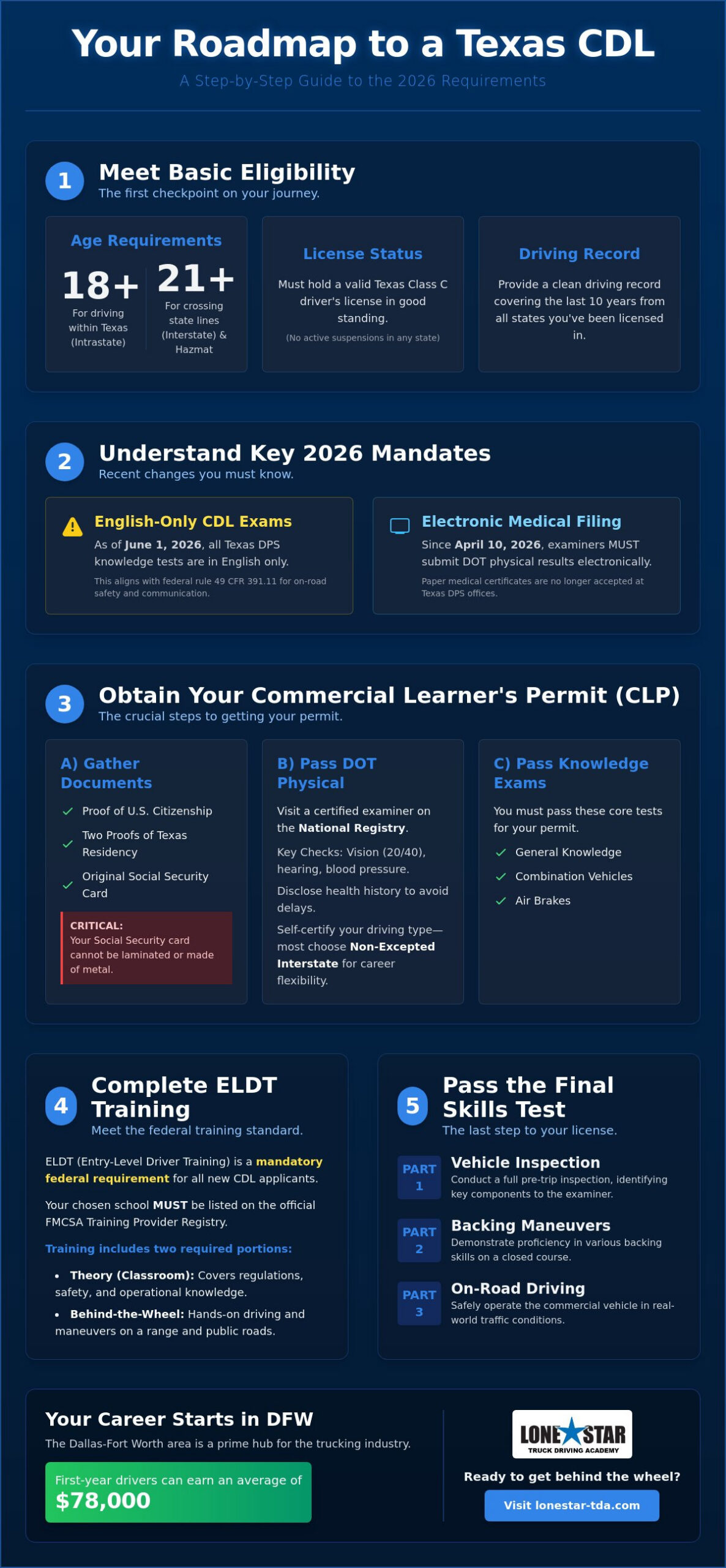
Before you ever step into a cab, you have to meet the baseline Texas commercial drivers license requirements set by both the state and federal government. It’s a process that starts with your current driving status. You must hold a valid Texas Class C drivers license that is in good standing. If your current license is suspended, revoked, or canceled in Texas or any other state, you won’t be able to move forward until those issues are resolved. A Commercial driver’s license (CDL) isn’t just a permit to drive; it’s a professional credential that demands a high level of responsibility.
Age is the next major factor. If you’re at least 18 years old, you can apply for a CDL to drive within the borders of Texas. However, if you want to cross state lines or haul hazardous materials, federal law requires you to be at least 21. You also need to provide a clean driving record covering the last 10 years. The DPS will check every state where you’ve held a license during that decade. We often help students with CDL permit preparation to ensure they understand how these background checks might impact their application before they pay their fees.
New 2026 English Proficiency Standards
A significant shift occurred on June 1, 2026, when the Texas DPS transitioned to English-only knowledge examinations. Spanish-language versions of the written tests are no longer available. This change aligns with 49 CFR 391.11, which mandates that every commercial driver must be able to read and speak English well enough to converse with the general public and understand highway traffic signs. Safety is the primary driver here. When you’re behind the wheel of an 80,000-pound rig in heavy Dallas or Fort Worth traffic, being able to instantly interpret warning signs and communicate with emergency personnel is a non-negotiable skill.
Identity and Residency Documentation
Efficiency at the DPS office starts with having the right folder of documents. You must provide proof of U.S. citizenship or lawful permanent residency. For Texas residency, you’ll need two different documents, such as a utility bill or a mortgage statement, that show your name and a Texas address. One specific rule that catches many people off guard is the Social Security card requirement. You must present an original, non-laminated Social Security card. If your card is metal or has been laminated, the DPS will reject it. Getting these documents organized early saves you from multiple trips to the office and keeps your training on schedule.
The Medical Certification and DOT Physical Process
Passing a Department of Transportation (DOT) physical is one of the most vital Texas commercial drivers license requirements. This is not a standard wellness checkup; it is a safety-focused health assessment designed to ensure you can safely operate a heavy vehicle for long hours. During the Texas CDL application process, you must prove your physical fitness before you are allowed to test for your permit. You must schedule your exam with a provider listed on the National Registry of Certified Medical Examiners. These professionals understand the specific demands of the trucking industry and will evaluate your vision, hearing, and blood pressure.
A major change took effect on April 10, 2026. The Texas DPS no longer accepts paper medical certificates at their offices. Your medical examiner is now required to submit your results electronically via the National Registry II system. While this streamlines the process, it means you must be proactive about your health. If you have a history of sleep apnea, heart conditions, or diabetes, bring your treatment records to the exam. Disclosing your medical history early prevents delays. If your blood pressure is high or your vision doesn’t meet the 20/40 standard, your examiner may issue a short-term certificate while you seek treatment. Staying on top of these details ensures you remain eligible for the high-paying roles in the Dallas-Fort Worth area, where first-year drivers can earn an average of $78,000.
Self-Certification Categories
Every driver must certify the type of commercial operation they intend to perform. You will choose between four categories based on whether you drive interstate (across state lines) or intrastate (only within Texas). Most trainees choose Non-Excepted Interstate (NI). This category offers the most flexibility for your career, allowing you to haul freight anywhere in the country. It is essential to keep your medical card current at all times. If your medical certification expires, the DPS will automatically downgrade your CDL to a standard Class C license, which could stop your paycheck immediately.
Managing Medical Waivers
A medical condition does not always mean your journey ends. The Skill Performance Evaluation (SPE) is a federally mandated program that allows drivers with physical impairments, such as limb loss or impairment, to demonstrate they can operate a commercial vehicle safely. There are also specific waiver processes for vision or insulin-controlled diabetes. If you are unsure how your health history fits into the current Texas commercial drivers license requirements, it is best to speak with a CDL training advisor who can guide you through the specific paperwork needed for your situation.
Obtaining Your Commercial Learner’s Permit (CLP)
Once you’ve secured your medical certificate, the next phase of meeting the Texas commercial drivers license requirements involves hitting the books. To earn your Commercial Learner’s Permit (CLP), you must pass three core knowledge exams: General Knowledge, Air Brakes, and Combination Vehicles. These are multiple-choice tests administered at the DPS office. As of June 2026, the fee for a CLP is $24. It is a small investment for a document that allows you to start your hands-on training on the roads of Dallas and Fort Worth. Keep in mind that these exams are now exclusively in English, so you’ll need to be comfortable with the terminology used in the official handbook.
While holding your permit, you’re under strict supervision. You must hold your CLP for at least 14 days before you can even schedule your final skills test. During this time, you can only drive a commercial vehicle if a qualified CDL holder is in the front seat next to you. You are also prohibited from carrying any passengers other than the instructor or examiner. This period is designed for you to build muscle memory and confidence before the high-stakes evaluation. It’s the time to move from theory to reality, practicing your turns and shifting under the watchful eye of a professional.
Effective Permit Test Preparation
Many students make the mistake of trying to memorize the entire Texas Commercial Motor Vehicle Drivers Handbook on their own. While the book is essential, solo studying often leads to frustration. We recommend structured CDL permit prep to focus on the specific logic the state uses in its questions. Navigating these Texas commercial drivers license requirements is much easier when you have an instructor pointing out the common pitfalls. When you’re ready, you can visit DPS locations in Dallas, Mansfield, or Fort Worth to sit for your exams. The Texas Department of Public Safety CDL Application Process requires you to schedule an appointment online, so don’t just show up expecting a walk-in slot.
Understanding Endorsements
If you want to maximize your earning potential, consider adding endorsements during the permit phase. The Tanker (N) and Double/Triple (T) endorsements only require passing a written test. The Hazardous Materials (H) endorsement is more involved. It requires a separate TSA background check and a $60 fee. Getting these out of the way early makes you more attractive to recruiters. Most high-paying carriers look for drivers who can handle a variety of freight without needing extra training down the line. It’s a simple way to set yourself apart in the DFW job market.
Meeting Federal ELDT Standards in Texas
Since February 7, 2022, every new driver has had to comply with the Entry-Level Driver Training (ELDT) mandate. This federal requirement is a cornerstone of the Texas commercial drivers license requirements. It ensures that every driver on the road has met a minimum standard of safety and skill before they ever take their final test. You can’t just have a friend teach you in a parking lot anymore. You must complete a program through a provider listed on the FMCSA Training Provider Registry (TPR). This registry is the only way the DPS knows you’ve received authorized instruction.
The process is methodical. Once you choose a school, they are responsible for reporting your progress to the federal government. Without this digital “handshake” between your school and the FMCSA, you won’t be allowed to sit for your skills exam. It’s a system designed to improve road safety across the country, especially in high-traffic hubs like Dallas and Fort Worth. We focus on making this transition as smooth as possible for our students, acting as a steady partner throughout your training journey.
Theory vs. Behind-the-Wheel Training
ELDT is split into two distinct parts: theory and behind-the-wheel (BTW). Theory training covers the “why” and “how” of trucking. You’ll study hours of service, driver wellness, and basic safety protocols. To move forward, you must score at least 80% on the theory assessment. BTW training is where the real work happens. This is divided into range time, where you practice maneuvers like backing and coupling, and public road time. For a full breakdown of what this looks like in practice, check out our Class A CDL training curriculum. It’s designed to be thorough yet manageable for working adults who need flexibility.
Choosing a Registered Training Provider
Before you pay a single dollar in tuition, verify that your school is on the TPR. If they aren’t registered, the DPS will not let you schedule a skills test. This is where many students get stuck. They spend weeks training only to find out their provider wasn’t authorized. Lone Star Truck Driving Academy is a fully registered ELDT provider. We take the guesswork out of the process by electronically reporting your training hours directly to the FMCSA. This ensures your records are ready when you head to the DPS office.
Local students often prefer our CDL training in Mansfield because it offers the hands-on experience needed for real-world career preparation. We focus on safety and professionalism from day one. If you’re ready to start your journey and want to ensure you meet every federal and state standard, contact us today to discuss your training options. Our instructors are mentors who have been where you are and know exactly how to guide you to success.
The Final CDL Skills Test and Licensing
The final hurdle in meeting the Texas commercial drivers license requirements is the skills test. This is where your weeks of preparation in Dallas or Mansfield are put to the ultimate test. The exam is divided into three distinct parts: the Pre-Trip Inspection, Basic Vehicle Control, and the On-Road Driving Test. You must pass them in that specific order. If you fail the pre-trip, the test ends right there. In fact, the Pre-Trip Inspection is the #1 reason students fail their first attempt. It’s not enough to just point at a part; you have to explain exactly what you’re looking for, such as checking that a belt isn’t cracked or frayed. Developing this eye for detail is essential, as experts like Alliance Fleet Solutions highlight that proactive maintenance and fleet optimization are critical to the efficiency of any commercial operation.
Third-Party Testing vs. DPS
One of the biggest challenges for students in the DFW area is the wait time at local DPS offices. It’s common to see backlogs that stretch for weeks or even months. This is why many drivers opt for third-party testing. By using a private testing site, you can often schedule your exam much sooner. Testing on the same equipment you used during your training at Lone Star Truck Driving Academy also provides a significant confidence boost. For a deeper look at how this works, read our guide on Understanding Third Party CDL Testing Services. It explains the convenience and standards involved in private examinations.
Removing the Automatic Restriction
When you take your skills test, the type of transmission in the truck matters. If you test in a vehicle with an automatic transmission, the DPS will place an “E” restriction on your license. This means you are legally prohibited from driving a commercial vehicle with a manual transmission. While many modern fleets are switching to automatics, having this restriction can limit your job options and earning potential. We encourage students to train on a manual to become a “universal” driver. If you already have your license but are stuck with this limitation, our automatic restriction removal service can help you upgrade your credentials. Mastering a manual transmission is a hallmark of a true professional in this industry.
Take Control of Your Professional Future
Earning your CDL in 2026 requires more than just driving skills; it demands a strategic approach to the latest Texas commercial drivers license requirements. You’ve learned that success begins with meeting the new English proficiency standards and ensuring your medical examiner handles filings electronically. By choosing a training partner that understands the federal ELDT mandate and the nuances of the local job market, you’re setting a foundation for long-term professional growth and stability.
Lone Star Truck Driving Academy is here to serve as your mentor. As an FMCSA Registered ELDT Provider serving Dallas, Fort Worth, and Mansfield, we provide the hands-on training you need to move from the classroom to the cab. We offer authorized on-site third-party testing to help you bypass long DPS wait times and test on the equipment you already know. Don’t let confusing regulations or technical hurdles stand in your way of a better career.
Start Your Texas CDL Journey at Lone Star Truck Driving Academy and take the first step toward a rewarding career on the open road. Your future is within reach; let’s get you ready for it.
Frequently Asked Questions
How long does it take to get a CDL in Texas?
Most students complete their training and earn their license in 3 to 7 weeks. This timeline depends on whether you attend full-time or part-time classes and how quickly you pass your permit exams. Remember that Texas law requires you to hold your Commercial Learner’s Permit for a minimum of 14 days before you’re eligible to take the final skills test. If you’re working a full-time job in Dallas or Fort Worth, weekend programs offer the flexibility you need, though they may extend the process by a few weeks.
Can I get a Texas CDL if I have a criminal record?
You can still earn a CDL with a criminal record in many situations. While certain felonies involving motor vehicles, human trafficking, or the use of a vehicle in the commission of a felony are permanent disqualifiers, many other offenses won’t stop you from getting licensed. It’s best to be upfront with your training advisor at Lone Star Truck Driving Academy. We can help you understand how your history might impact your ability to meet specific Texas commercial drivers license requirements and find work with local carriers.
Do I need to go to truck driving school to get a CDL in Texas?
Yes, you must attend a registered school to satisfy the federal ELDT mandate. This training is a core part of the Texas commercial drivers license requirements in 2026. You must complete both theory and behind-the-wheel instruction from a provider listed on the FMCSA Training Provider Registry. The DPS will verify your completion in the federal system before they allow you to schedule your final skills exam, making professional instruction a mandatory step in the process.
What is the minimum age for a CDL in Texas in 2026?
The minimum age is 18 for drivers who intend to drive only within Texas borders. If you want to drive interstate or cross state lines, federal law requires you to be at least 21 years old. This higher age limit also applies if you plan to haul hazardous materials. Many young drivers in the Mansfield and Dallas regions start with intrastate driving to build experience before moving into interstate roles once they reach the age of 21.
How much does the CDL license and permit cost at the DPS?
The Texas DPS charges $24 for your Commercial Learner’s Permit (CLP). When you’ve passed your skills test and are ready for your full license, the fee is $96 for an eight-year CDL. These costs are paid directly to the state at the DPS office. If you choose to add a Hazardous Materials endorsement, there’s an additional $60 fee, and that specific endorsement is valid for five years before it requires renewal and another background check.
Can I take the Texas CDL test in Spanish in 2026?
No, you cannot take the test in Spanish this year. Effective June 1, 2026, the Texas DPS transitioned all CDL knowledge exams to an English-only format. This change ensures all drivers can read highway signs, understand traffic control devices, and communicate effectively with emergency personnel. It’s a safety standard that applies to every new driver in the state, so you’ll need a functional command of the English language to pass your written exams.
What happens if I fail my CDL skills test?
You don’t have to start the entire process over if you fail one part of the skills test. The DPS allows you to retake the specific section you failed, whether it’s the pre-trip inspection, basic control maneuvers, or the road test. You generally have three attempts to pass within a 90-day window before your application expires. If you don’t pass within those three tries, you’ll need to re-apply at the DPS and pay the application fees again.
Is a DOT physical the same as a regular check-up?
A DOT physical is a safety-focused exam that is much more specific than a standard wellness check-up. While a regular doctor looks at your overall health, a Certified Medical Examiner is checking for conditions that could interfere with your ability to safely operate a 80,000-pound vehicle. They focus heavily on vision, hearing, blood pressure, and any history of epilepsy or diabetes. It’s about ensuring public safety on the road rather than just your personal health maintenance.
Article by
Lone Star Truck Driving Academy Training Team
Lone Star Truck Driving Academy provides CDL training for students throughout Texas and North Carolina. Our training team specializes in Class A CDL training, Class B CDL training, CDL refresher programs, automatic restriction removal, third-party testing support, and workforce development partnerships designed to help students build successful careers in the transportation industry.
Training Information Notice
The information provided in this article is for general educational purposes only. Program availability, tuition, licensing requirements, testing procedures, endorsement requirements, and regulatory standards may change over time. Prospective students should contact Lone Star Truck Driving Academy directly to verify current program details, admissions requirements, and state-specific CDL regulations.