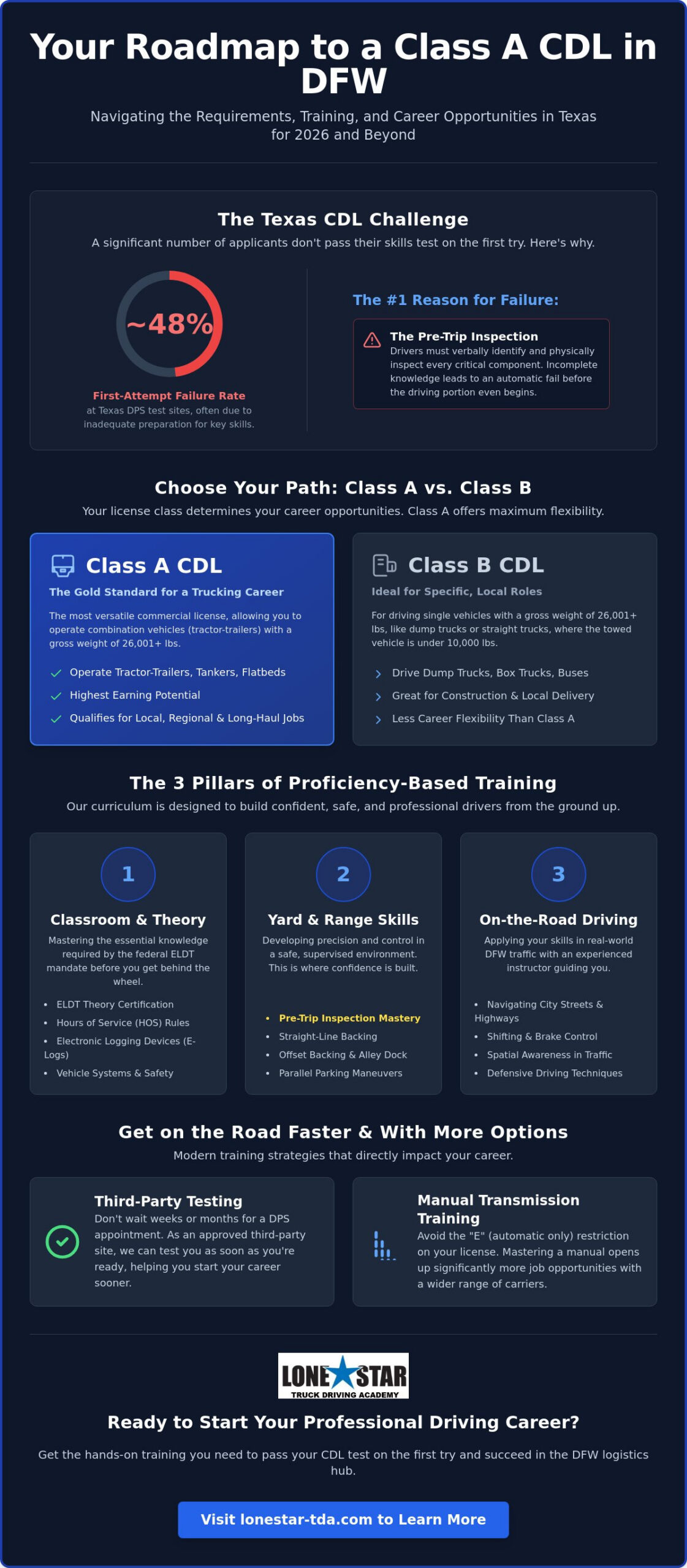
Did you know that nearly half of all drivers who take their CDL skills test at a Texas DPS site fail on their first attempt? It’s a frustrating statistic, but it highlights why so many people feel anxious about finding the right class a cdl training dallas tx. You’re likely worried about the federal ELDT mandates or how to fit practice sessions into an already busy work schedule. We understand those concerns because we see them every day.
The good news is that you don’t have to be part of that failure rate. Our goal is to help you master the necessary skills and pass your exam on the first try. In this article, we’ll explain the current requirements for 2026, including the new English-only testing rules and the significant advantages of third-party testing. You’ll also get a clear look at training costs and the high-demand career paths available right here in the Dallas-Fort Worth area. Whether you’re interested in local delivery or long-haul routes, we’ll provide the roadmap you need to start your new career with confidence.
Key Takeaways
- Understand how 2026 federal ELDT mandates and the new English-only testing rules impact your path to a commercial license in Texas.
- Learn the essential skills for class a cdl training dallas tx, from mastering the pre-trip inspection to the art of backing and docking on the range.
- Discover why third-party testing offers a significant advantage over DPS wait times, helping you get on the road and earning faster.
- Identify the core requirements for DFW drivers, including age limits and the specific steps needed to secure your commercial learner’s permit.
- Explore how removing automatic restrictions and training on manual transmissions can broaden your job opportunities across North Texas.
What to Expect from Class A CDL Training in Dallas
Earning a Commercial Driver’s License (CDL) is more than just getting a new piece of plastic for your wallet; it’s the foundation of a stable, professional career. A Class A license is widely considered the “gold standard” in the trucking industry. This specific credential allows you to operate any combination of vehicles with a gross combination weight rating of 26,001 pounds or more, provided the vehicle being towed is heavier than 10,000 pounds. This covers everything from the massive tractor-trailers you see on I-35 to specialized flatbeds and tankers.
Choosing class a cdl training dallas tx puts you at a distinct advantage. The Dallas-Fort Worth metroplex is one of the most significant logistics hubs in the United States. With major arteries like I-30, I-35, and I-45 converging here, the demand for skilled drivers is constant. Local infrastructure supports a massive volume of freight, which means your training happens in the same environment where you’ll likely start your career. This includes opportunities in specialized service sectors where providers like Texas Septic Solutions require skilled professionals for expert septic system installation and repair. Our approach focuses on three core pillars to ensure you’re ready for the road: theory, range skills, and public road driving.
Understanding the ELDT Mandate in Texas
The 2026 landscape for new drivers is defined by the Entry-Level Driver Training (ELDT) federal mandate. Since February 2022, you can’t simply study a manual and head to the DPS for your test. Federal law requires you to complete a specific curriculum from an FMCSA-approved training provider. Your journey begins with ELDT theory certification, which covers the essential knowledge of safety, hours of service, and vehicle systems. Modern academies have moved away from outdated “hours-based” models. Instead, we focus on proficiency-based learning. This means we prioritize your actual ability to perform a task safely rather than just checking a box for time spent in a seat.
Class A vs. Class B: Choosing Your Path
Deciding between license classes is a common hurdle for beginners. While Class B training is a great fit for those wanting to drive local delivery trucks, dump trucks, or school buses, the Class A license offers the most career flexibility. With a Class A, you aren’t restricted to smaller vehicles. You’ll master a variety of equipment, from long-haul sleepers to nimble day cabs. This versatility is why most DFW drivers opt for the Class A path. It opens doors to interstate routes and specialized hauling that often come with higher earning potential. If you want the most options for your future, the Class A is the way to go.
Mastering the Curriculum: From the Classroom to the DFW Roads
Mastering the curriculum for class a cdl training dallas tx requires a blend of mental discipline and physical skill. Before you ever touch the steering wheel, you’ll spend time in the classroom understanding the rules of the road. We focus heavily on electronic logs and hours of service (HOS) regulations to keep you compliant with federal and Texas CDL requirements. Knowing how to manage your time and documentation is just as vital as knowing how to manage your rig. It’s about building the professional habits that carriers look for in new drivers.
The Pre-Trip Inspection is the #1 reason students fail their first exam attempt. It’s a comprehensive verbal and physical check of the vehicle’s components, from the air brake system to the coupling devices. You have to be able to identify every part and explain exactly what you’re looking for to ensure it’s safe. If you can’t prove the truck is roadworthy, you won’t even get the chance to show off your driving skills during the skills test. We spend significant time on this phase because safety is the foundation of everything we do; for those who appreciate high-performance engineering in other areas of transportation, you can visit Drive Systems USA to learn about specialist motorcycle drivetrain components.
The Yard: Mastering Backing and Maneuvers
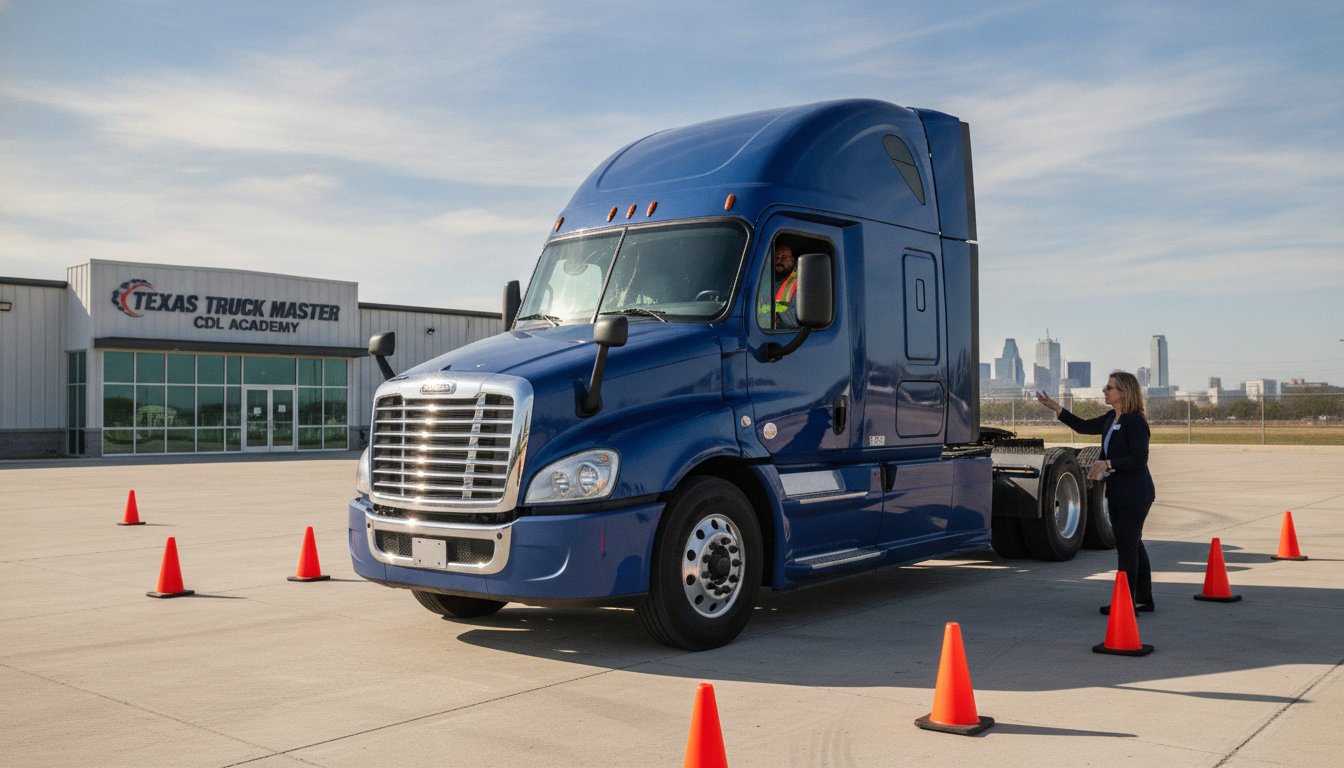
The yard is where you learn the “art” of the trailer. You’ll start with straight-line backing to get a feel for how the trailer reacts to small steering inputs. From there, we move to offset backing and the parallel park. These maneuvers can be stressful because they require high spatial awareness and patience. Our instructors use spotting techniques to help you visualize where the trailer is moving before it gets there. It’s a rewarding moment when that massive trailer finally slides perfectly into the dock after hours of practice.
Road Driving: Conquering Dallas Traffic
Once you’ve mastered the yard, we take you onto the streets of Dallas and Mansfield. When you choose class a cdl training dallas tx, you’re learning to handle one of the busiest trucking corridors in the country. Real-world traffic adds a layer of complexity that a closed course can’t replicate. You’ll learn to account for “off-tracking,” which is when the rear wheels of your trailer follow a different path than the front wheels during a tight right turn—a vital skill when transporting large structural components from Bradberry Steel. Managing the “danger zone” around your rig is critical in heavy DFW traffic, especially when passenger vehicles linger in your blind spots. We also practice progressive shifting and safe merging techniques on high-speed interchanges to build your confidence.
If you have questions about our specific training schedule or how we prepare you for these challenges, reach out to our team today.
The scheduling bottleneck at the Texas Department of Public Safety (DPS) is a well-known hurdle for new drivers. It isn’t uncommon for students to wait several months just to secure a testing date. This delay can lead to “skill decay,” where the sharp maneuvers you mastered during your class a cdl training dallas tx begin to fade. For those interested in how professional booking platforms help drivers in other regions overcome similar logistical hurdles, you can learn more about specialized road test scheduling services. If you aren’t behind the wheel daily, that precision starts to slip, making the eventual test much harder than it needs to be.
Utilizing third-party CDL testing at an academy completely changes this dynamic. In 2025, third-party providers administered 59% of all CDL skills tests in Texas. The data supports this choice. For the period through early 2026, third-party providers saw a road test pass rate of 84.9% compared to just 77% at DPS sites. The gap is even wider for the vehicle inspection portion, where third-party students saw an 84.6% pass rate while DPS testers struggled at 53.5%. These numbers highlight the “Texas Testing Advantage” that comes with choosing an integrated training and testing environment.
Benefits of On-Site Testing in Mansfield and Dallas
Testing at Lone Star Truck Driving Academy provides a significant psychological advantage. When you take your exam on the same range where you’ve spent weeks practicing, your anxiety levels naturally drop. You’re already familiar with the landmarks, the layout of the yard, and the specific equipment you’ve been using. This comfort allows you to focus entirely on your technical performance rather than second-guessing a new environment.
Academies also offer the flexibility to coordinate your test immediately following your training. Moving directly from instruction to examination ensures that your “muscle memory” is at its peak. Given the strong truck driver career outlook, getting your license sooner means you can enter the workforce and start earning while demand remains high. This demand is particularly strong in specialized logistics and waste management; for a look at the types of professional roll-off operations that hire skilled drivers, you can discover LA Dumpster Bins. Our Mansfield and Dallas locations prioritize this efficiency for our students.
What Happens During the Road Exam?
The examiner evaluates your performance through a structured three-part process. First is the Pre-Trip Inspection. While we discussed the difficulty of this in the previous section, during the test, the examiner looks for your ability to identify components and state their condition clearly to prove the vehicle is safe. Next is the Basic Vehicle Control portion. This is where you demonstrate the yard maneuvers you’ve practiced, such as straight-line backing and offset backing. Finally, you’ll head out for On-Road Driving. This real-world test monitors your safety habits, technical skills, and ability to manage a tractor-trailer in live DFW traffic. Success in all three areas is required to earn your credentials, and you can discover East USA CDL ACADEMY for a comprehensive guide on how to prepare for each part of the road test.
Planning Your Journey: Requirements, Costs, and Timeline
Starting your journey in class a cdl training dallas tx requires a clear plan and an understanding of the legal prerequisites. First, you must meet the age requirements. In Texas, you can obtain an intrastate CDL at 18, which allows you to drive anywhere within state lines. However, you must be 21 to drive interstate routes across the country. You’ll also need to secure a DOT Medical Examiner’s Certificate, often called a “Fed Med card,” to prove you’re physically fit for the demands of the job. For individuals interested in how these rigorous certification standards compare to other professional fields in transportation, you can explore FAA Professional Pilot Program to learn about the requirements for commercial aviation.
The next step is the CDL permit prep phase. You have to pass the written knowledge tests at a DPS office to earn your Commercial Learner’s Permit (CLP). Keep in mind that as of June 2026, these exams are administered in English only. Once you have your permit, Texas law requires you to hold it for at least 14 days before you’re eligible to take your skills test. Most students complete their full training cycle in about 4 to 6 weeks, depending on their availability and how quickly they master the maneuvers.
When looking at schools, consider the difference between “pay-as-you-go” models and “contract-based” programs. Contract schools often require you to work for a specific company for a year or more to pay off your tuition. Private academies offer more freedom, allowing you to choose your own employer once you’ve graduated. Much like the specialized programs at Aero Global Aviation Academy for aspiring pilots, private CDL training is an investment in your independence as a professional driver and your future career path.
The Texas CDL Paperwork Checklist
To get your CLP, you’ll need more than just a passing score on the written test. You must provide proof of Texas residency and evidence of lawful presence in the U.S. at the DPS office. Don’t forget to bring your DOT Medical card during this visit. Having your paperwork organized from day one prevents unnecessary delays in your training schedule and ensures a smooth transition to the hands-on phase of your education; additionally, planning for your future professional coverage with AMCO.NET LLC ensures you are fully prepared for the business and safety responsibilities of the road.
Flexible Training for Working Adults
We know that many people can’t afford to quit their current job to attend school full-time. This is why weekend CDL classes have become a vital resource for career changers in the DFW area. You can balance a 40-hour work week while still putting in the hours on the range and the road. The best programs adapt to the student’s pace, not just a calendar deadline. This flexibility ensures you don’t feel rushed and can focus on truly mastering the vehicle before your exam.
If you’re ready to see how our schedule can fit your life, contact us for more information about our upcoming classes.
Why Lone Star Truck Driving Academy is the Right Choice for DFW
Choosing where to complete your class a cdl training dallas tx is a decision that shapes your entire professional foundation. At Lone Star Truck Driving Academy, we move away from the “driver mill” model. Instead, we prioritize small class sizes and a mentor-led approach at our facilities in Dallas and Mansfield; this commitment to elite, personalized coaching is a standard we share with other premier Texas organizations like King Daddy Sports. This ensures you aren’t just a number in a crowded classroom. You’ll receive the individual attention required to master complex maneuvers and build the confidence necessary for the Texas road test.
Our commitment goes beyond just passing the exam. We prepare you for the reality of DFW logistics, emphasizing safety and professionalism in every lesson. Whether you’re looking for traditional tractor-trailer roles or specialized paths like hot shot driver training or RV operation, our curriculum is designed to be practical. We focus on the skills that local carriers actually value, ensuring you’re ready for the day-to-day challenges of the industry.
The Manual Transmission Advantage
Many corporate schools have switched entirely to automatic fleets because it’s cheaper and easier to train. However, this often results in an “Automatic Only” restriction on your license. Utilizing our automatic restriction removal service is a significant career booster. Being able to drive a manual transmission significantly expands your job opportunities, as many specialized and heavy-duty hauling companies still rely on manual rigs. We provide the hands-on shifting practice that other programs skip, helping you develop the coordination and gear-management skills that set you apart from other applicants.
Getting Started with Lone Star
We believe in transparency and real-world results. You won’t find generic motivational fluff here; instead, we offer a straightforward admissions process designed for working adults. The best way to see if we’re the right fit for your goals is to visit us in person. We invite you to schedule a tour of our Dallas or Mansfield facilities to meet the instructors and see the equipment firsthand. It’s the first practical step toward your new career. Contact Lone Star Truck Driving Academy today to start your Class A journey and get the guidance you need to succeed on the Texas roads.
Take the Next Step Toward Your Professional Driving Career
Navigating the DFW logistics landscape requires more than just knowing how to drive. It requires mastering the specific maneuvers and safety protocols that professional carriers demand. We’ve explored how ELDT compliance and the efficiency of third-party testing can significantly accelerate your journey into the industry; for those interested in how these safety standards are managed in the construction and industrial sectors globally, you can learn more about DL Safety. Choosing the right class a cdl training dallas tx means finding a partner that understands the local market and provides the hands-on experience you need to feel confident behind the wheel.
Lone Star Truck Driving Academy is an FMCSA-approved ELDT provider staffed by expert instructors with real-world DFW experience. Our authorized on-site third-party testing is designed to help you transition from the classroom to the road without the long wait times often found at DPS offices. We are here to support your transition into a stable and rewarding professional life with a focus on safety and mastery; this level of expertise is also what defines the high-end service provided by 1Executive Car in the Dallas-Fort Worth area.
If you’re ready to gain the skills needed to pass the Texas road test on your first attempt, Enroll in Class A CDL Training at Lone Star Truck Driving Academy today. You have the roadmap; now it’s time to take the wheel and start your new career.
Frequently Asked Questions
How long does Class A CDL training take in Dallas?
Most students complete their class a cdl training dallas tx in approximately 4 to 6 weeks. This timeline depends on whether you choose a full-time program or a flexible weekend schedule designed for working adults. You’re also required by Texas law to hold your commercial learner’s permit for at least 14 days before you’re eligible to take the skills test. This ensures you have enough time to practice maneuvers before your exam.
What is the difference between Class A and Class B CDL training?
Class A training prepares you to operate combination vehicles with a trailer weighing over 10,000 pounds, while Class B is for single vehicles like dump trucks or buses. A Class A license is more versatile because it also allows you to operate Class B and Class C commercial vehicles. Most drivers in the DFW area choose Class A because it provides the broadest range of career opportunities in the trucking industry; for those looking to brand their new business, you can learn more about Iris DTF for high-quality custom decals and transfers.
To complement your vehicle’s appearance, you can also learn more about RAW Merch for custom clothing and merchandise printing that helps you establish a professional brand identity on and off the road.
Do I need to know how to drive a manual transmission to get my CDL?
You aren’t required to learn a manual transmission, but testing in an automatic truck will place a restriction on your license. This restriction prevents you from legally driving any commercial vehicle with a manual gearbox. If you want to maximize your job prospects, learning to shift is a major advantage. Many specialized hauling companies still use manual trucks, so removing that restriction can open more doors for your career; similarly, for those interested in the broader field of logistics and aviation, Transport Canada drone pilot training offers another specialized path to high-demand technical skills.
Can I get my CDL training if I work a full-time job?
You can definitely complete your class a cdl training dallas tx while maintaining a full-time job by choosing an academy with flexible hours. Many programs offer weekend sessions specifically for career changers who can’t afford to leave their current employment. This allows you to keep your steady income while you gain the hands-on skills needed for your new profession. It’s a practical way to transition into trucking at your own pace; additionally, for those looking to expand their professional certifications, you can explore Theorieopleiding Belgisch Stuurbrevet to learn about maritime licensing requirements.
What are the ELDT requirements for Texas drivers in 2026?
Texas drivers must complete a standardized curriculum from a provider listed on the FMCSA’s Training Provider Registry to meet federal ELDT standards. This training includes both theory and behind-the-wheel instruction. Additionally, as of June 2026, the Texas DPS only conducts CDL knowledge examinations in English. You must finish all required training modules before you’re eligible to schedule your final skills and road test at any testing facility. Just as you prepare for these 2026 requirements, parents can learn more about preparing their children for kindergarten in the same timeframe.
Is third-party CDL testing legal in Texas?
Third-party testing is completely legal and accounted for 59% of all CDL skills tests in Texas during 2025. This option is highly popular because it typically offers much faster scheduling than the DPS. It also allows students to take their exam in a familiar environment with the same equipment they used during training. This comfort level often leads to higher success rates on the first attempt compared to state-run sites.
While the testing process varies by location, the demand for efficient booking is universal; for instance, Book Your Road Test provides third-party scheduling assistance to help drivers in Ontario secure their exam dates without the typical wait times.
How much does CDL school typically cost in the DFW area?
The cost of CDL school in the DFW area depends on whether you choose a private academy, a community college, or a carrier-sponsored program. Private schools often provide more flexibility and independence, while community colleges might have different enrollment timelines. When evaluating costs, consider whether the school requires a long-term employment contract. Choosing an independent academy gives you the freedom to select your own employer once you’ve earned your license; for those who choose the owner-operator path, timhalpin.com offers the specialized upfitting and equipment services needed to get a rig road-ready.
What happens if I fail my CDL road test the first time?
You are allowed to retake the exam if you don’t pass on your first attempt. There is usually a brief waiting period before you can schedule a second try, and specific fees may apply depending on the testing site. Failing one portion, like the pre-trip inspection, doesn’t mean you’ve failed the entire process. You’ll receive feedback on what needs improvement so you can focus your practice sessions before your next scheduled examination.
Article by
Lone Star Truck Driving Academy Training Team
Lone Star Truck Driving Academy provides CDL training for students throughout Texas and North Carolina. Our training team specializes in Class A CDL training, Class B CDL training, CDL refresher programs, automatic restriction removal, third-party testing support, and workforce development partnerships designed to help students build successful careers in the transportation industry.
Training Information Notice
The information provided in this article is for general educational purposes only. Program availability, tuition, licensing requirements, testing procedures, endorsement requirements, and regulatory standards may change over time. Prospective students should contact Lone Star Truck Driving Academy directly to verify current program details, admissions requirements, and state-specific CDL regulations.