What if you could trade your current commute for a professional career that gets you home every single night, all without spending months in a classroom? If you are searching for Class B CDL training Dallas programs, you probably already know that the demand for skilled local drivers across North Texas is higher than ever. It’s common to feel a bit of anxiety about handling a large vehicle or frustration with the long wait times at the DMV. We agree that the recent shifts in ELDT regulations have made the licensing process feel more complicated than it needs to be.
This article will show you exactly how to earn your Class B CDL in the DFW area, from meeting federal theory requirements to passing your road test on-site. We’ll walk through the steps to help you secure a local driving job with daily home time in cities like Dallas, Fort Worth, and Mansfield. By focusing on hands-on preparation and clear guidance, Lone Star Truck Driving Academy helps you move past the confusion and toward a stable professional future. You’ll get a preview of the training process and the practical skills required to master your vehicle with confidence.
Key Takeaways
- Understand why the Dallas-Fort Worth logistics hub offers unique local career opportunities for professional Class B drivers.
- Master the 2026 ELDT standards and medical certification requirements needed to secure your commercial permit in Texas.
- Learn how Class B CDL training Dallas helps you avoid the automatic restriction by mastering manual transmission vehicles.
- Identify the benefits of flexible scheduling, including weekend classes, designed specifically for working adults in North Texas.
- Discover how on-site third-party testing streamlines your certification process and gets you on the road faster without DMV delays.
What is Class B CDL Training and Why is Dallas the Best Place to Start?
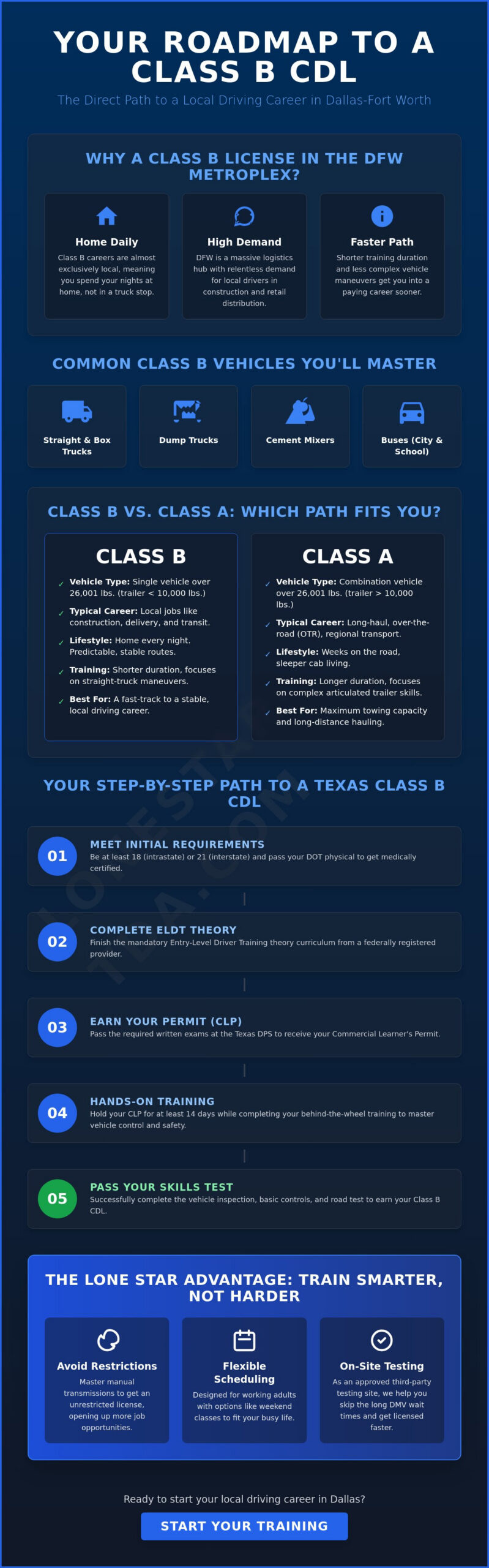
Choosing Class B CDL training Dallas puts you at the center of one of the fastest growing economic regions in the country. A Class B Commercial Driver’s License (CDL) allows you to drive single vehicles weighing over 26,001 pounds, such as dump trucks or large delivery vans, provided any trailer being towed weighs less than 10,000 pounds. While many people immediately think of long-haul trucking when they hear the word “CDL,” the Class B license is actually the gateway to some of the most stable local careers in Texas.
The Dallas-Fort Worth Metroplex is a massive logistics hub. Between the ongoing construction projects in Mansfield and the constant retail distribution needs in Fort Worth, the demand for local drivers is relentless. For many of our students at Lone Star Truck Driving Academy, the lifestyle is the biggest selling point. Unlike Class A drivers who might spend weeks on the road, Class B roles are almost exclusively local. You get to spend your evenings at home rather than in a sleeper cab at a truck stop.
Common Class B Vehicles You’ll Learn to Master
The versatility of a Class B license is impressive. In North Texas, you’ll see these drivers operating the dump trucks and cement mixers that build our highways and suburban neighborhoods. Local retail logistics also rely heavily on box trucks and straight trucks to move goods from warehouses to storefronts. Additionally, this certification is the standard for those looking to operate school buses or city transit vehicles throughout the DFW Metroplex, providing essential services to our local communities.
Class B vs. Class A: Which Path Fits Your Goals?
If you’re just starting out, Class B is often a faster and less intimidating path to a paycheck. The training duration is typically shorter because you don’t have to master the complex maneuvers required for articulated trailers. Backing up a straight truck is much more intuitive for beginners than backing a 53-foot trailer. While a Class A license offers more towing capacity, many drivers find that the Class B covers everything they need for a successful local career. If you’re still weighing your options, you can read our Class A vs Class B CDL comparison to see which path aligns with your specific career vision. We focus on helping you choose the route that provides the most flexibility for your life.
Texas Class B CDL Requirements and the ELDT Process in 2026
Securing your certification begins with understanding the specific legal hurdles set by both the state and federal government. Finding the right Class B CDL training Dallas program means moving beyond just driving skills and navigating the regulatory landscape first. In Texas, you can obtain an intrastate license at age 18, which allows you to drive anywhere within state lines. However, if you plan to cross into Oklahoma or Louisiana, federal law requires you to be at least 21 years old. Every student must also pass a DOT physical to ensure they are medically fit to operate a commercial vehicle safely. You can find a complete breakdown of these standards on the official Texas Class B CDL Requirements page.
Since February 2022, the Entry-Level Driver Training (ELDT) mandate has changed how everyone enters the industry. You can no longer simply study a handbook and head to the DMV. You must complete a curriculum from a provider listed on the federal Training Provider Registry. This process ensures that every driver on our roads has met a high standard of safety and knowledge. Once you complete your theory training and pass the required written tests at the DPS, you’ll receive your Commercial Learner’s Permit (CLP). Remember that Texas law requires you to hold this permit for at least 14 days before you can sit for your final skills test.
Mastering ELDT Theory and Permit Preparation
The written portion of the process is where many students feel the most pressure. Our ELDT theory certification takes the guesswork out of the equation. While some try to self-study, professional prep ensures you actually grasp complex topics like air brake systems and cargo securement. We focus on practical Texas traffic laws and safety protocols that you’ll use every day on the job. If you’re unsure where to start with your medical certification or permit paperwork, feel free to reach out to our advisors for direct guidance.
Behind-the-Wheel Training: Skills and Road Mastery
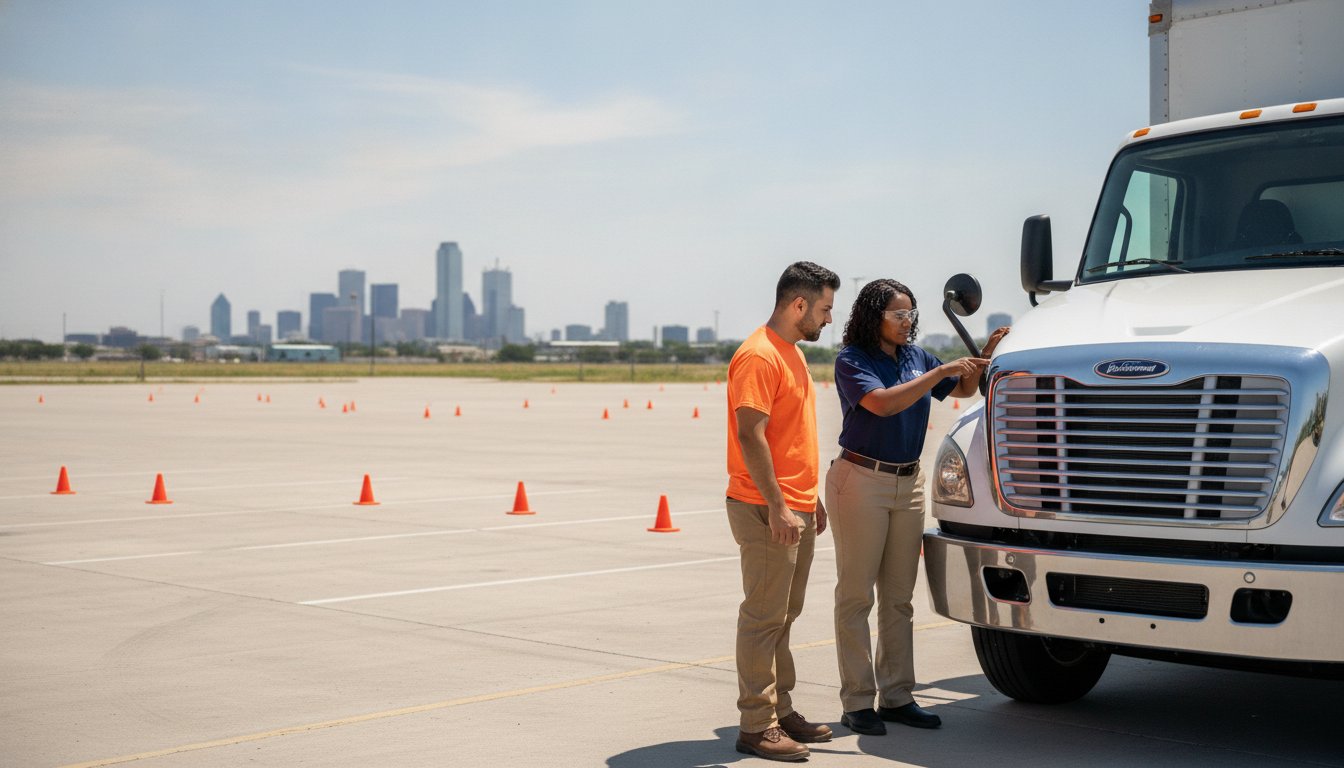
Once your permit is in hand, the real work begins on the training range. You’ll spend hours mastering backing maneuvers and the incredibly detailed pre-trip inspection, which is often the most difficult part of the final exam. Our instructors then take you out into real-world environments, teaching you how to navigate Dallas traffic and highway merges with a 26,000-pound vehicle. This hands-on experience is designed to build the muscle memory and professional confidence you need to pass your test and start your career safely.
Manual vs. Automatic CDL: Navigating Restriction Removal
When you begin your Class B CDL training Dallas, one of the most important decisions you’ll make is which transmission type to master. If you choose to complete your skills test in a vehicle equipped with an automatic transmission, the Texas DPS will place an “E” restriction on your license. This restriction legally prevents you from operating any commercial motor vehicle that uses a manual transmission. While automatic trucks are becoming more common in large over-the-road fleets, the Class B vocational market in North Texas still relies heavily on manual equipment. Choosing the right path now can prevent professional limitations later.
The demand for manual-capable drivers remains high because manual transmissions are often preferred for their durability in heavy-duty applications. Whether you’re operating a dump truck on a muddy construction site in Mansfield or a specialized delivery vehicle in downtown Dallas, having a “clean” license without restrictions makes you a more valuable asset to local employers. If you’ve already earned your license but feel held back by the “E” restriction, we offer a dedicated automatic restriction removal service. This process focuses specifically on the shifting skills needed to clear that hurdle with the DPS.
The Automatic Restriction: A Career Roadblock?
Think of the automatic restriction as a locked door to certain high-paying sectors. Heavy construction companies and transit agencies often maintain mixed fleets. If you can’t drive every vehicle in their yard, you might be passed over for a more versatile candidate. Upgrading your license later is entirely possible, but it requires a new road test. By following the federal ELDT Process in 2026 and learning manual from the start, you save yourself time and future testing fees. It’s about building a foundation that supports your long-term growth from day one.
Manual Transmission Training for Class B Drivers
Mastering a manual transmission requires patience and professional guidance. At Lone Star Truck Driving Academy, we focus on the double-clutching technique, which is the industry standard for non-synchronized transmissions. You’ll learn how to listen to the engine, manage your RPMs, and time your shifts perfectly. This training does more than just help you pass a test; it gives you a deeper understanding of vehicle mechanics. Understanding how power moves from the engine to the wheels makes you a safer driver, especially when navigating the hills and heavy traffic of the DFW Metroplex. We don’t just want you to shift gears; we want you to have total control over your vehicle in every situation.
Choosing the Right CDL School in the Dallas-Fort Worth Metroplex
Not all schools are created equal. Finding the best Class B CDL training Dallas has to offer requires looking past the glossy brochures and focusing on the actual student experience. You want a school with a reputation for putting the learner first. Read the local reviews carefully. Are students praising the instructors’ patience? Are they mentioning that they felt truly ready for the final road test? Instructor experience is the backbone of any program. At Lone Star Truck Driving Academy, we prioritize hiring seasoned pros who have seen everything the Texas highways can throw at a driver.
Location and scheduling are often the biggest hurdles for working adults. If you are currently employed, you can’t always drop everything for a full-time weekday program. This is why weekend CDL classes are a game changer for many in North Texas. Whether you are training at our facility in Mansfield or looking for options closer to central Dallas, proximity matters. You’ll be spending a lot of time at the range and in the classroom. Choose a location that doesn’t add a stressful commute to your already busy day. You also need to ensure the equipment you’re using is modern and well-maintained. Learning on outdated gear only makes your eventual transition to a job more difficult.
What to Look for in a DFW Training Program
Don’t get lost in a crowd. High student-to-instructor ratios are a major red flag in this industry. You need focused, one-on-one attention to master the pre-trip inspection and backing maneuvers we discussed earlier. Ask specifically about “seat time.” You aren’t paying to watch someone else drive; you are paying to have your own hands on the wheel. Finally, look for transparency in pricing. A quality school will be upfront about the costs of materials and testing. Ensure there are no hidden fees that surprise you once you’ve already started the program.
The Importance of Local Expertise
Texas roads have their own personality. From the shifting traffic patterns on I-35 to the specific weight restrictions on local DFW bridges, your instructors should know these details inside and out. Local expertise also means having deep roots in the community. A school that has been around for years often has networking connections with local construction firms and transit authorities. We also recognize that the DFW area is a diverse hub. Support for bilingual students or those with unique learning needs isn’t just a bonus; it’s a necessity for a truly supportive training environment. We believe everyone deserves a clear path to a better career.
Ready to start your new career? Contact our Mansfield or Dallas advisors today to schedule a tour of our facilities and see our equipment in person.
Lone Star’s Advantage: On-Site Third-Party Testing and Support
One of the biggest obstacles for many students is the “DMV headache.” After completing your Class B CDL training Dallas, the last thing you want is to wait weeks or even months for a road test appointment at a state facility. This delay kills your momentum and keeps you away from a paycheck longer than necessary. We believe that once you are trained and ready, you should be able to prove your skills immediately. That’s why Lone Star Truck Driving Academy offers authorized third-party testing right at our own locations.
Testing on-site provides a massive psychological advantage. You aren’t just a number in a long line at a government office. Instead, you are testing in a familiar environment where you’ve already spent hours practicing. You’ll use the exact same truck you operated during your training, meaning you already know the feel of the brakes, the clutch, and the turning radius. This familiarity significantly reduces test-day anxiety, allowing you to focus entirely on demonstrating your mastery of the vehicle and your knowledge of safety protocols.
Why On-Site Testing is a Game Changer
Speed and convenience are the primary reasons students choose our program. By bypassing the traditional DPS backlog, you can often secure your license and enter the workforce much faster. We maintain high standards to ensure every driver we certify is truly ready for the responsibilities of the road. For a deeper dive into how this process works, you can read our guide on understanding third party testing. It explains the regulations and why this service is such a vital tool for modern commercial drivers in Texas.
Join the Lone Star Family
Our goal is to be a steady partner in your professional transition. We don’t just teach you how to pass a test; we prepare you for a career. The mentorship you receive here extends beyond the classroom, providing you with a foundation of reliability and expertise that you can carry with you to every job site. Whether you are aiming for a role in construction, local delivery, or transit, we provide the supportive environment you need to succeed. We are proud to serve the Dallas-Fort Worth community by training the next generation of professional drivers.
The journey toward a better career and more time at home starts with a single step. We have the instructors, the equipment, and the testing facilities ready to help you reach your goals. Contact us today to start your Class B journey and discover how simple the licensing process can be when you have the right team behind you.
Take the Next Step Toward Your Professional Driving Career
Earning your Class B license is a commitment to a stable and rewarding future right here in North Texas. By choosing the right Class B CDL training Dallas program, you position yourself to take advantage of the massive logistics and construction boom currently happening in the DFW Metroplex. You now understand how mastering manual transmissions and meeting the latest ELDT regulations gives you a distinct competitive edge with local employers.
At Lone Star Truck Driving Academy, we focus on removing the barriers that typically slow students down. Our expert instructors bring decades of DFW experience to the training range, ensuring you receive practical guidance that works in the real world. With our ELDT-compliant curriculum and authorized on-site third-party testing, you don’t have to deal with long DMV wait times. You get to test in the same environment where you practiced your skills.
The path to a professional career with daily home time is open to you. We’re ready to provide the steady foundation you need to build your new professional identity. Start Your Class B Career with Lone Star Truck Driving Academy today. Your future on the road is waiting.
Frequently Asked Questions
How long does Class B CDL training take in Dallas?
Class B CDL training Dallas programs typically take less time than Class A certifications because the maneuvers are less complex. Most students can complete their requirements within a few weeks, depending on their specific schedule and prior experience. At Lone Star Truck Driving Academy, we focus on efficient, high-quality instruction that respects your time. Remember that Texas law requires you to hold your learner’s permit for at least 14 days before taking the road test.
Can I get a Class B CDL if I have an automatic restriction on my regular license?
An automatic restriction on your regular Class C license doesn’t prevent you from seeking a Class B CDL. However, if you take your commercial road test in an automatic vehicle, the DPS will place an “E” restriction on your commercial license. This prevents you from driving manual commercial vehicles. We recommend learning on a manual transmission to ensure you have the most career flexibility in the North Texas market.
What is the difference between a Class A and a Class B CDL?
The primary difference lies in the weight and towing capacity of the vehicle. A Class A license is required for combination vehicles, like tractor-trailers, where the trailer weighs more than 10,000 pounds. A Class B license is for single vehicles weighing over 26,001 pounds, such as dump trucks or box trucks. If you aren’t planning to pull heavy trailers, Class B is a faster path to a stable local career.
How much does Class B CDL training cost in Texas for 2026?
The cost of obtaining a license in Texas includes state fees like the $61 permit fee and the $97 license fee. Tuition for private training programs varies based on the level of instruction and the type of equipment used. While some community colleges offer different rates, private academies often provide faster testing turnarounds and more hands-on time. We recommend contacting our advisors directly to discuss current program options and materials.
Do I need to go to a specialized school for a Class B license?
Yes, federal law now requires all new CDL applicants to complete an Entry-Level Driver Training (ELDT) program from a provider on the FMCSA Registry. You can no longer simply study on your own and go to the DMV. Specialized schools like ours ensure you meet these federal standards while providing the specific equipment and range space needed to master pre-trip inspections and backing maneuvers safely and professionally.
What kind of jobs can I get with a Class B CDL in the DFW area?
The DFW area offers a wide variety of local roles for Class B drivers, from construction to transit. You can find opportunities driving dump trucks in Mansfield, cement mixers for highway projects, or local delivery box trucks in downtown Dallas. Many drivers also find stable roles with city transit authorities or school districts. These positions are ideal for those who want to stay local and be home every night.
Is the ELDT theory certification required for Class B drivers?
Yes, the ELDT theory certification is a mandatory federal requirement for anyone seeking a Class B CDL for the first time. This mandate went into effect on February 7, 2022, to standardize safety training across the country. You must complete this theory portion and be registered in the federal database before you are eligible to take your skills test. Our Class B CDL training Dallas program includes this certification to keep you compliant.
Can I take my CDL road test at Lone Star Truck Driving Academy?
Yes, you can complete your road test at Lone Star Truck Driving Academy through our authorized third-party testing services. This is a major advantage because it allows you to test in a familiar environment using the same equipment you used during your training. It eliminates the long wait times typically found at the Texas DPS and helps reduce the stress often associated with the final certification step.
Article by
Lone Star Truck Driving Academy Training Team
Lone Star Truck Driving Academy provides CDL training for students throughout Texas and North Carolina. Our training team specializes in Class A CDL training, Class B CDL training, CDL refresher programs, automatic restriction removal, third-party testing support, and workforce development partnerships designed to help students build successful careers in the transportation industry.
Training Information Notice
The information provided in this article is for general educational purposes only. Program availability, tuition, licensing requirements, testing procedures, endorsement requirements, and regulatory standards may change over time. Prospective students should contact Lone Star Truck Driving Academy directly to verify current program details, admissions requirements, and state-specific CDL regulations.