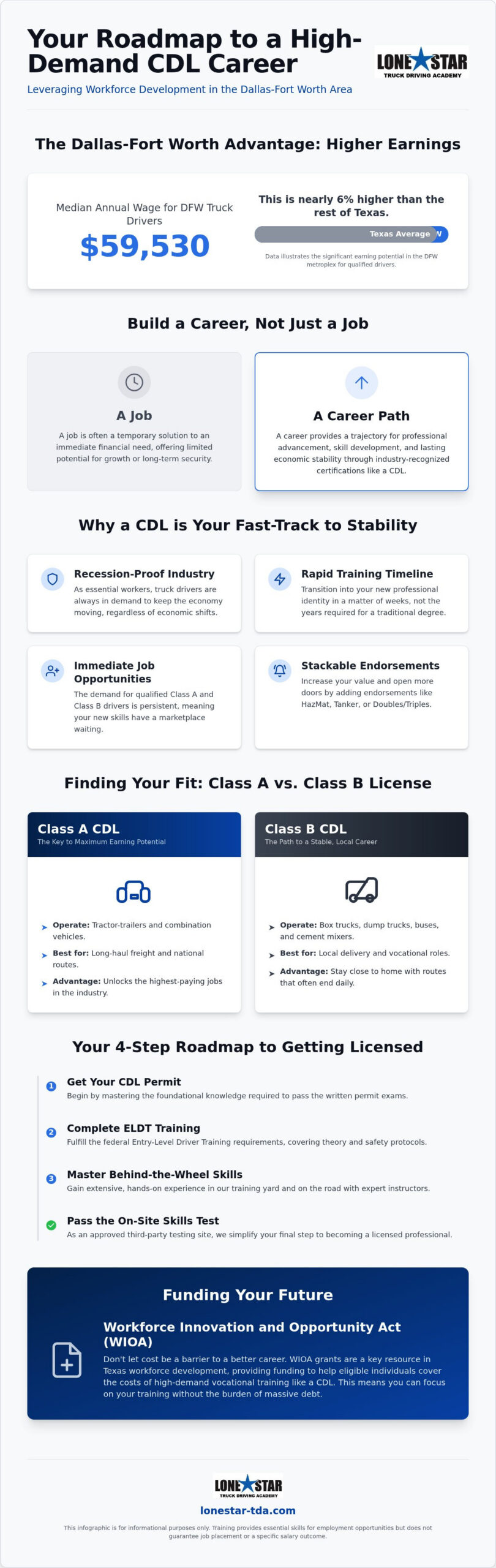
Did you know that truck drivers in the Dallas-Fort Worth area earn a median annual wage of $59,530, which is nearly six percent higher than the rest of Texas? It’s common to feel stuck in a low-growth job while worrying that the cost of career retraining is simply out of reach. You aren’t alone if you feel anxious about tuition or confused about which vocational programs actually lead to a reliable paycheck. Many Texans are searching for workforce development careers that offer immediate stability and a clear professional identity without years of expensive classroom study.
At Lone Star Truck Driving Academy, we see ourselves as mentors for students in Dallas, Mansfield, and Fort Worth who are ready for a change. This guide will show you how local workforce development initiatives can fast-track your path to a stable, high-demand career in the commercial driving industry. We’ll explore how to use resources like WIOA grants to fund your training and provide a step-by-step roadmap to mastering your CDL permit, ELDT requirements, and behind-the-wheel skills. You’ll discover how to transition into a professional role that keeps the Texas economy moving while finally securing your own long-term stability.
Key Takeaways
- Identify how to transition from a stagnant job into workforce development careers that prioritize economic mobility and specialized vocational skills.
- Discover why Class A and Class B CDL roles are considered recession-proof and essential for the Texas logistics infrastructure.
- Learn how to navigate local funding options like WIOA grants to help cover the costs of your professional driver training.
- Gain insights into the mix of technical driving maneuvers and essential soft skills needed to excel as a professional driver.
- Understand how utilizing on-site third-party testing can simplify your licensing process and get you started in your new career sooner.
What are Workforce Development Careers?
Workforce development is a strategic approach to economic growth that focuses on providing individuals with the specialized vocational training needed to move into high-demand industries. It’s about more than just getting a paycheck; it’s about building a foundation for long-term economic mobility. In 2026, we’re seeing a massive surge in demand for technical and logistical trades as businesses prioritize practical skills over traditional four-year degrees. These roles are often referred to as “essential,” meaning they remain stable even when other sectors of the economy fluctuate. Workforce development is the intersection of individual skill and market demand.
This shift toward skill-based professional advancement is supported by a mix of government and private partnerships. Organizations work together to ensure that training programs align with the actual needs of local employers. Programs like the Workforce Innovation and Opportunity Act (WIOA) provide the funding necessary for adults to retrain without the burden of massive debt. These initiatives ensure that our local economy stays strong by funneling motivated workers into sectors that need them most, such as transportation and logistics.
The Difference Between a Job and a Career Path
A job is often a temporary solution to a financial problem, but a career path offers a trajectory for growth and stability. Pursuing workforce development careers means you’re investing in yourself by obtaining industry-recognized certifications, such as a Class A or Class B Commercial Driver’s License. Unlike general labor roles, these certifications stay with you and increase in value as you gain experience. You can “stack” your skills by adding endorsements for tankers or hazardous materials, which opens even more doors. At Lone Star Truck Driving Academy, we focus on this long-term vision. We help you move beyond “just working” and into a professional identity that provides security for your family.
Key Industries Driving Workforce Growth
Logistics and transportation serve as the backbone of the Texas economy. The Dallas-Fort Worth (DFW) area has solidified its position as a primary hub for workforce development careers due to its massive distribution centers and proximity to major shipping routes. Whether you’re in Dallas, Mansfield, or Fort Worth, the need for skilled operators is constant. The DFW metroplex is a logistics powerhouse, acting as a central point for freight moving across the country. We also see this growth extending into the Greensboro and North Carolina corridor, where specialized drivers are in high demand to keep supply chains moving. These regions aren’t just places to work; they are centers of professional opportunity for those with the right training.
Why CDL Training is a Premier Workforce Development Path
While some individuals research administrative Careers at the Department of Labor, many in the DFW area find that professional driving is a much faster route to economic independence. CDL training is a standout among workforce development careers because it bridges the gap between vocational training and immediate employment. The persistent demand for Class A and Class B operators ensures that your new skills have a marketplace waiting for them the moment you finish your training. This isn’t just about finding a job; it’s about entering a field that remains stable regardless of economic shifts.
Trucking remains recession-proof because the movement of goods is the lifeblood of our local and national economy. In Dallas and Fort Worth, drivers are considered essential workers who keep store shelves stocked and construction projects moving. Another major advantage is the time investment. Unlike a traditional two-year degree that requires a massive commitment before you see a return, CDL school allows you to transition into your new professional identity in a matter of weeks. This versatility makes the CDL an ideal tool for anyone from long-haul freight enthusiasts to those interested in local delivery or hot shot driving.
Class A vs. Class B: Choosing Your Specialization
Your career trajectory depends on whether you choose a Class A or Class B license. A Class A license allows you to operate tractor-trailers, which usually leads to higher earning potential and the ability to handle heavy freight over long distances. Class B licenses are perfect for vocational roles like delivery trucks, cement mixers, or buses, often allowing you to stay local and return home every night. For those who want a niche opportunity, hot shot driver training offers a unique path using heavy-duty pickups to move smaller, time-sensitive loads. Evaluating your preferred lifestyle and the local job market in Mansfield or Dallas will help you decide which path fits your goals.
The Impact of ELDT Regulations on Professional Standards
The Entry-Level Driver Training (ELDT) mandate has fundamentally changed how new drivers enter the industry. It’s no longer enough to just “learn from a friend.” Federal regulations now require that all new applicants receive standardized training from an authorized provider. This shift has elevated the professionalism of the entire industry, ensuring that every driver on the road has mastered essential safety and technical standards. Choosing a school that is fully compliant with these federal requirements is non-negotiable for your licensing success. If you’re ready to explore how these standards prepare you for the road, talking to a training advisor can provide the clarity you need to start.
Navigating Training Costs and Funding in Texas
One of the most significant hurdles for those entering workforce development careers is the upfront cost of professional training. In Texas, several programs exist to bridge this gap and ensure that financial status doesn’t prevent motivated individuals from advancing. The Workforce Innovation and Opportunity Act (WIOA) is a federal program administered locally by boards like Workforce Solutions Greater Dallas and Workforce Solutions for Tarrant County. These grants are designed specifically for individuals who are underemployed or looking to transition into high-demand sectors like logistics. By aligning with Texas workforce education programs, these initiatives ensure that the state’s labor force remains competitive and skilled. Investing in yourself through these channels isn’t just about paying for school; it’s a strategic move to protect your future income against economic shifts.
When researching schools, transparency is vital. A reputable academy should clearly outline what’s included in the tuition. Beyond the instruction itself, you should account for ancillary costs like the DOT physical exam, which usually runs between $75 and $150, and the mandatory drug screen. Texas DPS fees, including the $25 permit fee and the $97 license fee, are also separate. Knowing these numbers upfront prevents surprises and helps you plan your budget effectively. Professional training is a hedge against the future. It provides you with a portable, valuable skill set that doesn’t disappear if a specific company closes its doors.
Finding Affordable CDL Training in Mansfield and Dallas
Finding the right balance between cost and quality is essential for your success. You want a program that offers significant hands-on time behind the wheel, not just classroom lectures. Utilizing CDL permit prep can significantly reduce your overall training time by getting the written requirements out of the way early. For many working adults in Mansfield and Dallas, the biggest challenge isn’t just the money, but the time. This is where weekend CDL classes become invaluable. They allow you to maintain your current income while preparing for your new career, making the transition much less stressful for your family.
Employer-Sponsored Training vs. Self-Funding
Many large carriers offer “paid CDL training,” but it’s important to read the fine print before signing. These programs often come with a contract requiring you to work for that specific company for 6 to 12 months. If you leave early, you may owe the full cost of tuition immediately. Self-funding or using a WIOA grant offers far more freedom in your career choice. When you graduate from an independent academy like Lone Star Truck Driving Academy, you have the leverage to choose the employer that offers the best benefits and routes for your specific needs. This independence is a cornerstone of building a successful professional identity.
Essential Skills for a Lifelong Career in Trucking
Mastering the wheel is only the first step toward success in workforce development careers. To build a long-term professional identity, you must develop a blend of technical mastery and professional discipline. This toolkit makes you indispensable to carriers throughout the Dallas-Fort Worth metroplex. While driving a tractor-trailer requires physical coordination, it also demands mental sharpness and a commitment to continuous learning. Top-tier drivers don’t just “drive”; they manage a complex logistical operation from the cab of their truck.
Technical skills start with precision backing maneuvers. Backing a 53-foot trailer into a tight loading dock in a busy Mansfield distribution center requires patience and exactness. You’ll need to master straight-line, offset, and alley-dock maneuvers until they become second nature. Coupling and uncoupling are equally critical. Ensuring the kingpin is properly locked into the fifth wheel is a safety requirement that cannot be overlooked. Modern trucking also relies heavily on technology. You’ll use Electronic Logging Devices (ELDs) to track your hours of service and advanced navigation systems to plan the most efficient routes through North Texas traffic.
Beyond the mechanics, soft skills often separate average drivers from elite professionals. Effective time management ensures you meet delivery windows without rushing or compromising safety. Clear communication with dispatchers and customers helps resolve issues before they become expensive delays. Maintaining a professional mindset and a clean driving record are your best assets for long-term growth. Carriers prioritize drivers who demonstrate reliability and a calm demeanor under pressure.
Safety and Professionalism on the Road
Safety is the primary metric by which professional drivers are judged. It’s the foundation of all successful workforce development careers in the transportation sector. A commitment to safety begins before the engine even starts. Thorough pre-trip inspection training is essential for identifying potential mechanical failures, such as frayed belts or air leaks, before they cause an accident. By adopting a professional attitude and treating your equipment with respect, you position yourself for better opportunities with companies that value high standards and safety records.
Removing Career Barriers: Manual Transmission Skills
Many students today train on automatic trucks, which results in a restrictive code on their license. While automatics are common, having an “automatic only” restriction can limit your versatility. Choosing to undergo automatic restriction removal services is a strategic career move. Learning to operate a manual transmission allows you to drive any vehicle in a fleet, from older vocational trucks to specialized heavy-haul equipment. This skill makes you a more flexible candidate, ensuring that no job is off-limits because of the equipment’s gearbox.
Speak with an advisor about mastering these essential skills
How Lone Star Truck Driving Academy Supports Your Transition
Lone Star Truck Driving Academy acts as a bridge for individuals ready to enter workforce development careers. We understand that transitioning into a new industry can feel overwhelming, especially when you are balancing current work and family obligations. That is why our programs are designed to be student-centric, focusing on hands-on vocational training that prepares you for real-world challenges. One of our primary advantages is the availability of third-party testing at our own facilities. This means you don’t have to wait for weeks on a state-administered exam schedule at the DPS. You can test in the same environment where you trained, using the equipment you have already mastered.
We take pride in serving both the North Texas and North Carolina communities. With accessible training locations across the DFW metroplex and Greensboro, we ensure that high-quality instruction is never too far from home. Our goal is to simplify the journey from permit preparation to your final road exam, providing a clear path toward your new professional identity. We provide the tools and the environment, but you provide the drive to succeed.
A Mentor-Led Approach to Learning
Our instructors aren’t just teachers; they are seasoned professionals who act as guides for those new to the trucking industry. We maintain small group sizes to ensure you receive the personalized attention you deserve. Whether you are training in Dallas or Mansfield, we focus on building your confidence behind the wheel. We don’t just teach you how to pass a test. We place you in practical, real-world scenarios that you will encounter every day on the job. This hands-on preparation ensures that you are ready to handle a tractor-trailer safely and professionally from your very first day on the road.
Ready to Start Your New Career?
Taking the first step is often the hardest part of any career change. We make the enrollment process as straightforward as possible so you can focus on your training. You can start with our ELDT theory and permit prep to build a strong knowledge base before you ever step into the yard. If you are still weighing your options, we invite you to schedule a tour of our facilities or speak directly with a training advisor. They can answer your questions about scheduling, funding, and what to expect during your training weeks. Your journey toward a stable future starts with a single decision to invest in your own potential today.
Take the Wheel of Your Professional Future
Professional driving is more than just a job; it is a gateway to long-term stability in the heart of the Texas economy. By focusing on workforce development careers, you are choosing a path that prioritizes specialized skills and immediate market demand. We have explored how local grants and accessible training can remove the financial barriers that often hold people back from making a significant life change. Whether you are in Dallas, Mansfield, or Fort Worth, the opportunity to transition into a high-demand industry has never been more attainable.
Lone Star Truck Driving Academy is here to serve as your steady partner throughout this transition. As an authorized ELDT theory certification provider, we offer the hands-on preparation you need to succeed. Our flexible weekend schedules ensure you don’t have to choose between your current paycheck and your future goals. With the added convenience of on-site third-party testing, you can move from the classroom to the cab with confidence and speed.
Your journey toward a more secure professional identity is within reach. We look forward to helping you master the skills needed to drive your career forward.
Frequently Asked Questions
What exactly is a workforce development career?
Workforce development careers are professional paths that prioritize specialized vocational training to meet specific industry demands. Instead of focusing on general education, these programs equip you with the technical skills needed for immediate entry into high-growth sectors. In the Dallas-Fort Worth area, this often means moving into logistics and transportation. These careers offer a foundation for economic mobility and long-term stability by focusing on mastery of a practical trade rather than theoretical study.
How long does it take to get a CDL through a workforce program?
Most professional CDL programs allow you to transition into your new career in approximately three to five weeks. This timeline is significantly shorter than traditional college degrees, making it one of the most efficient workforce development careers for adults. The exact duration depends on whether you are pursuing a Class A or Class B license and your previous experience behind the wheel. Programs are designed to be intensive yet manageable for those looking to start working quickly.
Are there grants available for CDL training in Texas or North Carolina?
Yes, residents in both Texas and North Carolina can often access federal funding through the Workforce Innovation and Opportunity Act (WIOA). In the DFW metroplex, you should contact local boards like Workforce Solutions Greater Dallas or Workforce Solutions for Tarrant County to determine your eligibility. These grants are designed to support individuals who are looking to retrain for essential roles in the logistics industry, helping to cover the costs of professional instruction.
Can I get my CDL if I have a full-time job right now?
You can absolutely obtain your license while maintaining your current employment by choosing a school that offers flexible scheduling. Lone Star Truck Driving Academy provides weekend CDL classes specifically for working adults in Dallas and Mansfield. This allows you to complete your ELDT theory and behind-the-wheel training without sacrificing your current paycheck. Balancing your schedule this way reduces the financial stress often associated with career transitions while you build your new professional identity.
What is the difference between Class A and Class B for my career?
The primary difference lies in the weight and type of vehicle you are authorized to operate. A Class A license allows you to drive tractor-trailers and handle heavy freight; this often leads to more diverse long-haul opportunities. A Class B license is suited for vocational roles like local delivery trucks, buses, or cement mixers. Choosing Class A offers the most versatility in the job market, though Class B is excellent for those who prefer staying local.
Do I need a high school diploma for a career in truck driving?
You do not strictly need a high school diploma or GED to obtain a commercial driver’s license under federal law. However, some individual carriers in the Fort Worth and Dallas areas may require one as part of their specific hiring criteria. The most important requirements are your ability to pass the DOT physical, maintain a clean driving record, and successfully complete the required ELDT theory and skills testing through an authorized training provider.
What is ELDT and why do I need it for my new career?
Entry-Level Driver Training (ELDT) is a federal mandate that requires all new CDL applicants to receive standardized training from a provider listed on the FMCSA Training Provider Registry. This ensures that every new driver on the road has mastered essential safety and technical maneuvers before taking their skills test. You need this certification to be eligible for your final road exam at the DPS, as it confirms you have met the national professional standards.
How do I choose the best CDL school for my workforce goals?
To find the best fit for your workforce goals, look for an academy that prioritizes hands-on time behind the wheel and offers mentor-led instruction. Convenience is also a major factor; schools that provide on-site third-party testing can save you weeks of waiting for a state exam date. Ensure the facility is an authorized ELDT provider and check for local reviews in the DFW or North Carolina regions to verify their reputation for safety and professionalism.
Article by
Lone Star Truck Driving Academy Training Team
Lone Star Truck Driving Academy provides CDL training for students throughout Texas and North Carolina. Our training team specializes in Class A CDL training, Class B CDL training, CDL refresher programs, automatic restriction removal, third-party testing support, and workforce development partnerships designed to help students build successful careers in the transportation industry.
Training Information Notice
The information provided in this article is for general educational purposes only. Program availability, tuition, licensing requirements, testing procedures, endorsement requirements, and regulatory standards may change over time. Prospective students should contact Lone Star Truck Driving Academy directly to verify current program details, admissions requirements, and state-specific CDL regulations.