Did you know that CDL truck drivers in Dallas now earn an average of $72,391 per year? While the earning potential is high, many people struggle with the technicalities of how to get a CDL in Dallas because of complex federal ELDT mandates. You probably already know that the DFW logistics market is booming, yet the fear of failing a pre-trip inspection or waiting months for a DPS road test can be discouraging. It’s completely normal to feel overwhelmed by the red tape between you and your new career.
We believe that getting your license shouldn’t be a guessing game. This guide provides a clear roadmap to mastery, covering everything from permit preparation to the final skills exam. You’ll learn how to navigate the 2026 regulations and use options like third-party testing at Lone Star Truck Driving Academy to speed up your journey. We are here to help you build a professional foundation and move toward your goals with confidence and clarity.
Key Takeaways
- Identify the specific age and residency documentation required by the Texas DPS to ensure your application process starts smoothly.
- Follow a clear, 5-step roadmap for how to get a CDL in Dallas, including the mandatory federal ELDT theory and behind-the-wheel training.
- Understand the advantages of local academies where smaller student-to-instructor ratios lead to better mastery of complex backing maneuvers.
- Learn how to bypass multi-month wait times at state offices by utilizing authorized third-party testing facilities for your final skills exam.
- Prepare for the DFW logistics industry by choosing a program that emphasizes hands-on experience and professional safety standards.
Understanding CDL Requirements in Dallas and Texas
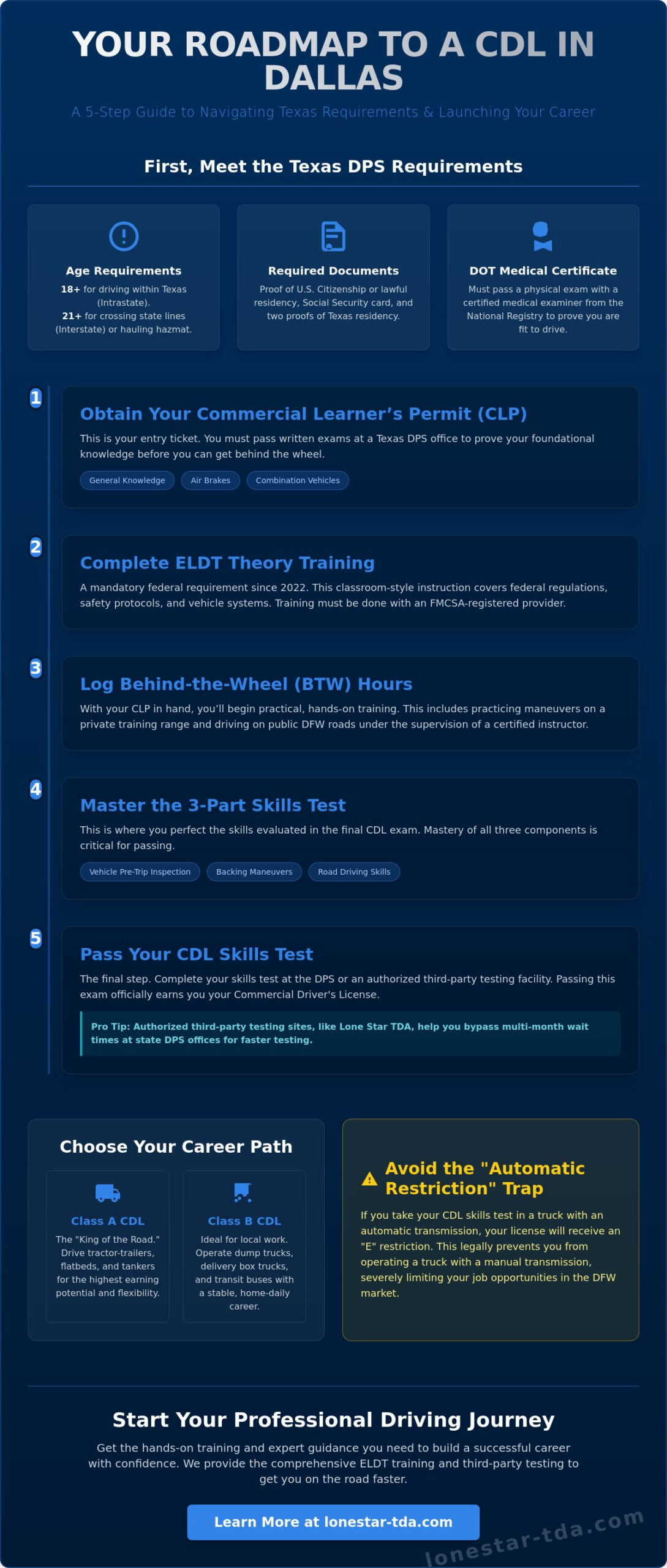
Before you sit in the driver’s seat, you need to understand the legal ground rules. Texas has specific standards for anyone looking at how to get a CDL in Dallas. First, your age dictates where you can drive. If you’re at least 18, you can operate a commercial vehicle within Texas borders. However, you must be 21 to cross state lines or haul hazardous materials. You’ll also need to gather your paperwork for the DPS. This includes proof of U.S. citizenship or lawful permanent residency, a valid Social Security number, and two documents proving your Texas residency, such as utility bills or a rental agreement.
A critical piece of the puzzle is the DOT Medical Examiner’s Certificate. This document, officially known as Form MCSA-5876, proves you are physically fit to handle a heavy vehicle. You must visit a certified medical examiner on the National Registry to get this done. Once you have your medical card, you’re ready to start the process of obtaining a Commercial Driver’s License (CDL). This certificate is a prerequisite before you can even apply for your learner’s permit.
Class A vs. Class B: Which Dallas Career Path Fits You?
Choosing the right license depends on your career goals in the North Texas logistics hub. A Class A license is often called the “King of the Road.” It allows you to drive tractor-trailers, flatbeds, and tankers. If you want the highest earning potential in DFW, Class A CDL training is usually the best path. Class B is better for local work, such as operating dump trucks, delivery box trucks, or transit buses. Both paths offer stability, but Class A provides more flexibility for different types of freight and longer hauls. Understanding these rules is the first hurdle in learning how to get a CDL in Dallas effectively.
The Federal ELDT Mandate Explained
The days of “self-studying” and simply showing up at the DPS for a road test are over. Since February 2022, the Federal Motor Carrier Safety Administration (FMCSA) has required all new applicants to complete Entry-Level Driver Training (ELDT). This means you must receive instruction from a provider listed on the Training Provider Registry (TPR). Training is split into two distinct parts:
- Theory Instruction: This covers the essential knowledge of safety, federal regulations, and basic vehicle operation.
- Behind-the-Wheel Training: This involves practicing maneuvers on a private range and driving on public roads under expert supervision.
At Lone Star Truck Driving Academy, we handle both stages as a registered TPR provider. We provide the comprehensive CDL permit preparation and theory certification you need to qualify for your skills test. This ensures you aren’t just memorizing facts but actually building the professional mastery required for a safe and successful trucking career.
The 5-Step Process to Getting Your CDL in Dallas
Once you’ve met the basic requirements, it’s time to execute the plan. Navigating how to get a CDL in Dallas requires moving through five distinct phases. This isn’t just about passing a test; it’s about developing the skills to handle an 80,000-pound machine safely through DFW traffic. Following these steps correctly is the most efficient way to learn how to get a CDL in Dallas without wasting time.
- Step 1: Obtain your Commercial Learner’s Permit (CLP). You’ll need to pass written exams at a local DPS office.
- Step 2: Complete ELDT Theory Training. This is the classroom portion that must be registered with the FMCSA.
- Step 3: Log Behind-the-Wheel Hours. You’ll practice maneuvers on a private range and drive on public Dallas roads.
- Step 4: Master the Technical Skills. Focus on the pre-trip inspection, various backing maneuvers, and road driving techniques.
- Step 5: Pass your CDL Skills Test. Complete your final examination at an authorized site to collect your hard-copy license.
Mastering the Commercial Learner’s Permit (CLP)
The CLP is your ticket to start training. In the DFW area, the Carrollton and Fort Worth Mega Centers are popular choices for permit testing because of their size, though they stay busy. To succeed, you’ll need to pass three core exams: General Knowledge, Air Brakes, and Combination Vehicles. Many students fail because they underestimate the “Combination” section or skip the Texas-specific rules in the handbook. These requirements align with Federal CDL standards, ensuring you’re ready for any carrier in the country. We recommend focused CDL permit preparation to ensure you walk into the DPS with confidence.
The “Automatic Restriction” Trap
One of the biggest mistakes new drivers make is testing in an automatic truck. If you do, the DPS places an “E-restriction” on your license. This legally prevents you from driving a manual transmission commercial vehicle. While many modern fleets use automatics, many specialized local jobs and heavy-haul companies in North Texas still rely on manuals. Learning on a manual transmission is a core part of professional mastery. Removing this restriction increases your job opportunities by 40%. If you’re already stuck with this limitation, an automatic restriction removal service can help you unlock your full career potential. You might consider looking into specialized training options to ensure you have the widest range of career paths available to you.
Choosing a CDL School: National Chains vs. Local Academies
Deciding where to train is a pivotal choice that shapes your entire career. When you’re researching how to get a CDL in Dallas, you’ll quickly notice two main options: massive national chains and local, independent academies. Many national chains offer carrier-sponsored training, which sounds appealing because of the low upfront cost. However, these programs often come with a catch. You’ll likely sign a contract that locks you into driving for that specific carrier for a year or more. If the job isn’t a good fit, you’re still stuck with the commitment or a significant debt. Independent schools focus on building your skills so you can choose the employer that best fits your lifestyle.
Quality instruction often comes down to the student-to-instructor ratio. We believe a 4:1 ratio is the gold standard for safe backing maneuvers and technical mastery. In larger schools, you might be one of fifteen students waiting for a turn behind the wheel. That downtime doesn’t help you learn. You should also evaluate the school’s fleet. Training on modern trucks ensures you’re prepared for the technology you’ll encounter in the DFW logistics industry. Following the official Texas Department of Public Safety CDL Application Process is much smoother when you have an expert instructor guiding you through every technical detail.
The Independence Factor
Investing in your own training offers a level of freedom that carrier-paid programs can’t match. Dallas is a major transportation hub with thousands of local and regional opportunities. By paying for school upfront, you become a “free agent” who can shop for the best pay, benefits, and home-time balance. You can use The Ultimate Guide to CDL A Training Programs in 2026 to compare your options and see which path aligns with your goals. This independence is often the fastest way to build a professional identity that you truly own.
Niche Training: Hot Shot and RV Operations
Not every driver wants to haul a 53-foot trailer. Dallas has emerged as a significant hub for Hot Shot trucking, where drivers use heavy-duty pickups and gooseneck trailers to move smaller, time-sensitive freight. This path requires specific knowledge of load securement and maneuvering in tighter spaces. We’ve also seen a rise in North Texas RV owners seeking professional training. Handling a large motorhome requires the same safety mindset as a commercial rig. Whether you’re interested in Class A training or specialized hot shot driver training, choosing a school that understands these niches is essential for your success. Learning how to get a CDL in Dallas should be tailored to the specific type of driving you plan to do.
Bypassing the DPS Wait: Authorized Third-Party Testing
The biggest bottleneck for most students isn’t the training itself. It’s the wait. In 2026, the reality at Dallas and Mansfield DPS offices remains a significant challenge, with wait times for skills tests often stretching between two and three months. If you are learning how to get a CDL in Dallas, sitting at home for eight weeks after finishing your classes is the last thing you want. You lose your muscle memory and your confidence. This is where authorized third-party testing becomes a game-changer for your career timeline.
By choosing a school that offers on-site testing, you can often schedule your exam within days of completing your training. Lone Star Truck Driving Academy operates as an authorized third-party testing location, meaning you don’t have to deal with the state’s backlog. You finish your hours, you refine your skills, and you test immediately. This streamlined approach is the most reliable way to figure out how to get a CDL in Dallas without unnecessary delays.
How Third-Party Testing Works in Texas
Texas allows private entities to conduct the CDL skills test, provided they meet strict regulatory requirements. These examiners are trained and certified to the same standards as DPS officers. For 2026, these regulations ensure that every third-party site maintains high integrity and safety standards. Testing on-site at a school like Lone Star TDA is faster simply because we prioritize our students and local drivers rather than managing a massive public queue. It bridges the gap between completing your ELDT requirements and actually holding your license.
Reducing Test-Day Anxiety
Testing at a government facility can be intimidating. You’re in a new environment with an unfamiliar range and different equipment. On-site testing eliminates the “unknown” factor of a state-run facility by allowing you to test on the same range where you practiced your backing maneuvers. You’ll use the same truck you’ve been driving for weeks. This familiarity significantly reduces stress. Our examiners take a “friendly mentor” approach, ensuring you feel supported while maintaining professional standards. When you’re comfortable, you perform better.
If you’re ready to skip the lines and get on the road, you can schedule your third-party CDL test today and bypass the state backlog entirely.
Start Your Professional Driving Journey at Lone Star TDA
Learning how to get a CDL in Dallas is a significant step toward professional stability and career independence. At Lone Star Truck Driving Academy, we don’t just teach you to pass a test. We focus on professional mastery. Our instructors are seasoned experts who understand the unique challenges of the North Texas roads. Whether you are looking for Class A CDL training to haul heavy freight or Class B training for local delivery, our programs are tailored to the specific needs of the DFW market.
We also provide critical support for drivers at different stages of their careers. If you’re returning to the industry after a break, our CDL refresher courses help you regain your confidence and technical precision. For drivers currently limited by an automatic transmission restriction, our removal service provides the manual transmission instruction required to expand your employment options. Every program we offer is designed with flexibility for working adults, ensuring you can balance your training with your current responsibilities.
Beyond the License: Career Support and Mastery
Recruiters in Dallas aren’t just looking for a license. They want professionals they can trust with their equipment and their reputation. We emphasize safety and professionalism in every lesson, from pre-trip inspections to complex backing maneuvers. Our Mansfield facility serves as a primary hub for the entire Dallas-Fort Worth area. We’ve built our reputation on community trust and individual support. We provide a steady foundation where you can build a new professional identity under the guidance of mentors who have seen thousands of drivers succeed.
Your Next Steps to a Dallas CDL
Your transition to a new career begins with a simple visit. We invite you to schedule a tour of our Mansfield facility to see our equipment and meet our instructors firsthand. Before you arrive, ensure you have your DOT medical card and residency documents ready. This preparation makes your enrollment process smooth and efficient. Understanding the full scope of how to get a CDL in Dallas is much easier when you have a dedicated partner by your side. We are ready to help you navigate the process from your first permit exam to your final skills test.
Ready to start? Contact Lone Star Truck Driving Academy today!
Master the Road in North Texas
Building a successful trucking career requires more than just luck. It takes a clear roadmap and the right partners. We’ve explored the essential requirements, the technical steps for licensing, and the strategic advantage of bypassing state backlogs through third-party testing. Understanding how to get a CDL in Dallas is your first step toward long-term professional stability in one of the nation’s largest logistics hubs. By focusing on manual transmission mastery and safety, you set yourself apart from the competition immediately.
Lone Star Truck Driving Academy is here to guide you through every mile. As an FMCSA-approved ELDT provider, we offer the hands-on training and expert manual transmission instruction you need to drive with confidence. Our authorized on-site third-party testing ensures you don’t have to wait months to start earning. You have the drive and the ambition to change your life; we have the expertise to help you get there. Your new professional identity is within reach.
Start Your Dallas CDL Journey with Lone Star Truck Driving Academy
Frequently Asked Questions
How much does CDL school cost in Texas for 2026?
Tuition for professional training varies across North Texas based on the program’s depth and the equipment provided. Most comprehensive courses include the mandatory ELDT classroom and range instruction required for your license. In addition to school costs, you will need to pay the Texas DPS a $24 fee for your permit and a $97 fee for the license issuance. These state fees are standard for all applicants aged 18 to 84.
How long does it take to get a CDL in Dallas?
Most students complete their training in three to six weeks when attending a full-time program. This timeline covers the mandatory ELDT theory and the hands-on hours required on the range and public roads. If you choose weekend classes, the process will take longer to accommodate your existing work schedule. Your total time also depends on how quickly you pass your written permit exams at the DPS.
Can I get a CDL if I have a regular Texas driver’s license?
You can transition to a commercial license if you currently hold a valid, non-commercial Texas Class C driver’s license. This is the first step in learning how to get a CDL in Dallas correctly. You’ll need to provide proof of residency and legal status while also passing a DOT physical. Once these are cleared, your regular license allows you to apply for the commercial learner’s permit and begin your training.
What is the fastest way to get a CDL road test in Dallas?
The fastest way to secure a road test is to use an authorized third-party testing facility. While state-run offices in the DFW area often have wait times of 60 to 90 days, third-party sites can usually schedule your exam within a week of training completion. This allows you to enter the workforce much sooner. Testing on the same range where you practiced also provides a significant psychological advantage on exam day.
Do I need to attend a school to get a CDL in Texas?
You must attend a school listed on the FMCSA Training Provider Registry to qualify for your license. Federal ELDT mandates mean that self-study is no longer an option for new applicants. You need documented theory and behind-the-wheel instruction from a certified academy. This ensures every driver on the road has met a high professional standard before they ever take their final skills test at a state or third-party site.
What happens if I fail the CDL skills test at Lone Star TDA?
If you don’t pass the skills test on your first try, you are allowed to reschedule for a retest after a brief waiting period. We focus on identifying the specific maneuvers or inspection points that caused the failure. Our instructors provide targeted coaching to help you master those areas before your next attempt. We want you to feel prepared and confident when you return to the range for your retest.
Is there a difference between Dallas CDL schools and Mansfield CDL schools?
The primary difference is the training environment and traffic density during your road hours. While schools in the heart of Dallas deal with heavy congestion, our Mansfield location offers a dedicated range with easier access to diverse testing routes. This allows for more focused practice on backing maneuvers without the constant stress of urban gridlock. Both locations follow the same strict Texas DPS and federal training requirements for professional drivers.
Can I remove an automatic transmission restriction at Lone Star TDA?
You can remove the automatic transmission restriction by completing our specialized restriction removal service. This requires you to demonstrate your proficiency in a manual transmission commercial vehicle during a focused skills test. Mastering a manual gearbox is a key part of how to get a CDL in Dallas that offers the most career flexibility. Many high-paying specialized hauling jobs in North Texas still require this specific skill set for their fleets.
Article by
Lone Star Truck Driving Academy Training Team
Lone Star Truck Driving Academy provides CDL training for students throughout Texas and North Carolina. Our training team specializes in Class A CDL training, Class B CDL training, CDL refresher programs, automatic restriction removal, third-party testing support, and workforce development partnerships designed to help students build successful careers in the transportation industry.
Training Information Notice
The information provided in this article is for general educational purposes only. Program availability, tuition, licensing requirements, testing procedures, endorsement requirements, and regulatory standards may change over time. Prospective students should contact Lone Star Truck Driving Academy directly to verify current program details, admissions requirements, and state-specific CDL regulations.