You don’t need a massive savings account or a high-interest loan to start a career that pays an average of $78,000 in your first year. Many aspiring drivers in the Dallas-Fort Worth area feel stuck because they look at the costs of professional training and assume the door is closed. It’s frustrating to want a better life for your family but feel sidelined by expenses you can’t afford right now. We know the fear of hidden loan traps and the confusion of government bureaucracy can make the process feel like an uphill battle.
The good news is that grants for truck driving school Texas are specifically designed to help motivated individuals transition into high-demand roles without the burden of debt. You can launch your career with confidence knowing that state and federal programs exist to cover these costs. In this guide, we’ll provide a clear list of available Texas grants and step-by-step instructions on how to apply. You will gain the clarity needed to choose a school that accepts grant funding and get your training started without the stress of upfront payments.
Key Takeaways
- Understand the difference between non-repayable grants and private scholarships to fund your training without the burden of student debt.
- Discover how to successfully apply for grants for truck driving school Texas through local Workforce Solutions offices in Dallas, Fort Worth, or Mansfield.
- Follow a clear 5-step checklist to gather necessary documentation and streamline your approval process for tuition assistance.
- Explore specialized funding opportunities available specifically for veterans, career changers, and women entering the trucking industry.
- Learn why selecting an approved provider like Lone Star Truck Driving Academy ensures your grant is applied correctly to high-quality ELDT training.
What are CDL Grants and How Do They Work in Texas?
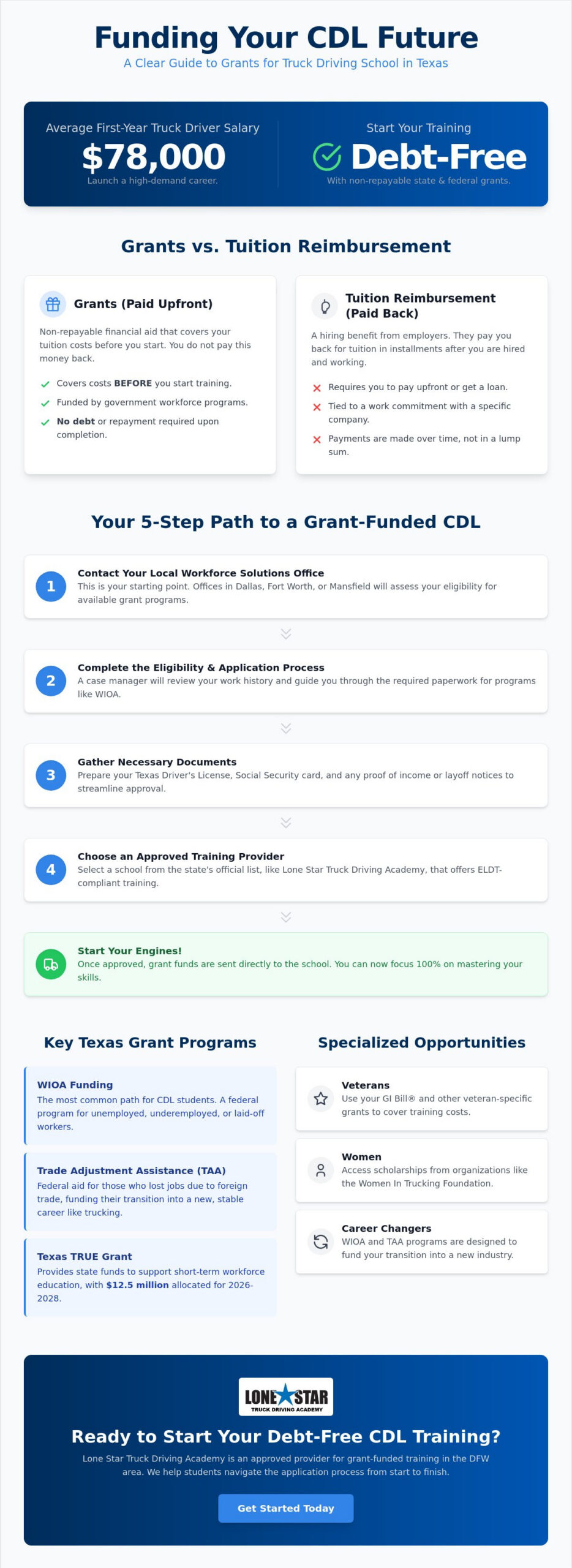
A CDL grant is essentially an investment in your future career. Unlike a traditional student loan, a grant is non-repayable financial aid. This means if you qualify and complete your training, you don’t owe the money back. These funds are designed to help you obtain a Commercial driver’s license (CDL) and enter a high-demand workforce without the stress of debt. In Texas, these programs are vital because the state relies heavily on the trucking industry to keep the economy moving.
It’s helpful to understand that not all grants for truck driving school Texas are the same. Federal grants, such as those through the Workforce Innovation and Opportunity Act (WIOA), focus on helping unemployed or underemployed people find stable careers. State grants often come from the Texas Workforce Commission (TWC) to support specific industries. Private scholarships, like those offered by the Texas Trucking Association (TXTA) Foundation, are another layer of support provided by organizations that want to see new drivers succeed.
The timing couldn’t be better for Texas residents. For the 2026-2028 period, the state has allocated $12.5 million through the TRUE Grant program to support short-term workforce education. With a national shortage of 80,000 drivers, Texas is prioritizing funding for trucking more than ever. This makes it a prime time to secure your training at no upfront cost to you.
The Role of the Texas Workforce Commission (TWC)
The TWC is the primary engine behind workforce funding in the state. They identify “in-demand” occupations that are critical to the Texas economy. Since heavy truck driving is consistently at the top of that list, the TWC directs significant resources toward vocational training. While the TWC manages various programs, including those for standard driver’s education, their workforce initiatives are what help adults transition into professional driving. By aligning state economic goals with your individual tuition needs, the TWC helps ensure that your training leads directly to a viable career path in areas like Fort Worth or Mansfield.
Grants vs. Tuition Reimbursement: What You Need to Know
It’s easy to confuse grants with tuition reimbursement, but the difference is huge for your bank account. A grant covers your costs at the beginning. You don’t have to pull money from your pocket to start your CDL training in Dallas. Tuition reimbursement, on the other hand, is usually offered by trucking companies after you’re hired. They pay you back in monthly installments while you work for them.
The most successful students often combine these methods. You might use a state grant to cover your initial ELDT training and then work for a company that offers reimbursement as a bonus. This strategy can lead to a truly zero-cost experience. At Lone Star Truck Driving Academy, we help students understand how to navigate these options so they can focus on mastering the equipment rather than worrying about the bill.
Major Grant Programs for Texas Truck Driving Schools
Finding the right financial support is about knowing which door to knock on. In Texas, several heavy-hitting programs are designed to get you behind the wheel without a massive bill. These aren’t just generic financial aid packages; they’re targeted investments in the state’s infrastructure. If you’re looking for grants for truck driving school Texas, you’ll likely start with the most prominent federal and state initiatives that local providers work with every day.
One specific example of state-level commitment is the Jobs and Education for Texans (JET) grant, which provides funding to schools to purchase equipment and train students for high-demand jobs. While programs like JET often fund the institutions themselves, other initiatives like the Trade Adjustment Assistance (TAA) focus on the individual. TAA is a federal program that helps workers who have lost their jobs due to foreign trade. If your previous industry was outsourced, you might be eligible for full tuition coverage to transition into a stable trucking career.
WIOA Funding: The Gold Standard for CDL Students
The Workforce Innovation and Opportunity Act (WIOA) is the most common path for our students to achieve debt-free training. It’s designed for unemployed adults, low-income individuals, and “dislocated workers” who have been laid off. WIOA is comprehensive. It doesn’t just cover the basic tuition; it often includes funds for your books, permit fees, and even the final testing costs. To use this funding, you must choose a school that is a “Qualified Training Provider” on the state’s Eligible Training Provider List (ETPL). This ensures the school meets strict standards for safety and career preparation. If you aren’t sure where to start, you can always reach out to our team to see how these programs apply to our courses.
Texas-Specific Workforce Solutions Programs
In North Texas, your primary resource is the Workforce Solutions network. They have offices throughout the DFW metroplex, including locations in Dallas, Fort Worth, and Mansfield. Each office manages local initiatives that can bridge the gap between your current situation and a new career. They offer specialized Dislocated Worker programs for those recently impacted by company closures and Youth programs for young adults ages 16 to 24 looking to enter the trades.
Texas also utilizes the Skills Development Fund. This program often works through partnerships between businesses and community colleges or private schools to train workers for specific regional needs. Because the Dallas area is a major logistics hub, local trucking needs are always prioritized. When you visit a local Workforce Solutions office, ask specifically about “Individual Training Accounts” (ITAs), which are the actual vouchers used to pay for your grants for truck driving school Texas.
How to Apply for a CDL Grant in Texas: A 5-Step Checklist
Securing a grant isn’t an overnight process, but it is a manageable one if you follow the right steps. In the DFW metroplex, the system is designed to identify individuals who are truly ready to commit to a professional driving career. To get started with grants for truck driving school Texas, you’ll need to move through the Texas Workforce Solutions (TWS) pipeline. This process ensures that state resources are directed toward students who have a clear plan for success.
Follow this checklist to navigate the application process efficiently:
- Locate your nearest office: Visit a Workforce Solutions center in Dallas, Fort Worth, or Mansfield to speak with a career counselor.
- Gather your paperwork: You’ll need more than just a driver’s license. Prepare your residency documents and employment history ahead of time.
- Attend a mandatory orientation: Most TWS offices require you to sit through an intake session or orientation to understand the rules of the grant.
- Select an approved provider: Choose a school like Lone Star Truck Driving Academy that is already vetted and listed on the state’s eligible provider list.
- Begin your theory training: Starting your ELDT theory certification can show your counselor that you’re serious about the career.
Documentation You Must Have Ready
You can’t walk into a TWS office empty-handed and expect to walk out with a grant. You’ll need to provide proof of Texas residency and right-to-work documents, such as a birth certificate or social security card. For male applicants, proof of Selective Service registration is often a firm requirement for federal funding. If you’ve been recently laid off, bring your WARN notice or any official layoff documentation. You can stay updated on current requirements by checking the latest Texas Workforce Commission grants and funding updates.
The Interview: Proving Your Commitment to Trucking
The intake interview is where many applications are either fast-tracked or stalled. Workforce counselors are looking for a “likelihood of success.” They want to see that you’ve researched the industry and understand the demands of the job. Be prepared to discuss your driving record and any background check concerns early. If you show that you’ve already looked into CDL training in Mansfield or Dallas and understand the difference between Class A and Class B licenses, it demonstrates a level of professionalism that counselors appreciate. They aren’t just looking for someone who needs a job; they’re looking for someone who wants a career.
Specialized Funding: Veterans, Women, and Career Changers
While broad state initiatives are excellent, many students find success through targeted grants for truck driving school Texas that focus on their specific background or career goals. These specialized funds often have less competition than general workforce programs. If you’re a veteran transitioning to a civilian career, a woman entering the industry, or an entrepreneur looking into specialized hauling, there are financial paths designed specifically for your situation.
Veteran-Specific Texas Funding
Texas supports its veteran population with several robust programs. The Post-9/11 GI Bill is a primary resource for veterans attending approved academies. It often covers the full cost of tuition while providing a monthly housing allowance during your training. You should also be aware of the Hazlewood Act, a Texas-specific benefit that provides up to 150 hours of tuition exemption. It’s important to understand that the Hazlewood Act typically applies to public institutions and community colleges. If you are looking at private training, check with your counselor to see if federal benefits are the better fit. Additionally, many veterans can utilize the Military Skills Test Waiver. This allows those with qualifying military heavy vehicle experience to skip the skills portion of the test, though you must still complete the required ELDT theory training to remain compliant with federal law.
Grants for Underrepresented Groups
The trucking industry in the Dallas-Fort Worth area is actively working to diversify its workforce. Organizations like Women In Trucking (WIT) offer quarterly scholarships that help women cover the costs of obtaining their CDL. These grants are vital for residents in areas like Mansfield and Fort Worth who want to enter a stable, high-paying career field. Beyond transportation, many find that specialized vocational training, such as that offered at an esthetician school raleigh nc, provides a similar gateway to professional independence. Minority-focused vocational scholarships are also available through various community organizations that aim to improve economic mobility in North Texas. Residents of rural Texas counties may also qualify for regional development grants. These programs prioritize training for individuals in areas where transportation jobs are the backbone of the local economy.
Funding for Specialized Skill Sets
Sometimes, the funding you need is for a specific endorsement or a skill upgrade rather than a full initial course. Many grant programs recognize that specialized training leads to higher retention and better pay. You might find assistance for an Automatic Restriction Removal Service if your current license limits you to automatic trucks and you want to expand your opportunities to manual fleets. For those interested in the fast-growing delivery sector, Hot Shot Driver Training can sometimes be funded through small business development grants. These programs are ideal for individuals who plan to operate as independent owner-operators. If you’re unsure which specialized funding path fits your background, contact us today to explore the options available for your specific situation.
Maximizing Your Grant: Why Lone Star Truck Driving Academy?
Once you’ve navigated the paperwork for grants for truck driving school Texas, the next critical decision is where to take that funding. Not all training programs are created equal. You need a partner that understands the local landscape and has a proven track record with state agencies. Lone Star Truck Driving Academy is an approved provider for Texas workforce grants, which means we’ve met the rigorous standards required by the state to handle your tuition assistance and provide high-quality instruction.
One of the biggest advantages of training with us is our Third-Party Testing. Many students who use grant funding are in a hurry to start their new careers. Waiting weeks for a testing date at a state office can drain your momentum and delay your first paycheck. Because we offer on-site testing, we can move you through the process much faster. This efficiency ensures you’re on the road as soon as possible after completing your CDL A Training. For those who are currently working while trying to transition careers, our Weekend CDL Classes provide the flexibility you need to train without quitting your current job.
Localized Expertise in DFW and Beyond
Training in the Dallas-Fort Worth area offers a distinct advantage for your future career. We’ve built strong relationships with local Texas Workforce Solutions offices, which helps streamline the communication regarding your grants for truck driving school Texas. Our instructors provide hands-on training that prepares you for the specific challenges of North Texas highways. You’ll learn to navigate the busy interchanges in Dallas and the major logistics hubs in Mansfield and Fort Worth with confidence. This local familiarity is exactly what carriers are looking for when they hire new drivers.
Beyond the License: Career Preparation
Our goal isn’t just to help you pass a test; it’s to ensure you’re a safe, professional driver. This starts with our comprehensive ELDT Theory Certification, which provides the essential knowledge foundation required by federal law. If you’ve been off the road for a while and need to brush up on your skills, our CDL refresher course is an excellent way to regain your confidence. We encourage you to contact our team to see how your specific grant can be applied to our programs so you can start your training with a clear path forward.
Take the First Step Toward Your New Career
You now have a clear roadmap to secure grants for truck driving school Texas and launch a career without the burden of student debt. These programs are investments in your future, designed to get you behind the wheel and into a high-demand industry. By utilizing the 5-step application process through your local Workforce Solutions office, you can move from uncertainty to a stable professional path in just a few weeks. Whether you are a veteran transitioning to civilian life or a working adult seeking a fresh start, the funding resources in North Texas are ready for you to use.
At Lone Star Truck Driving Academy, we are proud to be a local Texas-owned and operated institution. Our ELDT compliant curriculum ensures you meet every federal standard, while our status as an authorized third-party testing site means you won’t be stuck waiting for a state testing date. We focus on providing the hands-on training you need to navigate Texas highways safely and professionally.
Don’t let the fear of upfront costs hold you back from your goals. Contact Lone Star Truck Driving Academy to discuss your funding options and see how we can help you apply your grant to our programs. You have the drive to succeed; we have the tools to help you get there.
Frequently Asked Questions
Do I have to pay back a CDL grant if I fail the test?
Most grants are non-repayable, so you don’t have to pay them back even if you don’t pass your skills test on the first try. These funds are designed to support your vocational training journey without the burden of debt. While you won’t owe the money, failing might affect your eligibility for future funding or additional testing fees. It’s always best to focus on your ELDT training and permit prep to ensure success on your first attempt.
Can I get a grant if I am currently employed in Texas?
You can still qualify for grants for truck driving school Texas even if you have a job. Programs like WIOA often assist “underemployed” adults who aren’t earning a living wage or are working in roles far below their skill level. Your local Workforce Solutions office in Dallas or Fort Worth will review your income and household size to determine if you meet the specific eligibility requirements for assistance.
How long does the grant approval process usually take?
The approval process typically takes anywhere from 2 to 12 weeks depending on the specific program and office volume. This timeline includes your initial intake, orientation, and the gathering of required documentation. Because this can take a few months, we recommend starting your application as early as possible. This ensures your funding is ready when you are set to begin your hands-on training in the DFW area.
Will a grant cover the cost of my CDL permit and DOT medical card?
Many comprehensive grants, especially WIOA, are designed to cover the full cost of your training, including permit fees and the DOT medical exam. Some programs even include funds for books and supplies. Every grant is different, so you should verify with your workforce counselor exactly what is included in your award letter. This helps you avoid any unexpected out-of-pocket expenses during your initial permit preparation.
Are there grants available for manual transmission training?
Yes, grants generally cover the full scope of your Class A or Class B training, which can include manual transmission instruction. Learning on a manual gearbox is a great way to avoid an automatic restriction on your license. If you already have a restricted license, you might even find funding for an automatic restriction removal service to expand your career opportunities with a wider variety of regional fleets.
Can I use a grant for hot shot driver training in Texas?
You can often use vocational grants to fund hot shot driver training if it’s part of a recognized CDL program. This type of training is popular for those in the Mansfield area looking to start as owner-operators. Since hot shot driving requires a Class A or Class B license depending on the trailer weight, state-approved schools can apply your grant funding toward these specific career paths.
What is the difference between WIOA and TWC funding?
WIOA is a federal act that provides the money, while the Texas Workforce Commission (TWC) is the state agency that manages how that money is spent. Think of WIOA as the source of the funds and TWC as the administrator. When you apply for grants for truck driving school Texas, you’ll be working with TWC’s local Workforce Solutions offices to access these federal WIOA resources.
What happens if the grant only covers part of the tuition?
If your grant doesn’t cover the entire tuition, you can often combine it with other sources like private scholarships or employer tuition reimbursement. Some students choose to pay the remaining balance using personal funds if the grant covers the majority of the cost. Our team at Lone Star Truck Driving Academy can help you look at your award letter and determine the best way to bridge any remaining financial gap.
Article by
Lone Star Truck Driving Academy Training Team
Lone Star Truck Driving Academy provides CDL training for students throughout Texas and North Carolina. Our training team specializes in Class A CDL training, Class B CDL training, CDL refresher programs, automatic restriction removal, third-party testing support, and workforce development partnerships designed to help students build successful careers in the transportation industry.
Training Information Notice
The information provided in this article is for general educational purposes only. Program availability, tuition, licensing requirements, testing procedures, endorsement requirements, and regulatory standards may change over time. Prospective students should contact Lone Star Truck Driving Academy directly to verify current program details, admissions requirements, and state-specific CDL regulations.