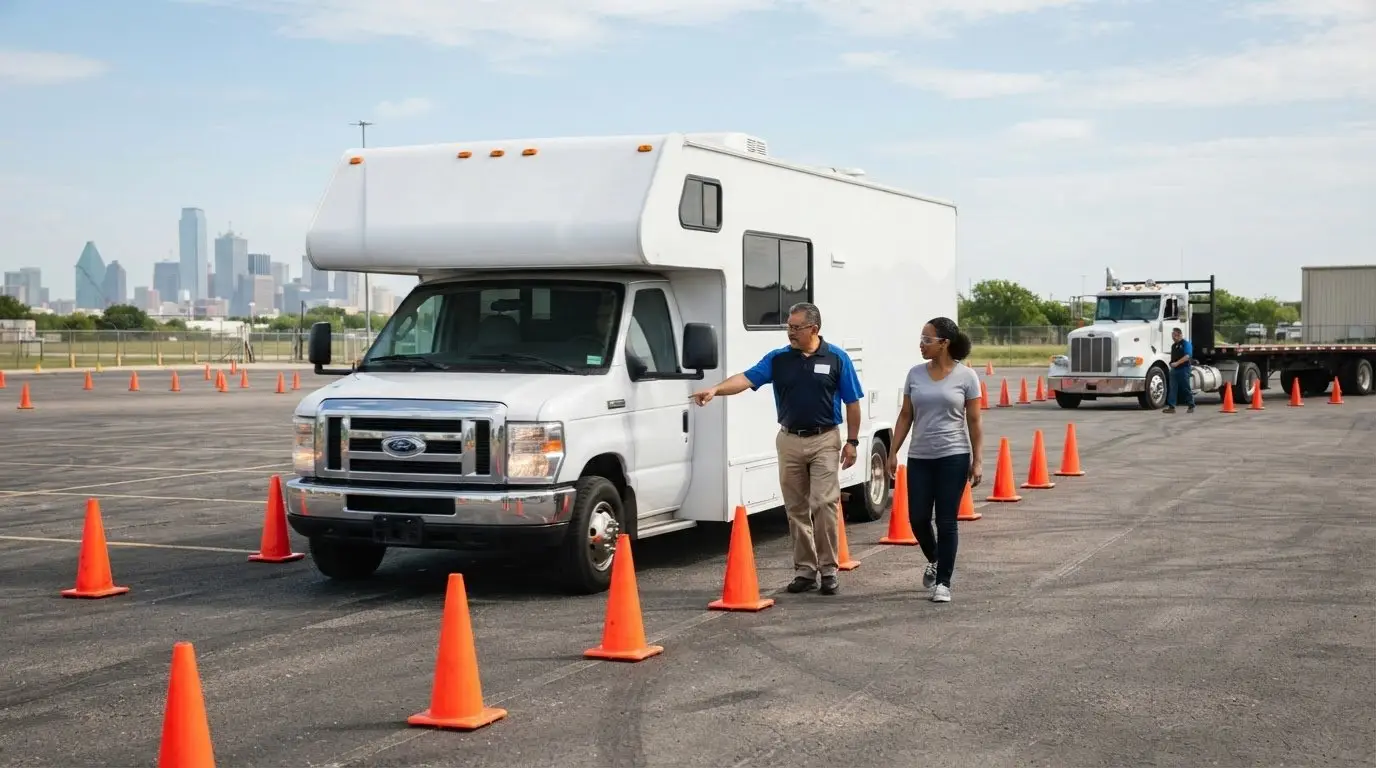
What makes an RV driving safety course in Texas useful? The right training prepares you for the driving you’ll actually do, whether you’re new to a larger vehicle or want to sharpen specific skills. When comparing options, look beyond the lesson list: consider whether the instruction fits your RV, your experience, and the kind of trips you plan.
A course title alone won’t tell you how well it prepares you to manage a larger vehicle on the road or in a tight campsite. The skills covered and the way you learn both matter. Online instruction can introduce safety principles, while practical instruction gives you a chance to work on vehicle handling with guidance.
This guide explains how to compare training formats, identify useful skills, and match instruction to your RV and intended travel. It also covers what a completion certificate can show and why it doesn’t replace applicable license requirements or prove driving readiness. Lone Star Truck Driving Academy offers RV driver training for people seeking focused preparation in Dallas, Mansfield, Fort Worth, Arlington, Denton, Greensboro, High Point, Winston-Salem, and Burlington.
Key Takeaways
- Match training to the RV you’ll drive, your experience, and the trips you plan to take.
- Use a skills checklist to compare coverage of turning, backing, parking, route preparation, and vehicle awareness.
- Compare online lessons with in-person guidance and behind-the-wheel practice to find a format that meets your learning needs.
- When evaluating an RV driving safety course Texas drivers can take, look beyond the title to the instruction and practice it provides.
- Understand what a course certificate represents, and keep it distinct from licensing, insurance eligibility, and demonstrated driving ability.
Why take an RV driving safety course in Texas if you already drive?
Driving experience gives you a useful foundation, but an RV asks you to apply that experience from a different seat, with different dimensions and sightlines. A vehicle that feels familiar on an open road can demand more attention when turning through town, merging onto a busy highway, or approaching a campground entrance. Preparation lets you think through these situations before they feel stressful.
An RV driving safety course focuses on handling an RV with greater awareness and control. That’s different from simply reviewing general road rules. Training can help you account for your vehicle’s sightlines, the space needed to turn, and the time and distance you allow when slowing or stopping. The goal is to build RV-specific awareness, not assume car-driving habits transfer automatically.
Texas travel can take you from wide highways to busy urban streets and smaller roads leading to parks, campgrounds, or other destinations. Each setting brings different demands. On a highway, plan lane changes around what you can see from your seat. In town, intersections and tight turns may require more room. Near your destination, parking areas and access roads often call for deliberate, low-speed maneuvering.
RVs also vary in type and intended use. A motorhome and a vehicle towing a trailer don’t present identical handling considerations. The overview of Recreational vehicle types and uses is a useful starting point for understanding that range, but your own vehicle’s layout and dimensions should guide the preparation you seek.
What makes driving an RV different from driving a car?
A larger vehicle changes what you see and how much room a maneuver requires. Mirrors and windows may leave areas that are harder to monitor, while a turn may call for more space than you’re used to allowing in a car. The vehicle’s size and load can also affect how it responds as you slow down. Learn the RV’s sightlines and handling rather than relying only on familiar car habits.
Small adjustments matter. Before a turn, consider where the rear of the vehicle will travel. When changing lanes, use the available views and give yourself time to assess nearby traffic. A driveway, fuel stop, or campground entrance can bring obstacles closer than they appear from the driver’s seat. These are reasons to practice awareness calmly, not reasons to avoid traveling.
Who can benefit from RV safety training?
First-time RV owners can use focused preparation to get familiar with a vehicle that may be substantially different from what they’ve driven before. Drivers returning after a break may appreciate refreshing their approach, and experienced motorists can benefit from practicing RV-specific decisions. Lone Star Truck Driving Academy offers RV driver training for focused preparation; its separate CDL refresher course serves a different training purpose.
Confidence behind the wheel is valuable, but it doesn’t show how an RV responds in every situation. An RV driving safety course Texas drivers consider should relate to the vehicle and travel they have in mind. With that focus, car-driving experience becomes a foundation to build on, not a reason to skip preparation.
Which safety skills should an RV course cover for Texas driving?
A useful course connects its topics to the way you’ll use your RV, not just a broad list of safety terms. Think about your regular trips: a highway journey across Texas, driving through Dallas-Fort Worth streets, or reaching a campground on a narrower road. Those plans help you judge which skills deserve attention and whether the instruction includes examples relevant to your travel.
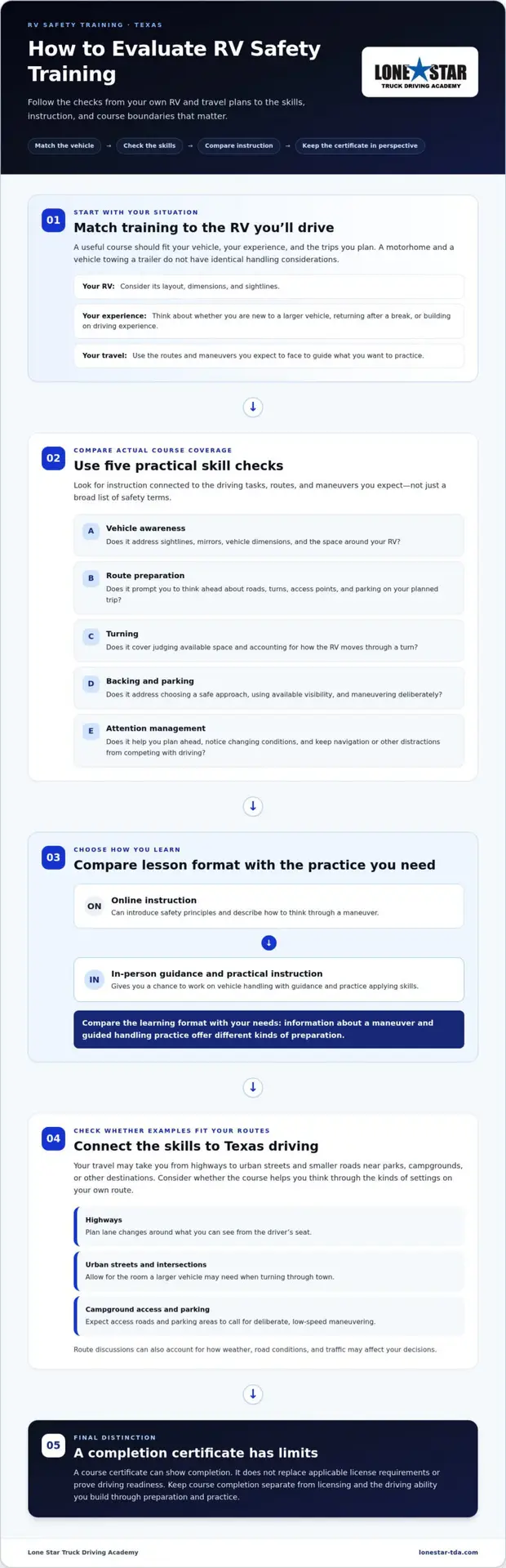
Good RV training connects what you learn to the actual driving tasks, routes, and maneuvers you expect to face. Use this checklist to compare course topics:
- Vehicle awareness: Does the material help you account for sightlines, mirrors, vehicle dimensions, and the space around your RV?
- Route preparation: Does it prompt you to think ahead about roads, turns, access points, and parking on your planned trip?
- Turning: Does it address judging available space and accounting for how the RV moves through a turn?
- Backing and parking: Does it cover choosing a safe approach, using available visibility, and maneuvering deliberately?
- Attention management: Does it help you plan ahead, stay aware of changing conditions, and keep navigation or other distractions from competing with driving?
Assess vehicle awareness, route planning, and road skills
Look for instruction that helps you think through what you can see from the driver’s seat and where the RV needs room. Route preparation should relate to your own journey, whether it includes highways, urban streets, or a destination with a confined entrance. A route discussion can also consider how weather, road conditions, or traffic may affect your decisions.
Licensing rules are separate from course content. For current state information, consult the Texas Department of Public Safety. A safety course can help you evaluate practical driving preparation, but its topic list alone doesn’t establish licensing requirements.
Look for manoeuvring practice that matches your needs
Turning, backing, and parking are easier to assess when you understand how the skills are taught. Online lessons can describe a maneuver and help you think through the steps, but they can’t provide feedback as you operate a vehicle. In-person instruction or behind-the-wheel practice may offer direct guidance. Compare the format with the tasks you want to practice.
For example, if you expect to park in unfamiliar destination areas, look for meaningful attention to your approach, visibility, and space awareness. If backing feels unfamiliar, consider whether the instruction includes an opportunity to practice and receive feedback, rather than only a written explanation. The right balance depends on your vehicle, experience, and travel plans.
An RV driving safety course Texas drivers choose should make its learning format and skill focus clear. Lone Star Truck Driving Academy offers RV driver training as focused preparation for recreational vehicle operation.
Online lessons or hands-on instruction: what fits your RV safety goals?
The right format depends on what you need to learn, how familiar you are with your RV, and how you absorb new information. Online lessons, in-person guidance, and behind-the-wheel practice serve different purposes. A title such as “RV safety course” doesn’t tell you how lessons are delivered, whether an instructor gives feedback, or whether you’ll practice driving tasks.
Start with a specific goal. Are you looking to understand safety concepts before a trip, refresh your knowledge, or get more comfortable maneuvering a vehicle that feels unfamiliar? An RV driving safety course Texas drivers consider should make its teaching format clear enough for you to decide whether it matches that goal.
When online safety lessons may be useful
Online lessons can introduce concepts in a structured way and let you review material at your own pace. That can be useful if you want to study before traveling or revisit a topic you find challenging. Quizzes or a completion certificate show participation or knowledge within a course, not how you’ll handle an RV in motion. Check whether the format covers the skills you want to develop.
Consider what you can learn without being at the wheel. Online material may help you think through preparation, road awareness, or how to approach a maneuver. It can also help you identify questions to address through practice. For general RV background, the RV Industry Association offers a point of reference for learning about the industry and recreational vehicles.
When practical instruction may matter more
Some skills involve timing, judgment, and responding to what you see from the driver’s seat. Guided practice gives you a chance to try a task, receive feedback, and adjust your approach. The value depends on what you practice and how the instruction fits your experience. Don’t assume that a course advertised as “in person” automatically includes driving time.
If you’re new to RVs, you may want more support getting used to the vehicle’s controls and sightlines. If you’ve driven an RV before, your focus might be a specific task that still feels awkward. Consider your planned trips, too. Someone expecting mostly open-road travel may have different priorities from a driver who anticipates frequent parking or tight destination access.
Compare formats by considering what each part involves: reading or watching lessons, instructor-led discussion, demonstration, or time practicing a driving task. Is feedback part of the learning experience? These distinctions matter more than a course label. They show whether instruction offers information, practice, or both, without assuming one format suits every driver.
Lone Star Truck Driving Academy offers specialized RV driver training and practical driver education. The academy serves drivers in Dallas, Mansfield, Fort Worth, Arlington, and Denton, as well as Greensboro, High Point, Winston-Salem, and Burlington.
How to compare RV driving safety courses before enrolling in Texas
Compare a course against your actual goal, not just its title. If you want to prepare for personal RV travel, focus on RV instruction and what completion means. If you’re exploring commercial driving as a career, CDL training is a separate path with its own requirements. Keeping those goals distinct helps you choose relevant preparation and avoid assuming one course fulfills the purpose of another.
- Identify the RV. Note whether you’ll drive a motorhome or tow a trailer, along with the vehicle’s general size and layout. This gives you a practical starting point for judging whether the instruction fits your driving situation.
- Define your travel needs. Consider the roads and destinations you expect to encounter, and write down any tasks you want to feel more prepared to handle. A specific goal is more useful than choosing training based only on a broad promise of confidence.
- Inspect the listed topics. Compare the course content with the skills you want to develop. Look for clear descriptions of what the lessons address and how those topics relate to RV operation.
- Compare the learning format. Determine whether the course uses self-paced material, instructor guidance, or behind-the-wheel practice. Consider whether the format provides the explanation, feedback, or practice you’re seeking.
- Clarify completion terms. Find out what completing the course means and what documentation is provided, if any. Don’t treat a certificate as proof of driving ability, a license, an endorsement, or guaranteed insurance eligibility.
Match course content to your vehicle and travel plans
Compare each course with your RV experience and intended use. RV driver training prepares you for recreational vehicle operation; it isn’t CDL qualification. Commercial driving may be a separate consideration if your longer-term goal involves professional driving. Lone Star Truck Driving Academy offers Class A and Class B CDL training, ELDT theory certification and permit preparation, and third-party testing. Those services support commercial driver preparation, not RV course completion.
Other commercial goals can involve endorsements or manual-transmission restrictions, depending on the license and work you’re pursuing. Don’t assume RV training addresses those needs. Identify whether your priority is personal RV travel or a commercial driving career, then assess the relevant training path on its own terms.
Check what completion means before you choose
A course certificate, if provided, reflects completion according to that course’s terms. It doesn’t automatically establish driving proficiency, grant a license or endorsement, or qualify you for an insurance discount. For licensing requirements, consult the relevant authority; for possible insurance benefits, ask your insurer what it recognizes and what documentation it needs.
Drivers looking for broader skills refreshment in a commercial driving context can explore the CDL refresher course. It serves a different purpose from focused RV preparation. Keeping the distinction clear helps you choose training that matches your immediate needs without expecting an RV course to cover commercial licensing or career preparation.
Use the checklist to assess the fit between your goals, the instruction, and its completion terms. A clear understanding of what the course covers helps you make an informed choice and set practical expectations.
For focused RV preparation, Lone Star Truck Driving Academy provides RV driver training.
Build RV driving confidence with Texas-focused training and next steps
Choosing training is easier when you start with your own driving plans. Consider the RV you’ll operate, the tasks you want to practice, and whether you learn best through discussion, guided instruction, or time behind the wheel. Then compare those needs with the course’s topics and format. Clear completion terms also help you understand what training represents and what it doesn’t.
A useful RV driving safety course Texas drivers choose should fit the learner, not just the course title. Preparation for a first trip through busy DFW streets may call for different priorities than preparation for a familiar route or a long highway journey. Make a thoughtful plan around your vehicle and travel, without expecting one course to promise a particular result.
Turn your safety goals into a training plan
Before enrolling, write down your RV experience and the specific situations you want to handle with more confidence. Be practical. You might be new to driving a larger vehicle, want to become more comfortable parking at destinations, or need to think through the demands of towing. A short list of goals gives you a clearer basis for comparing course content and format.
- Describe the RV you expect to drive and your level of experience.
- Note the trips you have in mind, including highways, town driving, and destination access.
- Identify the maneuvers or driving decisions you most want to work on.
- Compare those priorities with the course topics, instruction format, and completion terms.
Keep your expectations grounded. Focused training can provide preparation relevant to your needs, while safe driving also depends on continued attention and decisions on the road. For Texas travel, consider the range of situations on your itinerary and choose preparation that addresses the tasks you expect to encounter.
Take the next step with Lone Star Truck Driving Academy
Lone Star Truck Driving Academy offers specialized RV driver training for people seeking focused preparation. The training is distinct from CDL qualification, and the right starting point depends on your vehicle, experience, and goals. Bringing those details into the conversation keeps your next step connected to the driving you plan to do.
Start with what you’ll be driving, where you expect to go, and which parts of RV operation feel least familiar. Those details give you a practical basis for discussing your training goals with the academy.
Make your next RV trip a more prepared one
Your next step can be simple: write down what you’ll be driving, where you plan to go, and which situations you want to feel more prepared to handle. That reflection can turn a broad interest in training into a clear personal goal. A well-matched RV driving safety course Texas drivers choose should support preparation suited to their experience and intended use.
Confidence doesn’t come from a course title alone. It grows as you understand your learning needs and make considered choices about practice and preparation. Focus on training that fits your goals and the driving you plan to do.
Take the next step at your pace. With a clear goal and thoughtful preparation, you can approach your RV driving plans with greater readiness.
Frequently Asked Questions
Is an RV driving safety course useful if I already have years of driving experience?
Yes. Years of car driving can build strong traffic awareness, but they may not include practice judging an RV’s rear clearance or positioning it in a campsite. An experienced driver planning a first trip through Dallas-Fort Worth, for example, may want to practice adapting familiar lane changes and turns to the RV’s visibility and dimensions. Training can address those RV-specific questions while building on, rather than discounting, your experience.
Can an online RV safety course teach me everything I need to drive?
No. Online lessons can explain concepts and give you material to review, but they can’t observe how you respond at the wheel or offer real-time feedback during a turn or backing maneuver. If your concern is physical control, choose instruction that includes relevant practice. Treat online completion as evidence that you finished or learned course material, not proof that you can handle every RV or driving situation.
Does completing an RV safety course qualify me for a Texas license or endorsement?
No. An RV safety course doesn’t issue a license or endorsement. For personal RV use, Texas generally doesn’t require a CDL, though vehicle weight ratings can mean a non-commercial Class A or B license is needed. The RV’s class and the driver’s license class are different things. Check Texas Department of Public Safety guidance for requirements that apply to your vehicle and circumstances.
Can I take RV driving training in my own vehicle?
The vehicle used for training and whether it involves a towing setup affect how closely practice matches your plans. Training in a familiar vehicle can feel different from learning in another setup, so consider the vehicle and skills involved when choosing preparation. Lone Star Truck Driving Academy offers RV driver training focused on recreational vehicle operation.
What should an RV driving safety course cover?
Look for topics that fit your vehicle and travel plans, such as mirror use, clearance awareness, route preparation, turning, backing, parking, and staying focused when navigation or passengers compete for attention. A driver expecting to reach a campground after a long highway trip may want preparation that considers both road awareness and low-speed maneuvers. The course should clearly state which subjects it covers and how instruction is delivered.
Will an RV driving safety course lower my insurance premium?
Not necessarily. Insurers set their own eligibility rules, and completing a course doesn’t automatically change your premium. Before relying on a discount, ask your insurer whether it recognizes the specific course and what documentation it requires. Keep the response with your policy records. Choose an RV driving safety course Texas drivers can use to build relevant preparation, rather than assuming a certificate will reduce costs or affect coverage.
Article by
Lone Star Truck Driving Academy Training Team
Lone Star Truck Driving Academy provides CDL training for students throughout Texas and North Carolina. Our training team specializes in Class A CDL training, Class B CDL training, CDL refresher programs, automatic restriction removal, third-party testing support, and workforce development partnerships designed to help students build successful careers in the transportation industry.
Training Information Notice
The information provided in this article is for general educational purposes only. Program availability, tuition, licensing requirements, testing procedures, endorsement requirements, and regulatory standards may change over time. Prospective students should contact Lone Star Truck Driving Academy directly to verify current program details, admissions requirements, and state-specific CDL regulations.