That “free” CDL training offered by mega-carriers might actually be the most expensive mistake you make in your trucking career. While the idea of zero upfront tuition sounds like a win, these programs often lock you into year-long contracts with lower wages and limited routes. Most drivers looking for job placement CDL schools are simply trying to find a stable path to a better life without drowning in debt. You’re likely feeling the pressure of high tuition costs or the anxiety of passing that final road test in front of a DPS examiner.
We understand that stress because we see it every day in our Mansfield and Fort Worth classrooms. This guide will show you how to evaluate training programs for long-term career success and why an independent license offers far more freedom than carrier-paid programs. You’ll learn exactly what it takes to land a high-paying regional or local job in the Dallas-Fort Worth area, where entry-level drivers can earn between $55,000 and $65,000. We’ll break down the benefits of manual transmission training, how to navigate the ELDT mandate, and the specific steps to becoming the kind of driver that every recruiter in North Texas wants to hire.
Key Takeaways
- Understand why “guaranteed placement” is often a marketing tactic and how to focus on building a resume that appeals to multiple carriers.
- Compare the long-term financial impact of carrier-sponsored training versus independent job placement CDL schools to avoid being locked into low-paying contracts.
- Identify the specific skills, like manual transmission mastery and ELDT compliance, that DFW recruiters look for when hiring new Class A drivers.
- Learn the right questions to ask local schools in Mansfield and Dallas about their training equipment and student-to-instructor ratios.
- Discover how obtaining an independent license provides the professional flexibility to pursue local, regional, or specialized hot shot driving roles.
What Does ‘Job Placement’ Really Mean in CDL Schools?
When you start researching various job placement CDL schools, it is easy to get swept up in the promise of an immediate paycheck. In many cases, “placement” is simply a marketing term used by large, carrier-owned schools to recruit new drivers for their own fleets. They aren’t necessarily placing you in a career that fits your life; they’re filling a seat in one of their trucks. At Lone Star Truck Driving Academy, we view this differently. We focus on career readiness, which means giving you the tools to be hired by any reputable carrier in the Dallas-Fort Worth area based on your skills and professionalism.
Obtaining your Commercial Driver’s License (CDL) is the first step toward a significant life transition. There is a fundamental difference between being “placed” in a job by a school and being “hired” on your own merits. When you earn your license through an independent program, you’re a free agent. Local recruiters in Mansfield and Greensboro often visit campuses that have a reputation for high standards because they know those students are prepared for the realities of the road. Your value in the market comes from your ability to handle a rig safely, not from a pre-signed recruitment contract.
Carrier-Owned vs. Vocational Schools
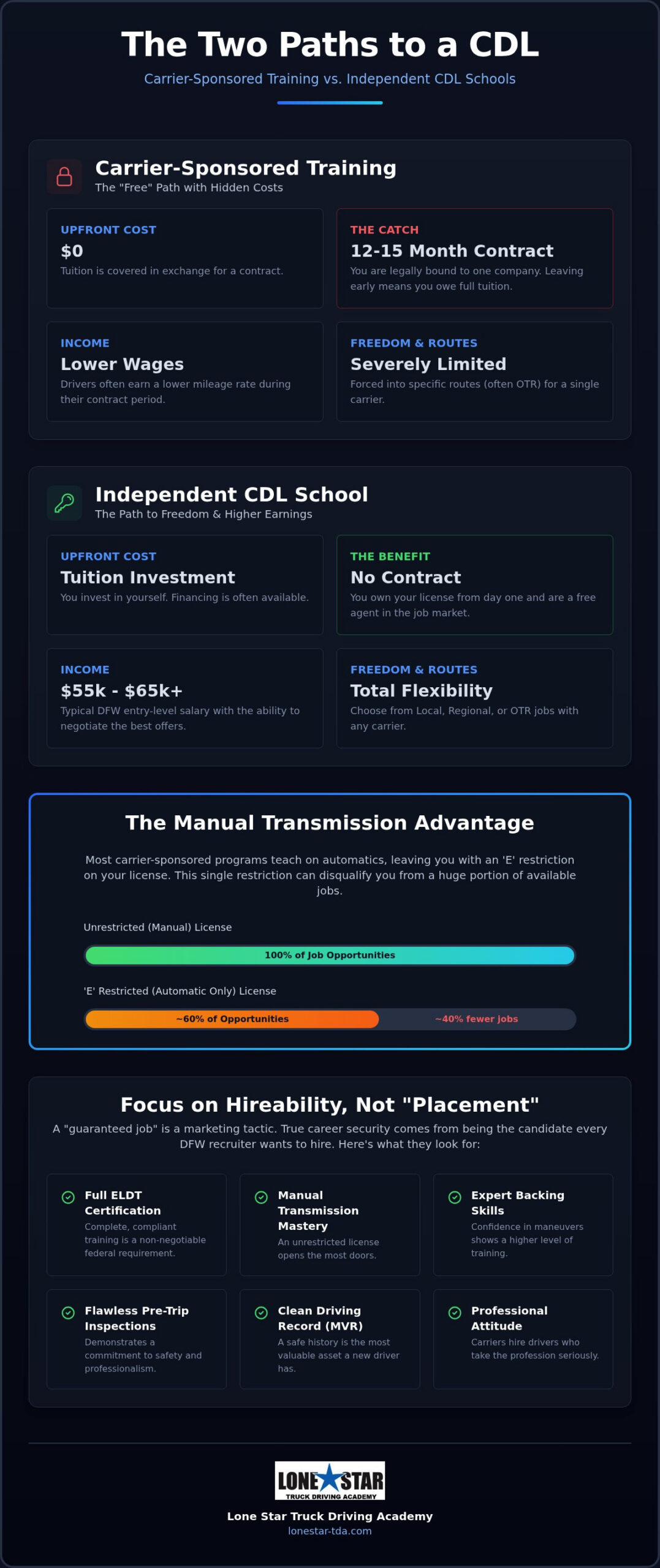
Carrier-owned programs often advertise “free” or low-cost training, but this usually comes with a heavy price tag later. These schools typically require you to sign a contract to drive for them for 12 to 15 months. During that time, you might earn a lower mileage rate than an independent driver, and if you leave the company early, you could be billed for the full tuition immediately. Independent vocational schools require tuition upfront or through financing, but you own your license from day one. This independence allows you to choose between local, regional, or over-the-road positions that offer the best pay and benefits for your situation. You can identify contract-heavy job placement CDL schools by asking to see their employment agreement before you ever sit in a classroom.
The Reality of Job Guarantees
No reputable school can legally guarantee you a specific job or a set salary. The final hiring decision always rests with a carrier’s safety department. They will closely examine your Motor Vehicle Record (MVR), your background check, and your performance during a road test. Instead of looking for a hollow guarantee, you should look for a program that provides comprehensive CDL A training and ELDT theory certification. Quality training builds a resume that stands out to recruiters. When you master backing maneuvers, pre-trip inspections, and safe driving habits, you become a candidate that companies in Dallas and Fort Worth actively compete to hire.
Carrier-Sponsored vs. Independent Schools: The Cost of ‘Free’
Many prospective drivers are lured by the promise of zero-cost training. It sounds like a shortcut to a new life. However, when you look at the total cost of ownership over your first two years, the “free” option often becomes the most expensive choice you can make. Large carriers that operate their own job placement CDL schools typically require a commitment of one year or more. During this period, you are often paid significantly less than the market rate. If you decide to leave before your contract is up, you could be hit with a bill for thousands of dollars in tuition costs, often at a higher rate than what you would pay at a private academy.
Independent training offers a completely different path. By investing in your own education, you maintain the power to shop for the best sign-on bonuses and benefits from day one. You aren’t forced into long-haul over-the-road (OTR) routes if you prefer local or regional work. Following federal CDL standards ensures you have the credentials to work for any company, but independence ensures you have the leverage to choose the right one for your family. This freedom is especially valuable in a major logistics hub like the DFW area, where local opportunities are abundant.
The Value of an Unrestricted License
Most carrier-sponsored programs train students exclusively on automatic transmissions because it is faster and cheaper for the school. While this gets you on the road quickly, it leaves you with an “E” restriction on your license. This restriction prevents you from driving a manual transmission truck, effectively cutting your job opportunities by nearly 40%. Our automatic restriction removal service allows you to master manual shifting. This mastery opens doors to specialized, higher-paying roles in construction, heavy haul, or specialized logistics that standard OTR carriers simply don’t offer.
Flexibility for Working Adults
Transitioning to a new career shouldn’t mean losing your current income or being separated from your family. Carrier schools often require you to travel to a distant facility and live in a dorm for several weeks. At Lone Star Truck Driving Academy, we prioritize the needs of working adults. Our weekend CDL classes allow you to train locally in Mansfield, Dallas, or Greensboro without quitting your current job. This flexibility means you can build your future while maintaining your present financial stability. If you’re ready to see how our schedule fits your life, reach out to our team for a campus tour.
Why Hireability Matters More Than a ‘Guaranteed’ Job
Recruiters in North Texas aren’t just looking for someone with a plastic card in their wallet. They’re looking for professionals who can back into a tight dock at a Dallas warehouse without breaking a sweat or compromising safety. While many people search for job placement CDL schools expecting a “guaranteed” position, the reality is that your skills are your only true guarantee. The job outlook for truck drivers shows consistent demand, but the highest-paying local fleets only hire those who demonstrate mastery during the road test.
Modern regulations have changed how you enter the industry. Completing your ELDT theory certification is now a federal requirement, but it’s just the baseline. True hireability comes from the hours spent on the range perfecting your pre-trip inspections and air brake checks. When local recruiters visit independent campuses in Mansfield or Greensboro, they aren’t looking for a contract; they’re looking for talent. Building a professional network while you train gives you a head start that a carrier-owned school simply can’t match.
Mastering the CDL Skills Test
One of the biggest hurdles for any student is the anxiety of the final exam. Taking your test with a stranger at a government facility can be intimidating. This is why on-site third party testing is such a significant advantage. You get to test on the same equipment you’ve been practicing with and at the same facility where you’ve spent weeks training. This familiarity reduces stress and allows your true skills to shine. Our instructors don’t just teach you to pass; they act as mentors, helping you navigate your first job search with confidence and real-world advice.
Specialized Training and Niche Markets
The trucking industry is much broader than just driving a 53-foot dry van. There’s a massive, growing demand for hot shot driver training, which involves smaller, class 3-5 trucks pulling specialized trailers. These roles often offer more home time and can be very lucrative for those who prefer more variety in their work. Similarly, obtaining a Class B certification opens doors to local construction, waste management, and delivery jobs that keep you close to home in the DFW or Greensboro markets. Diversifying your skill set with endorsements and specialized training makes you recession-proof, ensuring you stay in demand regardless of how the broader economy shifts.
Checklist: What to Ask CDL Schools About Career Support
Choosing between various job placement CDL schools requires more than looking at a tuition price. You need to know if the school actually invests in your future or if they’re just pushing you through a turnstile. Start by asking if the school hosts regular recruiter events or job fairs. A school with strong ties to the DFW and Greensboro freight markets will have carriers visiting the campus to meet students face-to-face. This is where you make the connections that lead to local or regional roles.
Next, ask about the instructor-to-student ratio. If you’re one of fifteen students waiting for ten minutes of seat time, you aren’t getting the hands-on experience you need. You should also clarify if there are extra fees for permit preparation or specialized services like removing an automatic restriction. Finally, confirm that you can test on the same equipment you used for training. Testing at the same facility where you practiced removes a massive layer of stress on exam day.
Don’t overlook the importance of long-term support. Ask if the school offers a CDL refresher course. Life happens, and if you’re out of the driver’s seat for a few months or years, many carriers will require you to complete a short course before they’ll put you back on the road. A school that supports its alumni through every stage of their career is a partner worth having.
Evaluating the Training Quality
Verify that any school you consider is an FMCSA-approved ELDT provider. Without this, you cannot sit for your CDL exam. Inspect the training equipment yourself; you want to learn on trucks that represent what you’ll actually drive in the workforce. While Class A is the gold standard, look for schools that also offer Class B training. At Lone Star Truck Driving Academy, we maintain our fleet to ensures students are ready for the modern workforce.
Local Reputation and Reviews
Comparing CDL training in Dallas to options in Mansfield or Greensboro requires looking at the school’s history in the community. Real student reviews often reveal the truth about the transition from the classroom to the cab. A school that has operated for years has built trust with local carriers, making their graduates a known quantity for safety managers. This local reputation distinguishes the best job placement CDL schools from those that just want your tuition.
Schedule a campus visit to meet our instructors
Your Path to a Professional Driving Career at Lone Star
Your search for job placement CDL schools usually begins with a simple question: who can I trust with my future? At Lone Star Truck Driving Academy, we answer that by treating you as a future professional colleague rather than just a student in a classroom. Our instructors are industry veterans who have spent years navigating the DFW and North Carolina freight corridors. They bring that real-world experience into every lesson, ensuring you understand the practical realities of the road before you ever take your first solo load.
We prioritize safety and professionalism above all else. Whether you are learning to navigate tight turns in Fort Worth or mastering the pre-trip inspection at our Greensboro facility, the focus remains on building your confidence. This high standard of training is exactly why local carriers respect our graduates. We also recognize that many of our students are balancing current jobs with their education. To accommodate this, we provide flexible scheduling options, including weekend classes and refresher courses for those returning to the industry. One of our greatest advantages is the ability to test at our authorized third-party sites. This means you skip the long wait times at the DPS and perform your skills test in the same environment where you practiced.
Getting Started with Permit Prep
The journey to a Class A or B license begins before you ever climb into the cab. Our CDL permit prep program provides a solid foundation in ELDT theory and the specific knowledge required by the state of Texas or North Carolina. We guide you through the complexities of air brakes, combinations, and general knowledge so you can move to hands-on training with total confidence. If you’re ready to take that first step, our campuses in Mansfield and Greensboro are equipped with the resources and staff you need to succeed from day one.
The Lone Star Difference
We don’t just train you to pass a state exam; we train you to manage a career. The Lone Star difference lies in our commitment to empowering drivers to own their professional identity. By choosing an independent academy, you gain the freedom to select your own employer and negotiate your own terms rather than being tied to a single carrier’s contract. We invite you to contact us today to schedule a campus tour and see our equipment firsthand. Your future in the trucking industry is a significant investment, and we’re here to help you drive toward it with the right skills and the right mindset.
Take the Wheel of Your New Career
Choosing between job placement CDL schools is a decision that shapes your entire professional future. While a “guaranteed” job from a mega-carrier might seem safe, it often limits your freedom and earning potential. By investing in independent training, you gain the skills to work for any carrier in the Dallas-Fort Worth area or beyond. You own your license from day one, giving you the power to choose the routes and pay scales that fit your life.
Lone Star Truck Driving Academy is a dedicated partner in this transition. As an FMCSA ELDT approved provider, we offer the high-quality instruction and hands-on experience that recruiters value. Our authorized third-party testing sites and flexible weekend or refresher courses are designed to work around your schedule. You don’t have to sacrifice your current stability to build a better future.
The road ahead is full of opportunity for those with the right preparation. We look forward to helping you master the skills needed for a long and successful career in the trucking industry.
Frequently Asked Questions
Do CDL schools really guarantee a job after graduation?
No reputable school can legally guarantee a specific job because the final hiring decision always rests with a carrier’s safety department. While many job placement CDL schools use “guaranteed” as a marketing term, your employment depends on your Motor Vehicle Record, background check, and road test performance. We focus on making you a highly hirable candidate by teaching the specific skills that Dallas and Fort Worth recruiters look for in new drivers.
Is carrier-paid CDL training actually free?
Carrier-paid training is rarely free in the long run. Most programs require you to sign a contract to drive for that company for 12 to 15 months. If you leave early, you’ll be billed for the full tuition, often at a premium rate. Additionally, these carriers often pay a lower mileage rate during your commitment period, meaning you pay for your training through reduced wages and limited career flexibility.
What is the difference between job placement and job assistance?
Job placement usually refers to a direct pipeline where a school funnels students into a specific carrier, often under a restrictive contract. Job assistance is what independent job placement CDL schools provide, offering resources like resume building, interview prep, and networking opportunities with various DFW and Greensboro carriers. This approach empowers you to be a free agent, allowing you to choose the best benefits and routes for your needs.
Can I get a local driving job right out of CDL school?
You can definitely find local work immediately after graduation, especially in major logistics hubs like Fort Worth and Mansfield. Many local beverage distributors, construction companies, and LTL carriers hire new Class A and Class B drivers. While many mega-carriers push new drivers toward over-the-road routes, an independent license gives you the freedom to apply for regional or local positions that keep you home more often.
How much does CDL school cost in Texas or North Carolina?
Training costs in the DFW and Greensboro markets vary significantly based on whether you choose a Class A or Class B program. In Texas, you’ll need to pay a $25 Commercial Learner’s Permit fee and a $97 license fee directly to the DPS. Many students utilize payment plans or workforce grants to manage their investment. Paying for your own training ensures you aren’t stuck with a carrier’s restrictive debt or long-term contracts.
Will an automatic restriction on my CDL hurt my job prospects?
An automatic restriction, known as the “E” restriction, can limit your career options. Approximately 40% of the trucking industry, including many specialized heavy-haul and construction roles, still utilizes manual transmissions. Removing this restriction through a targeted course at Lone Star Truck Driving Academy ensures you are eligible for a wider range of high-paying local jobs in the Dallas and Fort Worth markets that require manual shifting skills and technical mastery.
How long does it take to get a CDL and start working?
Most full-time CDL programs take between three and six weeks to complete, depending on whether you are pursuing a Class A or Class B license. If you choose weekend classes in Mansfield or Greensboro to accommodate your current work schedule, the process will naturally take longer. Once you pass your third-party skills test, you can often begin your new driving career with a local or regional carrier within a matter of days.
What if I fail my CDL road test the first time?
Failing the road test on your first attempt is more common than you might think and isn’t the end of your career. You are allowed to retest after a short waiting period. Testing at an authorized third-party site like ours provides a major advantage because you use the same equipment you practiced on. Our instructors work with you to correct specific mistakes, ensuring you return for your retest with increased confidence.
Article by
Lone Star Truck Driving Academy Training Team
Lone Star Truck Driving Academy provides CDL training for students throughout Texas and North Carolina. Our training team specializes in Class A CDL training, Class B CDL training, CDL refresher programs, automatic restriction removal, third-party testing support, and workforce development partnerships designed to help students build successful careers in the transportation industry.
Training Information Notice
The information provided in this article is for general educational purposes only. Program availability, tuition, licensing requirements, testing procedures, endorsement requirements, and regulatory standards may change over time. Prospective students should contact Lone Star Truck Driving Academy directly to verify current program details, admissions requirements, and state-specific CDL regulations.