
What if the only thing standing between you and a high-paying trucking career isn’t your ability to drive, but a simple lack of information about how to pay for cdl school? Many prospective students in the Dallas-Fort Worth area and Greensboro feel stuck before they even start because they assume a Class A license requires thousands of dollars in upfront cash or a predatory student loan. It’s a common concern, and frankly, the confusion surrounding “free” company training versus private schooling only makes the decision harder. You want a stable future in the driver’s seat, but you don’t want to start that journey buried in debt.
We understand that managing the financial side of education is often more stressful than the training itself. In this guide, we’ll show you exactly how to fund your career by leveraging government grants like WIOA, utilizing veteran benefits, and taking advantage of tuition reimbursement programs. Whether you’re looking for training in Mansfield, Dallas, or Greensboro, we’ll break down the most effective ways to fund your education at Lone Star Truck Driving Academy. You’ll discover how to maximize your return on investment while keeping your out-of-pocket costs as low as possible.
Key Takeaways
- Identify the typical cost range for Class A and B programs in 2026 and what specific services are included in your tuition.
- Navigate the process of how to pay for cdl school using government assistance programs like WIOA and the Texas Workforce Commission.
- Compare the trade-offs between “free” company-sponsored training and the career independence offered by private academy tuition.
- Learn how to leverage veterans’ benefits or specialized vocational financing to fund your training without taking on unnecessary debt.
- Discover how adding endorsements or manual transmission skills can drastically improve the return on your training investment.
Understanding the Real Cost of CDL Training
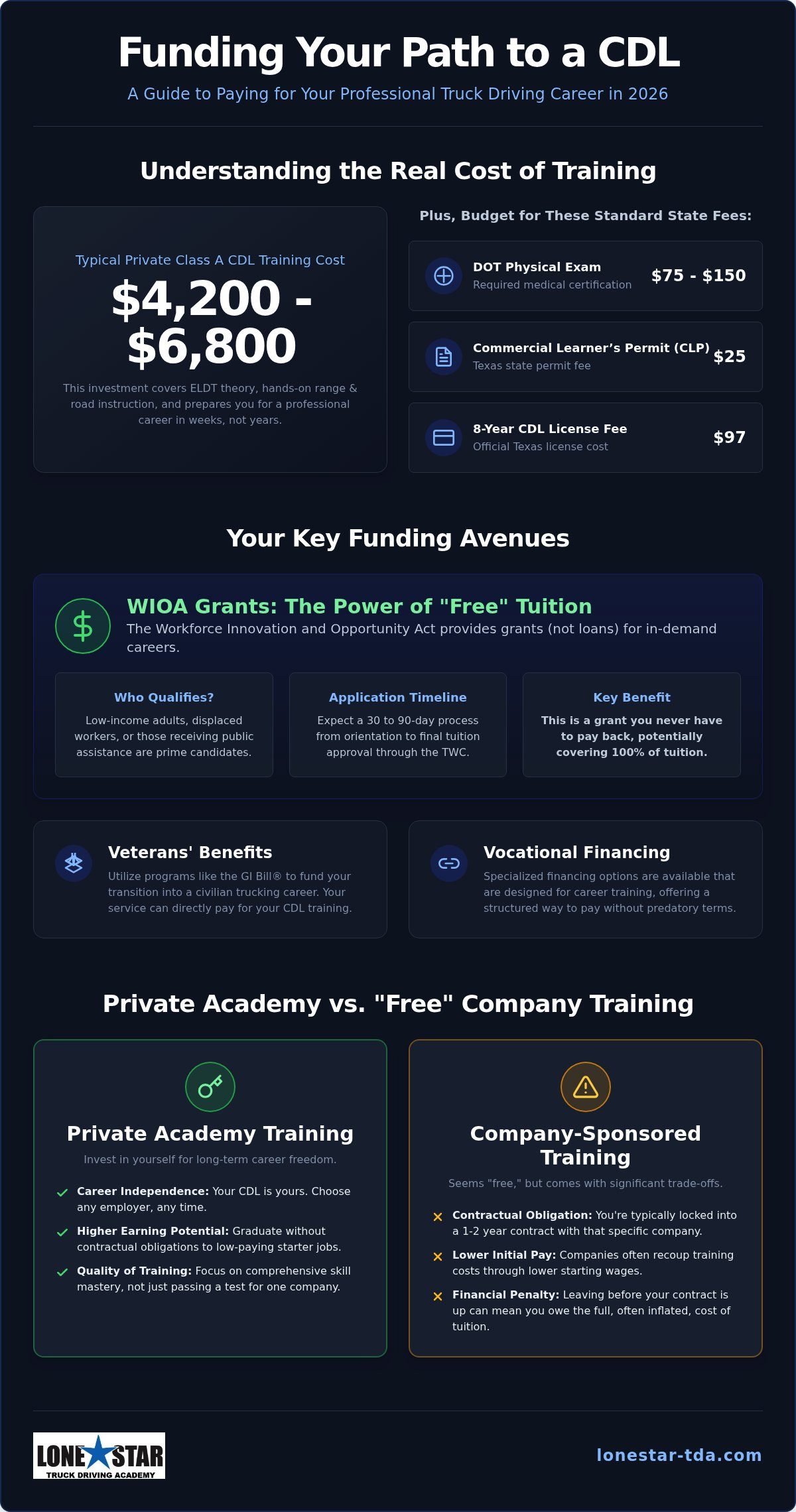
Choosing a career in trucking is a significant life transition. Before you dive into the specifics of how to pay for cdl school, it’s vital to understand the financial landscape of the industry in 2026. In the Dallas-Fort Worth market, private Class A training typically ranges between $4,200 and $6,800. While this might seem like a large upfront commitment, compare it to a four-year university degree. Most college graduates leave school with six-figure debt and no immediate job prospects. A Commercial Driver’s License (CDL) is a high-yield investment that puts you in a professional driver’s seat in a matter of weeks.
Your tuition at a reputable academy covers more than just a seat in a classroom. It includes your ELDT theory certification, hours of supervised range time where you master backing maneuvers, and actual road instruction in heavy traffic. However, you should distinguish between the tuition price and your “all-in” cost. Budgeting for your new career requires looking beyond the school’s invoice. Here are the standard out-of-pocket expenses you’ll encounter in Texas:
- DOT Physical Exam: $75 to $150
- Commercial Learner’s Permit (CLP): $25
- 8-Year CDL License Fee: $97
Class A vs. Class B Tuition Differences
The type of license you pursue dictates your training cost. Class A CDL training generally commands a higher price because the equipment is more complex. You’re learning to manage combination vehicles, air brakes, and articulated steering. If your goal is local delivery or operating straight trucks, Class B training offers a faster timeline and a lower entry cost. Evaluate your long-term career goals in Mansfield or Fort Worth before deciding which path offers the best return for your specific needs.
The Hidden Costs of “Cheap” Schools
It’s tempting to choose the school with the lowest sticker price, but “cheap” often comes with a hidden tax on your time. Some schools cut costs by limiting your actual driving hours or forcing you to share a truck with five other students. At Lone Star Truck Driving Academy, we prioritize hands-on experience and student-to-instructor ratios that actually lead to mastery. Choosing a school with authorized on-site third-party testing also saves you from the frustration of waiting weeks for a DPS appointment. Understanding these variables is the first step in figuring out how to pay for cdl school without taking on unnecessary stress.
Government Grants and Workforce Assistance Programs
Many people searching for how to pay for cdl school overlook federal programs designed specifically to put Americans back to work. The Workforce Innovation and Opportunity Act (WIOA) is the most powerful tool in your arsenal. Unlike a student loan, WIOA provides grants for CDL training that you never have to pay back. These funds are distributed through local workforce boards to help individuals gain the skills needed for high-demand industries like transportation.
In the Dallas-Fort Worth area, the Texas Workforce Commission (TWC) manages these vocational funds. To qualify as a low-income adult in 2026, the income limit for a family of four is $33,260. If you’ve been laid off, are receiving food stamps, or are currently underemployed, you’re a prime candidate for these grants. The application process requires patience. It generally takes between 30 and 90 days to move from your initial orientation to final tuition approval. You’ll need to prove your eligibility and confirm that your chosen school is on the Texas Eligible Training Provider List (ETPL).
WIOA Grants for Career Changers
If you’re near Mansfield or Dallas, your first stop should be a Workforce Solutions office. These grants are often underutilized because the paperwork can feel daunting. Don’t let a few forms stand between you and a debt-free education. Veterans and displaced workers often receive priority processing, making this a streamlined path to a Class A license. We’ve seen many students successfully navigate this system to start their careers with zero out-of-pocket tuition costs.
State-Specific Funding in North Carolina
For students at our Greensboro campus, the NC Works system offers similar vocational scholarships. Whether you’re in High Point or Winston-Salem, local workforce boards partner with community resources to cover tuition for high-demand fields. The process mirrors the Texas system, requiring an assessment of your current employment status and a commitment to completing the training. If you’re unsure where to start with your application, reach out to our team for guidance on our current local workforce partners. We can help you identify which office serves your specific zip code and what documentation you’ll likely need to provide.
Company-Sponsored Training vs. Private Tuition
When researching how to pay for cdl school, you’ll inevitably see ads for “free” or “paid” training. These programs are offered by large carriers who cover your tuition in exchange for a commitment to drive for them. While programs like the Workforce Innovation and Opportunity Act (WIOA) offer debt-free grants for those who qualify, many people still consider company-sponsored training as a quick entry point. It sounds like a perfect deal, but you must look at the fine print. You aren’t getting a free education; you’re trading your career flexibility for an upfront payment.
Graduates from our campuses in Fort Worth or Greensboro who choose private training aren’t tied to one specific carrier’s rules. This freedom allows you to shop around for the best cents-per-mile rates or the best home-time packages. When you aren’t under a repayment contract, you have the leverage to walk away if a company treats you poorly. This independence is a massive advantage during your first year in the industry.
The Reality of the One-Year Contract
Most company-sponsored programs require a contract lasting anywhere from 6 to 24 months. During this time, you’re often subject to “forced dispatch,” meaning you have little say over your routes or how often you get home to see your family in Dallas or Mansfield. If you decide the company isn’t a good fit and leave early, the consequences are steep. Carriers may bill you for the full cost of training, which is often marked up to $7,000 or more. They might even deduct $50 to $100 from your weekly paycheck during the repayment period, effectively lowering your take-home pay compared to an independent driver.
How Tuition Reimbursement Works
Many of our students at Lone Star Truck Driving Academy choose a middle path called tuition reimbursement. This is often the smartest answer to the question of how to pay for cdl school. You attend a private Class A CDL training program, which gives you the power to choose from dozens of different employers upon graduation. Once you’re hired, top-tier carriers will add a reimbursement bonus to your monthly paycheck. They might pay you an extra $200 or $300 every month until your tuition is fully covered. This model gives you the best of both worlds: the carrier eventually pays for your school, but you retain the right to quit or change jobs without a massive financial penalty hanging over your head.
Veterans Benefits and Flexible Financing Options
For those who have served our country, the transition to a civilian career often starts with earned benefits. If you’re a veteran wondering how to pay for cdl school, the Post-9/11 GI Bill (Chapter 33) is likely your most valuable resource. Unlike traditional four-year degrees, vocational programs offer a much faster route to a stable income. Veterans who served at least 90 days of active duty after September 10, 2001, and received an honorable discharge are generally eligible. These benefits can cover your full tuition, provide a monthly housing allowance, and even offer a stipend for books and supplies at VA-approved academies.
Before you get behind the wheel, you’ll need to focus on your CDL permit prep. Starting this process early ensures that your funding is in place by the time you’re ready for hands-on training. In the Dallas-Fort Worth area, local credit unions and banks often provide more favorable terms for vocational student loans than national lenders. These institutions understand the local job market and the high demand for drivers in North Texas and Greensboro.
Military to Trucking: Chapter 33 and More
The Post-9/11 GI Bill is specifically designed to cover non-college degree programs, making it perfect for truck driving training. It’s important to distinguish this from the older Montgomery GI Bill (Chapter 30), which pays a monthly rate directly to the student. Under Chapter 33, the VA pays the school directly for your tuition. Top-tier carriers highly value veterans because of the discipline, safety-first mindset, and technical skills developed during service. We recommend verifying your specific eligibility through the VA’s official tools to ensure your chosen program is fully covered.
Financing for Working Adults
We know that many students can’t afford to stop working while they train. This is why our weekend CDL classes are such a popular option for adults in Mansfield and Fort Worth. By keeping your current job, you can cover your living expenses and potentially pay for your training in manageable installments. Many private schools offer internal payment plans that break down the total cost into smaller chunks, helping you avoid high-interest personal loans. Even if you have “bruised” credit, specialized vocational financing companies often look at your future earning potential rather than just your past financial history.
Speak with a training advisor about your financing options
Maximizing Your ROI at Lone Star Truck Driving Academy
When you’re figuring out how to pay for cdl school, it’s easy to focus solely on the price tag. However, the real question is what that investment will earn you over the next decade. At Lone Star Truck Driving Academy, we view your tuition as seed money for a professional identity. The return on investment (ROI) for a CDL isn’t just about getting a job; it’s about the quality of the opportunities you can access. By choosing a school that offers specialized skills, you’re ensuring that every dollar spent on training works harder for your future.
One of the biggest drains on your potential earnings is the automatic transmission restriction. If you test in an automatic truck, your license will have an “E” restriction, preventing you from driving a manual. While many large fleets use automatics, specialized high-pay niches often require manual mastery. We prioritize manual transmission training to ensure our graduates have the widest possible range of career paths. Additionally, our authorized on-site third-party testing in Mansfield and Greensboro eliminates the hidden “cost” of waiting months for a state appointment, getting you into the workforce and earning a paycheck much faster.
Removing Restrictions to Open 40% More Jobs
Investing in an Automatic Restriction Removal Service is one of the fastest ways to increase your market value. When you can drive any truck on the lot, you aren’t stuck with the entry-level automatic-only fleets that often offer lower per-mile rates. This versatility makes you a more attractive candidate for specialized roles, including hot shot driver training opportunities. In the trucking industry, mastery equals money. Paying for comprehensive training now pays for itself within weeks of hitting the road because you won’t be limited by what you can’t drive.
The Lone Star TDA Difference
We’ve built our reputation on being more than just a training facility. We’re a mentor-led community that understands the local markets in Dallas, Fort Worth, and Greensboro. Our instructors have seen thousands of students through this transition and understand the specific hurdles working adults face. This supportive environment reduces the likelihood of failure, which is the highest hidden cost of any educational program. You can learn more about us and our commitment to safety and professionalism.
Deciding how to pay for cdl school is the first step toward a more stable life. Whether you’re utilizing a grant, a payment plan, or tuition reimbursement, we’re here to help you navigate the paperwork and the practical training. Don’t let the complexity of funding stop you from starting your journey. Contact us today to discuss which funding path is right for your situation and take the first step toward the driver’s seat.
Take the First Step Toward Your Professional Driving Career
Your journey into the trucking industry shouldn’t be stalled by financial uncertainty. As we’ve discussed, options ranging from federal WIOA grants to the Post-9/11 GI Bill provide viable paths for those willing to do the research. By choosing a private academy, you preserve your career independence and gain access to specialized skills, like manual transmission operation, that pay dividends for years to come. You’re investing in a professional identity that offers stability and growth well beyond your initial training period.
At Lone Star Truck Driving Academy, we’ve designed our programs to support working adults and veterans alike. With your ELDT theory certification included and the convenience of authorized on-site third-party testing, we focus on removing the barriers that keep you from the driver’s seat. Figuring out how to pay for cdl school is simply the first logistical step in a much larger professional transition. Our veteran-friendly training environment ensures you have the mentorship needed to succeed in Dallas, Mansfield, or Greensboro.
The road ahead is full of opportunity and we’re ready to help you navigate it. We look forward to seeing you at one of our campuses and helping you launch your new career with confidence.
Frequently Asked Questions
Is CDL school eligible for FAFSA or federal student loans?
Most private truck driving schools aren’t eligible for FAFSA because they are short-term vocational programs rather than degree-granting institutions. If you’re looking for how to pay for cdl school, you’ll typically look toward state grants, private vocational loans, or veteran benefits. Lone Star Truck Driving Academy focuses on getting you road-ready quickly. This means we prioritize streamlined funding options that don’t involve the multi-month federal financial aid application process required by universities.
Can I get a CDL for free in Texas?
You can obtain your CDL with zero out-of-pocket costs by qualifying for a Workforce Innovation and Opportunity Act (WIOA) grant. The Texas Workforce Commission (TWC) manages these funds to help residents in Dallas and Fort Worth enter high-demand careers. While some carriers offer “free” training, these usually come with a year-long employment contract. Grants are a better path if you want to keep your career independence from day one.
How long does it take to pay back the cost of CDL school?
Most drivers see a full return on their training investment within three to six months of starting their first job. Because trucking offers immediate entry into a professional salary bracket, the cost of school is relatively low compared to the earning potential. Graduates in the DFW area often find that the increase in their monthly income allows them to clear any vocational loans or personal expenses used for tuition very quickly.
What is the WIOA grant and how do I apply for it in Dallas?
The WIOA grant is a federal program that funds vocational training for eligible adults and displaced workers. To apply for it in Dallas, you must visit a Workforce Solutions Greater Dallas office. You’ll need to provide documentation regarding your employment status, residency, and income level. Once your eligibility is confirmed, you can select an approved provider like Lone Star Truck Driving Academy from the state’s training list to begin your program.
Does Lone Star Truck Driving Academy offer job placement guarantees?
Lone Star Truck Driving Academy does not offer guaranteed job placement. While we focus on providing high-quality instruction and real-world career preparation, no reputable school can legally or ethically guarantee employment outcomes. We do, however, provide the skills that make you highly marketable to carriers in Fort Worth and Greensboro. Our goal is to ensure you’re fully prepared for the safety and technical demands of the commercial driving industry.
Can I use my GI Bill for truck driving school in North Carolina?
Yes, you can use your GI Bill benefits for truck driving school at VA-approved facilities in North Carolina. Veterans in Greensboro, High Point, and Winston-Salem often utilize Chapter 33 benefits to cover their entire training cost. This includes your ELDT theory certification and hands-on range time. It’s a powerful way for service members to transition into a stable civilian career without the burden of student debt after their military service ends.
Is it better to pay for CDL school myself or go through a trucking company?
Paying for school yourself or through a grant is generally better because it grants you total career freedom. Company-sponsored programs often lock you into a specific carrier with lower starting pay and “forced dispatch” rules. When you research how to pay for cdl school and choose an independent path, you can select the employer that offers the best home time and cents-per-mile rates in the Dallas-Fort Worth market.
What happens if I fail my CDL test? Do I have to pay twice?
Policies vary by school, but failing a portion of the CDL exam doesn’t always mean you pay the full tuition again. At Lone Star Truck Driving Academy, we offer authorized on-site third-party testing to make the process less stressful for our students. If you don’t pass on your first attempt, we work with you to identify the areas needing improvement. Our goal is to get you licensed efficiently without unnecessary financial surprises.
Article by
Lone Star Truck Driving Academy Training Team
Lone Star Truck Driving Academy provides CDL training for students throughout Texas and North Carolina. Our training team specializes in Class A CDL training, Class B CDL training, CDL refresher programs, automatic restriction removal, third-party testing support, and workforce development partnerships designed to help students build successful careers in the transportation industry.
Training Information Notice
The information provided in this article is for general educational purposes only. Program availability, tuition, licensing requirements, testing procedures, endorsement requirements, and regulatory standards may change over time. Prospective students should contact Lone Star Truck Driving Academy directly to verify current program details, admissions requirements, and state-specific CDL regulations.