Could “free” CDL training leave you with a bill or a work commitment later? Free CDL training Dallas residents may find through grants or employer sponsorship can reduce upfront costs, but each arrangement has different terms. If tuition feels out of reach, start by finding out who pays, what costs remain yours, and what you agree to in return.
This guide explains common funding routes, what to review before enrolling, and how to plan your next steps in the Dallas-Fort Worth area. The practical goal is to compare the full cost and conditions, not just the word “free.”
You’ll learn what to clarify about sponsorship commitments and grant applications, and how funding fits alongside required training and testing. If funding doesn’t cover your full plan, Class A or Class B training, ELDT theory certification, and permit preparation can help you work through the next stages. Lone Star Truck Driving Academy provides CDL training and related preparation for students in Dallas, Mansfield, and Fort Worth.
Key Takeaways
- “Free” CDL training can mean a grant, employer sponsorship, or tuition reimbursement. Each may leave different costs or commitments.
- Explore free CDL training Dallas funding routes and review current eligibility, application steps, and program requirements before making plans.
- Compare options by repayment risk, payment timing, training content, and whether testing support is included.
- Choose your CDL class first, then follow the relevant funding requirements and prepare the documents the program requests.
- Build a Dallas-area plan that accounts for permit preparation, ELDT theory, hands-on instruction, and testing.
Free CDL Training in Dallas: What ‘Free’ Can Actually Mean
Free CDL training Dallas applicants hear about may mean an organization pays some tuition, not that every step costs nothing. “Free” might refer to a grant, employer-sponsored training, or tuition assistance with conditions. Before enrolling, find out who pays each expense, whether you could owe money later, and what happens if you leave or don’t complete the program.
Funded CDL training is training whose tuition or other approved expenses are paid in whole or in part by a third party, subject to that program’s rules. A grant may not require repayment when you meet its terms. Sponsorship, reimbursement, and deferred payment can carry different obligations.
These arrangements work in different ways:
- Grant: An administering organization awards funds for eligible training or expenses. Program rules determine which costs the award covers.
- Employer sponsorship: A company pays or arranges training, potentially in exchange for a work commitment or other written conditions.
- Reimbursement: You pay eligible costs first and seek repayment later. The agreement sets the amount, timing, and requirements.
- Payment obligation: Deferred tuition, a loan, or another payment arrangement may postpone a bill without removing it. You may still owe money under the agreement.
Training is one part of earning a Commercial Driver’s License (CDL). The class and preparation you need depend on your driving goals. Funding rules and covered expenses vary, so use current information from the organization administering the offer before relying on it.
Which expenses might a funding offer cover?
Tuition is only one line to review. Depending on the program, assistance may cover training but not permit preparation, testing, learning materials, or other costs. Don’t assume an expense is included because an offer is described as “full tuition” or “free.” Request an itemized breakdown and identify the costs you would need to pay yourself.
Keep each part of the process separate as you compare options. Ask whether funding covers classroom instruction and practical driving, and whether testing is included or paid separately. Coverage varies, so treat each expense as something to confirm in the specific offer rather than a standard part of every program.
Does ‘no upfront tuition’ mean training is free?
No. No upfront tuition may mean payment is delayed, costs are reimbursed after completion, or tuition is covered in return for meeting an employer’s conditions. Read the written terms before signing. Look for repayment rules, what happens if you withdraw or don’t complete training, any work commitment, and conditions that could make you responsible for costs. Ask the organization administering the arrangement to explain unclear terms in writing.
Dallas CDL Funding Routes: Grants, Workforce Programs, and Employer Sponsorship
For people exploring free CDL training Dallas options, workforce funding and employer sponsorship are two distinct routes. A workforce organization administers public funding under program rules. An employer makes its own offer, which may connect tuition support to training completion or a work commitment. A school can explain its training and testing process, while an outside organization determines whether it will fund that training.
Local funding eligibility depends on the program and your circumstances. WIOA, or the Workforce Innovation and Opportunity Act, is a federal grant program administered in Texas through the Texas Workforce Commission and local Workforce Solutions offices. It is a route to investigate, not a promise of funding. Eligibility rules, funding availability, approved training providers, and application steps can change, so rely on the administering organization for current requirements.
Funding also needs to support the CDL class you plan to pursue. Check which class the offer covers and whether the training meets applicable requirements. The Federal Motor Carrier Safety Administration (FMCSA) CDL requirements explain federal CDL and Entry-Level Driver Training (ELDT) information. Compare those requirements with your intended licensing path before applying.
How to investigate workforce funding in the Dallas area
Start with the Texas Workforce Commission and the Workforce Solutions office serving your area. Ask whether CDL training funding is available through the program, which providers are approved, and what eligibility rules and application steps apply. Dallas-area residents should use current local guidance rather than assume that rules or provider lists for another location apply to them.
Keep your first inquiry focused. Explain which CDL class you’re considering and ask what to do next. Gather documents when the program identifies what it requires. This avoids preparing paperwork from an outdated checklist or pursuing a funding route that doesn’t fit your training plan.
What to ask about employer-sponsored CDL training
An employer-sponsored offer may pay the training provider directly, reimburse you later, or require repayment if you don’t meet stated conditions. Get the terms in writing before accepting. Look for a work commitment, completion requirements, withdrawal rules, repayment clauses, and an explanation of when money changes hands. “Company paid” does not necessarily mean the same thing as a grant.
Separate training assistance from employment terms. A potential job offer does not guarantee placement, continued work, or income. Understand whether employment depends on completing training or meeting other requirements, and what happens if circumstances change. Ask the organization making the offer to explain unclear clauses before you sign.
Once you understand which funding route fits, plan for the CDL class, permit preparation, ELDT, and testing support you need. Lone Star Truck Driving Academy provides training in the Dallas area, including Mansfield and Fort Worth. Talk with the academy about a practical training plan that matches your goals.
Compare Dallas CDL Training Offers Before You Commit
A funding offer is useful only if its conditions fit your budget, schedule, and licensing plan. Look beyond the advertised tuition: find out who pays, when they pay, what you may owe later, and which parts of training and testing are included. Use the table as a comparison guide, not as a promise of standard terms. Details depend on the program or agreement.
| Option | Repayment risk | Eligibility and timing | Training and testing |
|---|---|---|---|
| Grant or workforce funding | May not require repayment if program rules are met; verify conditions. | Eligibility, deadlines, and funding availability depend on the administering program. | Confirm the approved training, covered expenses, and testing arrangements. |
| Employer sponsorship | Work, completion, or repayment conditions may apply. | Depends on the employer’s offer and terms. | Check which training and testing costs the agreement covers. |
| Reimbursement | You may pay first and seek reimbursement under stated conditions. | Timing depends on the agreement and any requirements for reimbursement. | Verify eligible costs and whether training or testing must meet specific criteria. |
| Self-funded training | No third-party funding condition, but you remain responsible for agreed training costs. | No funding-program eligibility; payment timing depends on the school’s terms. | Review training content and testing arrangements separately. |
Compare funding terms, not just the advertised tuition
“Covered” can mean different things. Get a written breakdown showing who pays the training provider, whether you pay anything before training, and whether you could owe money if you withdraw or miss a requirement. Note possible separate expenses, such as permit preparation, materials, or testing, once the program explains which apply to your offer.
Keep the written offer, eligibility decision, and cost breakdown together. For public workforce funding, use the Texas Workforce Commission (TWC) and the local organization administering the program for current information. A low initial payment may still lead to a larger obligation if reimbursement comes later or a condition triggers repayment.
Compare the training and licensing preparation
Make sure training fits the license path you intend to pursue. Class A and Class B programs are not interchangeable simply because both prepare students for commercial driving. For Class A, compare the Class A CDL training program with the funding offer’s description of instruction and covered costs.
Review each stage separately: ELDT theory, permit preparation, behind-the-wheel instruction, and the skills test. Find out who provides or pays for each part, and whether testing is arranged through the school or handled separately. Training preparation and testing support are distinct. An offer that helps with one does not automatically include the other.
A useful comparison shows your likely total obligation and what preparation you’ll receive. Funding can reduce upfront expenses, but it doesn’t replace understanding the conditions or confirming that the training covers the preparation you need.
Take These Steps to Find CDL Funding Near Dallas
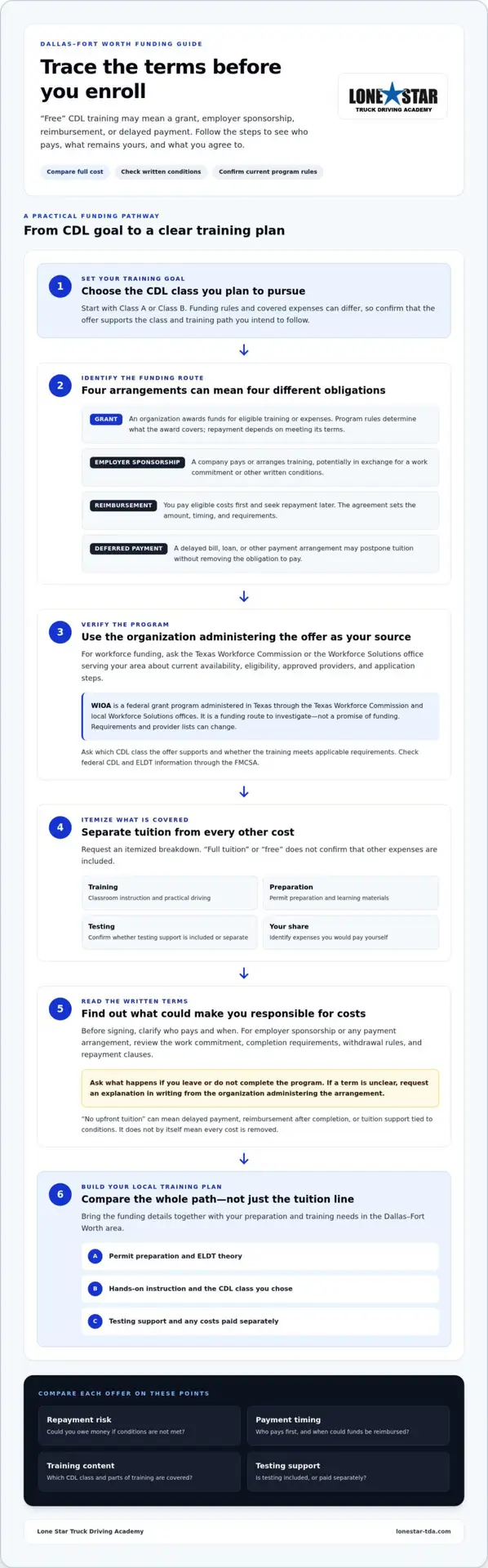
Funding research is easier when you start with the license you want, then look for programs that may support it. Use this sequence to keep your search focused, whether you’re searching for free CDL training Dallas drivers often look into, or exploring options in Mansfield, Fort Worth, or elsewhere in the area.
- Choose your CDL class. Decide whether you’re planning for Class A or Class B training. The class affects which program to look for and which funding requirements may apply.
- Identify current funding routes. Contact the organization administering a grant or workforce program, or review the written terms of an employer offer. Confirm current eligibility, application steps, deadlines, and whether the training provider is approved for that program.
- Record the details. For each option, note covered expenses, payment timing, repayment conditions, and the expected response timeline. Gather identification, education, or employment records only if the program requests them. Paperwork requirements can differ.
- Compare before accepting. Put the funding terms beside the training plan. Understand what happens if you withdraw, don’t complete training, or don’t meet a stated condition. Keep copies of the offer, application, and eligibility decision.
Build a personal CDL training and funding checklist
Make a checklist for each funding route. Include the CDL class, program contact, eligibility requirements, application steps, covered expenses, and expected response timeline. Add questions about unclear terms. Comparing these details side by side is more useful than relying on a headline such as “tuition covered.”
Permit preparation is a separate milestone to include in your plan. CDL permit preparation can help you organize the knowledge-test stage. Funding eligibility and payment are determined separately by the relevant program or agreement.
Confirm the route from training to testing
Map the process as distinct steps: permit preparation, ELDT theory, practical driving instruction, and the skills test. Identify which steps the training includes and which the funding arrangement pays for. Testing arrangements vary, so don’t assume an offer includes an exam or test appointment.
Before committing, clarify how testing is handled and who arranges it. Third-party CDL testing is separate from instruction and permit preparation. Knowing the difference helps you plan for the full licensing process rather than focusing only on getting into a training program.
A written checklist turns a confusing funding search into a series of manageable decisions. Compare the actual terms, then choose a training plan that fits your CDL class and prepares you for each stage.
To get started, discuss your CDL training plan with admissions professionals at Lone Star Truck Driving Academy.
Start Your Dallas-Area CDL Training Plan with Lone Star
After weighing your options, focus on the kind of driving you want to prepare for and the skills you’ll need to build. Lone Star Truck Driving Academy provides Class A and Class B CDL training, ELDT theory certification, permit preparation, and authorized on-site third-party testing. A well-planned route connects these steps and makes room to develop safe habits, sound judgment, and professional conduct behind the wheel.
If you’re researching free CDL training Dallas options, keep funding and training decisions separate. The organization offering funding sets its own terms. Your training plan should reflect your CDL goal, schedule, and preparation needs.
Match your training plan to your CDL goal
Decide whether Class A or Class B training fits the commercial vehicles and work you’re considering. For more context on the Class A path, explore the Class A CDL training program. Consider transmission type, too. Manual transmission experience may matter for the driving roles you’re pursuing, so understand how the training vehicle relates to your goals.
Endorsements may also matter, depending on the work and vehicles you have in mind. Include them in your longer-term plan and account for any additional study or testing they may involve. Permit preparation and ELDT theory build foundational knowledge, while practical instruction develops vehicle-control skills and safe decision-making.
Discuss your next step with the academy
Working adults often need to balance training with jobs, family responsibilities, and transportation. Before starting, make a realistic plan for attending instruction and practicing what you learn. Lone Star Truck Driving Academy serves students in Dallas, Mansfield, Fort Worth, Arlington, Denton, Greensboro, High Point, Winston-Salem, and Burlington. Students in these communities can discuss their CDL goals and enrollment questions with the academy.
The academy provides authorized on-site third-party testing, a separate step from instruction. Including testing in your plan can help you prepare for the transition from training to assessment. Training does not guarantee employment or a particular licensing result, but careful preparation supports a more informed, professional approach to the process.
Bring your questions and goals to the conversation, then build a plan that supports steady progress and safe driving habits.
Contact Lone Star Truck Driving Academy
Turn Your CDL Goal into a Practical Plan
A CDL can lead to different kinds of work, but the right direction depends on what you want from the role: the vehicles you hope to operate, the responsibilities you’re ready to take on, and how driving fits your life outside work. Think beyond the license itself. Knowing your priorities can help you choose a path you can commit to and develop the habits that matter behind the wheel.
If free CDL training Dallas is part of your search, let affordability inform your decision without making it the only measure of fit. Training also helps you prepare to operate professionally, build sound safety habits, and understand the expectations of commercial driving.
Your next step doesn’t need to answer every career question. It can help you move from considering the possibility to making an informed choice about training.
Take the next step at a pace that works for you, keeping your long-term goals in view as you build your skills.
Frequently Asked Questions
Is free CDL training available in Dallas?
Some applicants may find support that reduces their personal training expense, but it isn’t a universal option. If you’re considering free CDL training Dallas, contact the funding organization early and ask when it expects to make decisions. Timing matters when you’re coordinating a start date, childcare, transportation, or time away from work. Avoid major schedule changes until you have a clear decision and understand what it means for your plans.
Can I get WIOA funding for CDL training in Dallas?
WIOA may be worth exploring. Start by identifying the Workforce Solutions office that serves your area, then ask about current CDL funding requirements and the next step for applicants. If an appointment or intake process applies, find out how to schedule it and what to expect. Use current office guidance rather than an old checklist or another person’s experience.
Does employer-sponsored CDL training have to be repaid?
There isn’t one answer for every employer arrangement. Before accepting, read the training agreement alongside any employment offer so you can see how the commitments fit together. Keep a copy of the final documents and note any dates or actions you’re responsible for. Ask the organization offering the arrangement to explain unclear clauses before you sign.
What does free CDL training usually cover?
There’s no standard package, so use the course description and schedule to understand what instruction is planned. Look for the CDL class, theory component, and practical driving portion. Then compare those details with the preparation you need. If a course description uses broad terms such as “complete training,” ask the administrator what that includes before making enrollment plans.
Can I get CDL training without paying anything upfront?
Some arrangements may let you begin training before making an initial payment, but that doesn’t show what your budget may need to cover later. Ask for the payment schedule and note when each payment or reimbursement is expected. Compare those dates with your income and expenses. A clear calendar can help you identify a cash-flow gap before it affects your ability to continue training.
How do I find CDL funding near Dallas, Mansfield, or Fort Worth?
Start with the workforce organization serving your home address, since the office responsible for your inquiry may depend on where you live. If you’re unsure which office to approach, provide your ZIP code and ask where to direct your question. Keep brief notes on who you spoke with and any next steps. That makes it easier to follow up without restarting your search.
Does Lone Star Truck Driving Academy provide job placement after CDL training?
Lone Star Truck Driving Academy provides CDL training and licensing-related preparation. Training does not guarantee job placement. After training, review job postings and compare their stated qualifications with your experience, CDL class, and any endorsements you pursue. Employers set their own hiring criteria, so treat career research as a separate step in your plan.
Article by
Lone Star Truck Driving Academy Training Team
Lone Star Truck Driving Academy provides CDL training for students throughout Texas and North Carolina. Our training team specializes in Class A CDL training, Class B CDL training, CDL refresher programs, automatic restriction removal, third-party testing support, and workforce development partnerships designed to help students build successful careers in the transportation industry.
Training Information Notice
The information provided in this article is for general educational purposes only. Program availability, tuition, licensing requirements, testing procedures, endorsement requirements, and regulatory standards may change over time. Prospective students should contact Lone Star Truck Driving Academy directly to verify current program details, admissions requirements, and state-specific CDL regulations.