
You shouldn’t have to wait months for a Texas DPS appointment just to prove you are ready to start a new career. For many people searching for cdl training plano tx, the biggest hurdle isn’t learning to double-clutch or back up a trailer; it’s the administrative red tape and the massive backlogs at North Texas testing sites. It’s discouraging to feel like your professional growth is stuck in neutral while you wait for a testing date to open up.
I know the process feels complicated, especially with the June 2026 shift to English-only knowledge exams and the federal ELDT requirements. You need a clear, reliable path to your Class A or B license that doesn’t involve guesswork. This guide provides a direct roadmap to mastering the Texas CDL process, from permit preparation to the final skills test. We will look at how to find a school in the DFW area, such as Lone Star Truck Driving Academy, that offers authorized third-party testing. By testing where you train, you can bypass the DPS lines and move into a high-paying driving role much faster.
Key Takeaways
- Discover why the DFW logistics corridor makes Plano a prime location for launching a stable and rewarding trucking career.
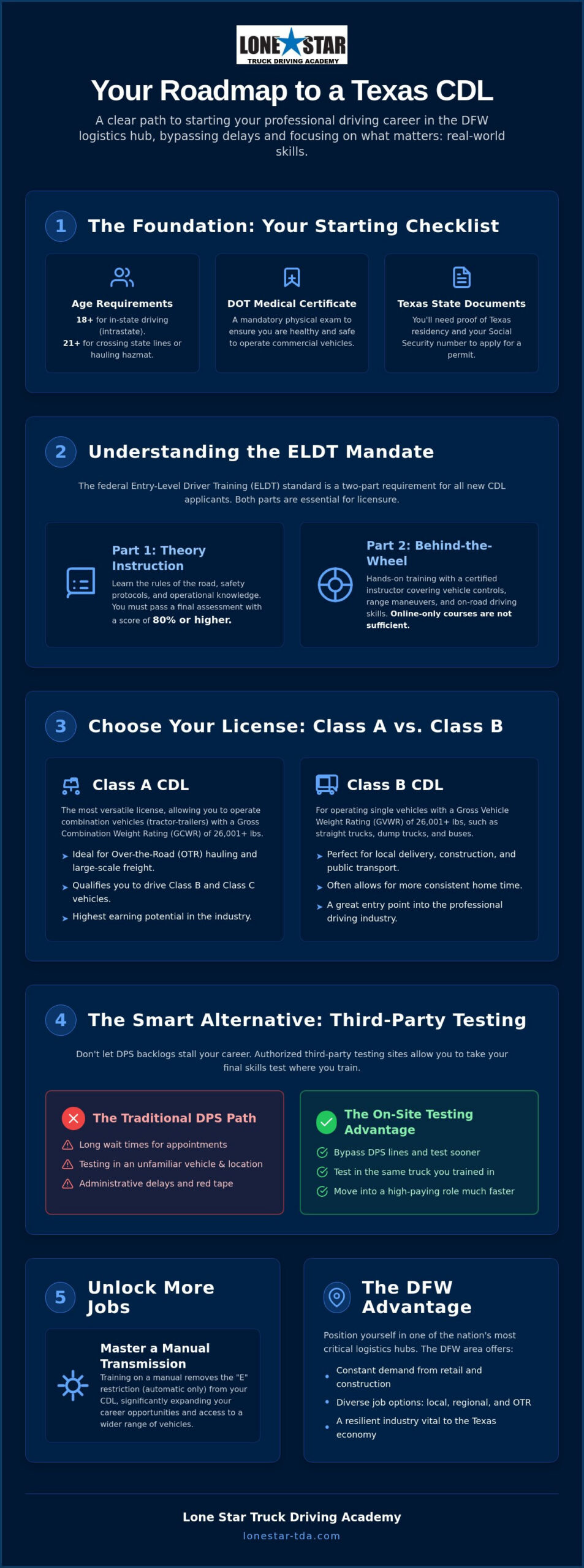
- Understand the mandatory ELDT requirements and the two-part process of theory certification and behind-the-wheel training.
- Compare Class A and Class B licenses to determine which vehicle weight ratings and career paths align with your professional goals.
- Learn how to bypass state-level bottlenecks by choosing cdl training plano tx that offers authorized on-site third-party skills testing.
- Explore how mastering a manual transmission can remove restrictive endorsements and open up a wider range of job opportunities.
Launching Your Trucking Career in the Plano and DFW Hub
North Texas serves as the heartbeat of the American supply chain. If you’ve spent any time driving through Collin County, you’ve seen the constant flow of freight moving along US-75 and the President George Bush Turnpike. This isn’t just traffic; it’s the engine of a massive regional economy. Choosing to pursue cdl training plano tx means positioning yourself at the center of one of the nation’s most critical logistics corridors. For Texas residents, earning a Commercial Driver’s License (CDL) provides a career path that remains remarkably stable, even when other sectors of the economy fluctuate. People always need food, fuel, and building materials, and in a fast-growing city like Plano, those needs only increase.
Modern truck driving is shifting away from the old “sink or swim” mentality. Today, the best programs focus on professional mentorship rather than just teaching you how to pass a test. You’re not just learning to steer a big rig; you’re preparing to manage a sophisticated piece of machinery while maintaining the highest safety standards. This transition into a professional driving career offers a sense of purpose and reliability that is hard to find elsewhere.
The Economic Impact of Trucking in North Texas
Plano sits in a strategic “sweet spot” within the DFW metroplex. Its proximity to major distribution centers for retail giants and construction suppliers creates a constant demand for qualified drivers. Whether you’re interested in local delivery routes that get you home every night or high-paying over-the-road (OTR) hauls, the opportunities here are diverse. The variety of industries needing drivers is vast. You might find yourself hauling consumer electronics for a tech firm one week and specialized equipment for a new housing development the next. This diversity is what makes the industry in North Texas so resilient.
Why “Local” Training Matters More Than Ever
Driving a commercial vehicle in the DFW area requires a specific set of skills. Navigating the complex interchanges of 635 or the tight service roads in downtown Dallas isn’t something you can learn from a textbook. Local training allows you to practice in the same environments where you’ll actually be working. It also gives you the chance to build a network with carriers that specifically hire from the Plano area. At Lone Star Truck Driving Academy, we emphasize this real-world preparation. We understand that your goal isn’t just to hold a piece of plastic; it’s to start a career with the confidence that you can handle North Texas roads safely and professionally from day one.
Navigating Texas CDL Requirements and ELDT Standards
Starting your journey toward a professional license involves meeting both state and federal rules. In Texas, you must be at least 18 years old to drive within state lines or 21 to cross into other states or haul hazardous materials. Before you even touch a steering wheel, you’ll need a DOT medical examiner’s certificate. This physical exam ensures you are healthy enough to operate heavy machinery safely and is a foundational step every driver must complete before applying for their permit at the DPS. It’s a straightforward checkup, but it’s the gatekeeper to your new career.
The process is more than just a physical exam; it’s a structured path designed to ensure safety on our highways. You’ll need to provide proof of Texas residency and social security, alongside your medical card, to begin the application process. Understanding these administrative steps early prevents delays later when you are ready to start your cdl training plano tx. Having your paperwork in order allows you to focus on the actual skill of driving rather than worrying about missing documents.
The ELDT Mandate: What You Need to Know in 2026
Since 2022, the federal government has required all new applicants to meet specific ELDT Standards. This training is divided into two distinct parts: theory instruction and behind-the-wheel practice. You must complete the theory portion and pass an assessment with at least an 80 percent score before you can sit for your final road test. While some try to piecemeal this together, Lone Star Truck Driving Academy simplifies the process by offering integrated ELDT theory certification. It’s important to remember that online-only courses are never enough on their own. You still need documented hours behind the wheel with a certified instructor to meet the full federal mandate and demonstrate your proficiency in the yard.
From Permit to License: The Texas Step-by-Step
Obtaining your Commercial Learner’s Permit (CLP) is the essential first step for any road training. To get it, you’ll visit a Texas DPS office to pass a series of knowledge tests, including the 20-question Texas Commercial Rules Test. As of June 1, 2026, these exams are administered exclusively in English to align with federal proficiency standards. Many beginners find this part of the process to be the most intimidating hurdle because of the technical language involved. Once you have your CLP in hand, Texas law requires you to hold it for at least 14 days before you are eligible to take the final skills exam. This waiting period is the perfect time to get hands-on experience in the truck. If you feel overwhelmed by the requirements, reaching out to a training advisor can help clear up the confusion and keep your progress on track.
Choosing Between Class A and Class B CDL Training
One of the first questions I get from prospective students looking for cdl training plano tx is whether they should go for a Class A or a Class B license. The answer depends on your long-term goals and the type of equipment you want to handle. The main difference lies in the Gross Vehicle Weight Rating (GVWR). A Class A license allows you to operate any combination of vehicles with a GCWR of 26,001 pounds or more, provided the towed vehicle weighs more than 10,000 pounds. This distinction is what separates the long-haul tractor-trailers from smaller local delivery trucks.
Choosing the right path early saves you time and money. While both licenses offer stable career paths in the DFW hub, the Class A license is generally considered more versatile. It’s the foundation for a wide range of specialized roles, including the growing niche of hot shot driving. Hot shot drivers typically use heavy-duty pickups to pull flatbed trailers; because these setups often exceed the 10,000-pound trailer threshold, a Class A license is usually required to stay legal on Texas roads.
The Class A “Master” License
This is often called the “universal” license in the trucking industry. With a Class A, you can drive tractor-trailers, tankers, and flatbeds. It offers the most flexibility because a Class A holder can typically operate Class B vehicles as well. If you want to maximize your career options and have the ability to haul dry van, refrigerated loads, or specialized flatbed freight, Class A CDL training is the industry gold standard. It prepares you for the widest variety of jobs, from long-haul interstate routes to regional distribution centers in Mansfield and Fort Worth.
Class B Opportunities in Plano
For those who prefer to stay local and be home every night, Class B training is an excellent choice. This license is for single vehicles with a GVWR of 26,001 pounds or more, or such a vehicle towing a trailer that does not exceed 10,000 pounds. In the Plano and DFW area, Class B drivers are in high demand for vocational roles such as:
- Dump trucks and cement mixers for local construction projects
- Large straight trucks for retail delivery
- Public transit and school buses
- Waste management and utility vehicles
Understanding the official Texas CDL requirements for each class is vital before you enroll in a program. Starting with the class that fits your desired lifestyle ensures you don’t have to return to school later to upgrade your license when a new opportunity arises. Whether you want the freedom of the open road or the consistency of a local route, the right training provides the steady foundation you need for a successful transition.
The Advantage of Third-Party and On-Site Testing
The biggest obstacle many students face isn’t the difficulty of the maneuvers; it’s the calendar. The “DPS Bottleneck” is a well-known reality in North Texas. Waiting for a state-run testing appointment at a local DPS office can often take months. This delay can derail your momentum and keep you out of the workforce when you are already prepared to start driving. Choosing a school that offers cdl training plano tx with integrated testing options is the most effective way to protect your professional timeline.
Third-Party Skills Testing (TPST) is a fully legal and state-authorized alternative to testing at a government facility. Texas allows certified organizations to administer the same rigorous road exam you would receive at the DPS. There is also a significant psychological advantage to this approach. You get to perform your exam in the same yard where you practiced and in the same truck you used during your training hours. This familiarity reduces test-day anxiety and allows you to focus entirely on demonstrating your skills rather than adjusting to a new vehicle or a foreign environment.
Skip the Lines with On-Site Testing
Lone Star Truck Driving Academy operates as an authorized third-party testing site. This means we can schedule your road exam shortly after you complete your required training and meet the 14-day CLP holding period. We provide the trucks for your exam, ensuring you are testing in equipment that is well-maintained and familiar to you. On-site testing can save a student between 4 and 8 weeks of waiting for a state appointment, allowing you to transition into your new career without unnecessary delays.
What to Expect During the CDL Road Test
The road exam is a comprehensive evaluation divided into three critical phases. You’ll start with the pre-trip inspection, where you must demonstrate a thorough understanding of the vehicle’s safety components. This is followed by the basic control skills portion, which includes specific backing maneuvers and docking. Finally, you’ll head out for the road driving phase. Our instructors focus on the exact maneuvers required for success, practicing on familiar Plano-area routes that mirror the conditions of the actual test. We make sure you aren’t surprised by the road conditions or the expectations of the examiner. If you want to secure a testing date that fits your schedule, reach out to our team today to learn more about our upcoming testing availability.
Specialized Training: Removing Restrictions and Hot Shot Driving
Earning your license is a major milestone, but the specific endorsements and restrictions on that license determine your actual market value. Many students who complete their initial cdl training plano tx in an automatic truck unknowingly walk into the “Automatic Transmission Restriction” trap. This is officially known as the E-restriction, and it legally prevents you from driving any commercial vehicle equipped with a manual transmission. In a competitive job market, this restriction can be a significant hurdle because it limits you to only a portion of a company’s fleet. Many specialized heavy-haul carriers still prefer manual transmissions for the control they provide on difficult grades or with oversized loads.
Beyond the transmission, you might also consider the entrepreneurial side of the industry. If you have been away from the driver’s seat for a while, jumping back into a full-sized rig can be intimidating. A CDL refresher course provides the supervised practice needed to polish your skills and learn current safety regulations. These specialized training paths ensure that your license remains a versatile tool for your professional growth rather than a document that limits your options.
Manual vs. Automatic: Unlocking Your Full Potential
Removing the E-restriction is about unlocking your full potential as a driver and making yourself more employable. While many modern interstate fleets have moved toward automatic trucks, the ability to drive a manual remains a highly valued skill in vocational trucking and heavy equipment transport. Our automatic restriction removal service allows you to train specifically on a manual gearbox and re-test to lift the restriction. Once you demonstrate proficiency, you are legally cleared to drive 100 percent of the commercial vehicles in your class, giving you maximum flexibility when choosing an employer.
Starting a Hot Shot Business in Texas
Hot shot trucking is a rapidly growing niche that appeals to independent-minded drivers in the DFW area. This type of hauling typically involves using a one-ton pickup truck and a flatbed trailer to deliver smaller, time-sensitive loads. It is an excellent path for Plano residents who want to start their own business without the massive overhead of a full tractor-trailer setup. However, because the combined weight of the truck and trailer often exceeds 26,000 pounds, you still need a Class A license. Specialized hot shot driver training focuses on the unique handling characteristics of these smaller combinations and the specific cargo securement rules for flatbeds. At Lone Star Truck Driving Academy, we focus on providing the practical, hands-on knowledge you need to handle these specialized roles with professionalism and safety.
Secure Your Future in the Texas Trucking Industry
Earning your commercial license is a significant life transition that requires a steady and reliable partner. By understanding the federal ELDT requirements and choosing the license class that aligns with your professional goals, you’ve already completed the most important planning steps. Now, it’s about taking action. Finding quality cdl training plano tx means more than just learning to shift gears; it’s about bypassing the long DPS wait times through authorized on-site third-party testing and learning from experienced Texas instructors who understand the unique challenges of our local roads.
Whether you’re pursuing a Class A career, exploring the entrepreneurial side of hot shot trucking, or removing a restrictive endorsement, the path forward is clearly defined. We provide flexible training for working adults, ensuring that your education fits into your busy life while maintaining high professional standards. You have the roadmap to success. Now, it’s time to get behind the wheel and start your journey toward a stable and rewarding career. Start Your Career at Lone Star Truck Driving Academy Today and take the first step toward your new professional identity. We look forward to seeing you in the yard.
Frequently Asked Questions
How long does it take to get a CDL in Plano, TX?
Most students complete their cdl training plano tx in three to seven weeks, depending on whether they choose a full-time or part-time schedule. You must hold your Commercial Learner’s Permit (CLP) for at least 14 days before you are eligible to take the final skills test. This period ensures you have enough time to demonstrate proficiency in both the yard and on the road.
Can I take my CDL road test at Lone Star instead of the DPS?
Yes, Lone Star Truck Driving Academy is an authorized third-party testing site. This allows you to take your road test on-site rather than waiting months for an appointment at a Texas DPS office. Testing in a familiar environment with the same trucks you used during training can significantly reduce test-day anxiety and help you get into the workforce faster.
What is the difference between Class A and Class B CDL training?
Class A training is required for combination vehicles where the towed unit weighs more than 10,000 pounds, such as tractor-trailers. Class B training is for single vehicles like dump trucks, buses, or straight trucks. While Class A offers the most career flexibility across the DFW area, Class B is a great choice for drivers who prefer local routes and vocational roles.
Do I need to know how to drive a manual transmission to get my CDL?
You aren’t required to learn a manual transmission, but testing in an automatic truck will result in an “E” restriction on your license. This restriction prevents you from legally operating manual fleet vehicles. Many students choose to learn manual shifting during their cdl training plano tx to ensure they have the most job opportunities available with specialized carriers.
What are the ELDT requirements for Texas drivers in 2026?
All new applicants must complete Entry-Level Driver Training (ELDT) from a provider listed on the FMCSA’s Training Provider Registry. This mandate includes both a theory certification and documented behind-the-wheel training. Additionally, as of June 1, 2026, the Texas DPS administers all knowledge exams exclusively in English to meet federal proficiency standards for commercial drivers.
How much does CDL school cost in the Dallas-Fort Worth area?
Tuition for CDL programs in the DFW metroplex typically ranges from $2,300 to over $8,000 depending on the school and the length of the course. Some programs offer shorter, specialized training, while others provide comprehensive 200-hour courses. It is important to find a program that includes ELDT theory and permit preparation to avoid hidden costs later in the process.
Are there weekend CDL classes available for working adults?
Yes, many training providers offer weekend schedules to accommodate students who are working full-time while they transition into a new career. These flexible programs allow you to complete your hours in the yard and on the road without sacrificing your current income. This is a popular option for residents in Dallas, Mansfield, and Fort Worth who need a manageable training pace.
What happens if I fail my CDL permit test the first time?
If you don’t pass a knowledge test on your first attempt, you are allowed to retake it. The Texas DPS generally permits three attempts for each exam within a 90-day window before a new application fee is required. We focus on thorough permit preparation to help you pass on your first try, ensuring your training stays on schedule without administrative delays.
Article by
Lone Star Truck Driving Academy Training Team
Lone Star Truck Driving Academy provides CDL training for students throughout Texas and North Carolina. Our training team specializes in Class A CDL training, Class B CDL training, CDL refresher programs, automatic restriction removal, third-party testing support, and workforce development partnerships designed to help students build successful careers in the transportation industry.
Training Information Notice
The information provided in this article is for general educational purposes only. Program availability, tuition, licensing requirements, testing procedures, endorsement requirements, and regulatory standards may change over time. Prospective students should contact Lone Star Truck Driving Academy directly to verify current program details, admissions requirements, and state-specific CDL regulations.