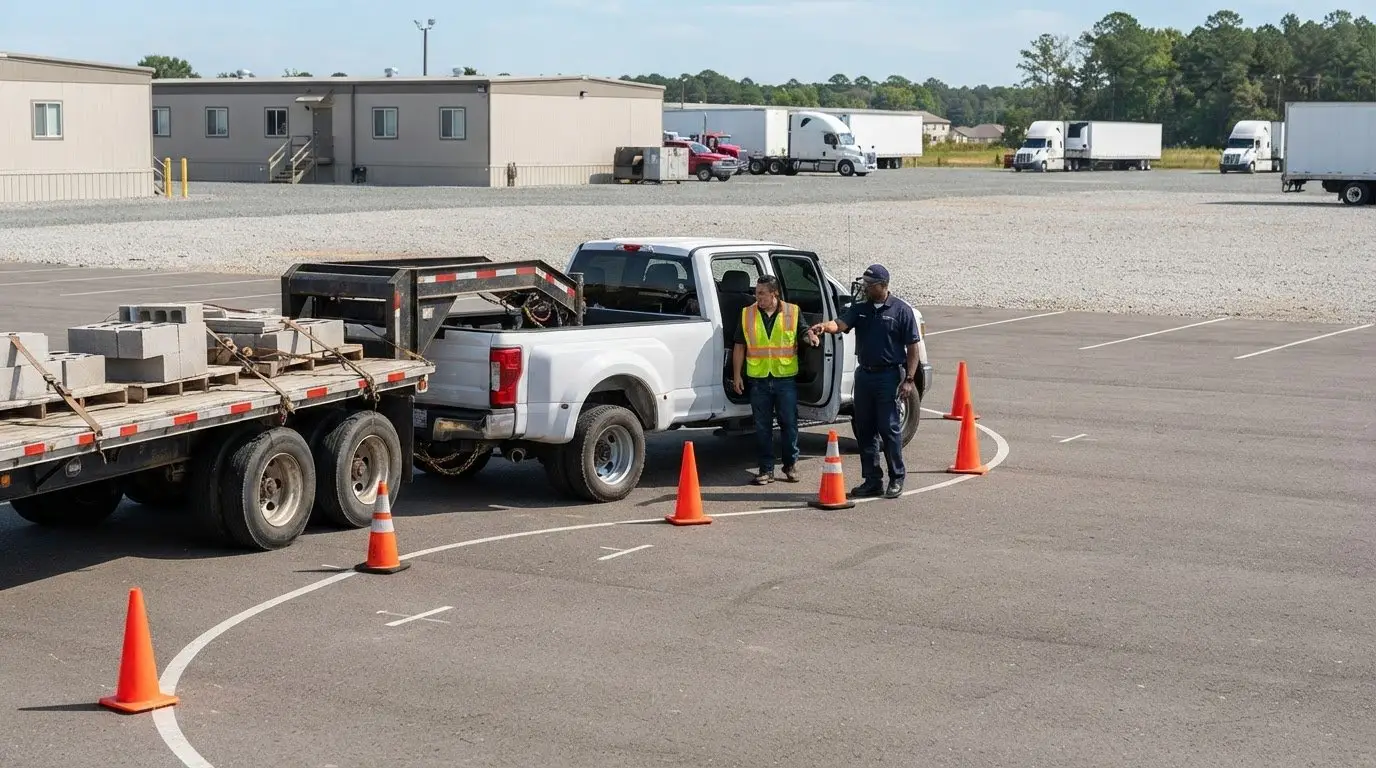
A dually’s size doesn’t guarantee an easy tow. When driving a dually with a gooseneck trailer, confidence comes from understanding the truck and trailer ratings, setting up the hitch and load correctly, and leaving room to maneuver. If turning, managing blind spots, or backing feels unfamiliar, that’s normal. A consistent routine makes each task easier to assess.
This guide covers how to check your combination before driving and build a repeatable routine for inspections, turns, stopping, and backing. It also explains why commercial use and vehicle ratings matter when you’re considering CDL requirements. Requirements depend on the details of your setup and how you use it, so use current Texas DPS and federal FMCSA guidance rather than relying on a general rule. Start with the ratings, prepare the equipment, then practice each maneuver deliberately.
Key Takeaways
- Driving a dually with a gooseneck trailer takes more than a capable truck; the full setup and how you use it matter.
- Learn how trailer length and axle position affect turns, and adjust your mirrors to improve awareness.
- Compare dually and single-rear-wheel trucks by their ratings, the load, driving conditions, and everyday needs.
- Use a consistent pre-trip routine to check the connection, safety equipment, tires, lights, and trailer brakes.
- Build confidence through deliberate maneuvering practice and training that fits your commercial driving goals.
What Makes Driving a Dually with a Gooseneck Trailer Different?
A dually is a pickup with two rear wheels on each side of its rear axle. Those extra tires widen the truck’s rear footprint, but they don’t establish whether it’s suited to a particular trailer. Driving a dually with a gooseneck trailer means managing the entire combination: truck, hitch, trailer, and load. Each part needs to work with the others, and the equipment ratings help define those limits.
A gooseneck trailer connects to a ball hitch mounted in the pickup’s bed, rather than to a hitch behind the bumper. This connection uses space in the bed, so the setup involves bed space and turning clearance as well as trailer length, loaded weight, and visibility. Don’t judge a setup by the truck’s size or number of rear tires. First identify the ratings and connection requirements for the specific equipment.
How the gooseneck connection changes the setup
The bed-mounted ball and coupler must be compatible and securely connected. Because the connection sits in the bed, the trailer’s front section moves in relation to the truck as you turn. Check the truck, hitch, and trailer documentation for compatible ratings and installation requirements. Also consider how the tailgate, bed equipment, and trailer overhang interact. The fit depends on the particular truck and trailer.
Check clearance before pulling away. Make sure the trailer can articulate through turns without contacting the cab, bed rails, or other parts of the truck. Don’t rely on a general rule based on bed length, because configurations vary. Use the manufacturers’ instructions to assess fit, and take extra care when turning sharply or maneuvering in a confined area.
Which vehicle and trailer ratings matter?
GVWR, or Gross Vehicle Weight Rating, is the manufacturer’s maximum allowable loaded weight for an individual vehicle. GCWR, or Gross Combination Weight Rating, is the manufacturer’s maximum allowable weight for the truck and trailer combination. These ratings describe limits. They don’t mean every truck can safely tow every trailer that appears to fall below a particular number.
The trailer’s loaded weight matters, as does the portion of its load carried by the truck, which affects the truck’s payload. Passengers, cargo, and equipment also use payload capacity. Review the labels and documentation for the truck, trailer, and hitch, then compare the relevant limits across the entire setup. Don’t use a rough estimate of today’s load instead of checking the manufacturer’s ratings.
Use this document check before choosing or loading a combination:
- Truck: Find its GVWR, GCWR, and payload information in the manufacturer’s materials.
- Trailer: Review its rating and loading instructions, then account for the equipment and cargo you plan to carry.
- Hitch: Confirm its rating and compatibility with both the truck and trailer.
Dual rear wheels don’t remove any of these limits. They’re one part of the truck’s configuration, not a substitute for checking the full setup. Resolve unclear rating or compatibility details using the manufacturer’s documentation before loading and driving.
How the Dually and Gooseneck Combination Handles on the Road
A dually may feel stable, but the trailer still changes how the whole rig responds. Its length and axle position affect the path it follows behind the truck, especially in turns. A loaded trailer also adds momentum, so acceleration, braking, and steering call for smooth, deliberate inputs. Give yourself time to read the road and avoid abrupt corrections.
Keep this principle in mind: A dually may add stability, but it doesn’t eliminate the need for careful speed, generous following space, and deliberate control.
Plan turns, lane changes, and stopping distance
Set up turns early. A trailer’s wheels track inside the truck’s path, so a turn that clears the curb with the pickup may bring the trailer close to it. Check the space around you, signal, and make a controlled turn that gives the trailer room to follow. Avoid swinging into another lane without checking for traffic and obstacles.
Leave room to slow down. A heavier loaded combination takes more effort to bring under control, and wet, uneven, or congested roads call for extra caution. Keep enough following space to respond, and increase it when visibility or traction is reduced. Accelerate and brake gradually to limit abrupt movement through the combination.
Lane changes also take planning. Check your mirrors, signal, and confirm the truck and trailer have enough room before moving over. Avoid quick steering inputs, especially when traffic is close or the lane narrows. If you can’t confirm there’s space, wait for a safer opening.
Use mirrors to manage blind spots
The trailer may block much of the view directly behind the truck. Adjust both mirrors before moving so you can monitor the trailer’s sides and see nearby traffic as clearly as possible. Mirror views vary by vehicle, so learn what each one shows with your setup. Don’t depend on a single mirror or check only when changing lanes.
Build a steady scan: look ahead, check each mirror, and return your attention to the road. If a vehicle disappears from one mirror, don’t assume it has cleared the combination. Check the other view and make a safe decision before changing position.
A spotter can help you judge clearance in a tight yard, driveway, or loading area. Agree on clear signals before moving, keep the spotter in view, and stop if you lose sight of them. A spotter is an extra set of eyes, not a replacement for checking your own surroundings.
Practice these habits in an open, low-traffic area before handling tighter turns or busy roads. Focus on how the trailer tracks, how much space the combination needs, and what your mirrors reveal. Consistent scanning and smooth inputs make the rig more predictable. Patience gives you time to respond when conditions change.
Dually vs. Single-Rear-Wheel Trucks: Choose by the Whole Setup
A dually has two rear wheels on each side; a single-rear-wheel truck has one. That difference can matter for some heavy-duty towing applications, but it doesn’t determine whether a truck is a suitable match for a particular gooseneck trailer. The right choice depends on the truck’s documented ratings, the trailer and its loaded weight, how you’ll use the combination, and the conditions it will encounter.
Compare the entire setup instead of choosing by appearance or assuming more tires automatically mean a safer or compliant combination. Neither configuration is right for every trailer or driver.
| Factor | Dually | Single-rear-wheel truck |
|---|---|---|
| Intended use | May suit some heavy-duty towing applications. | May suit a different mix of towing and everyday driving needs. |
| Ratings | Must meet the documented limits for the truck, hitch, trailer, and combination. | Must meet the documented limits for the same equipment. |
| Daily considerations | Consider the truck’s overall size and how it fits your regular driving and parking. | Consider its fit for the trailer and the driving tasks you expect. |
When a dually may fit the work
Drivers may consider dual rear wheels for towing work that calls for a heavy-duty setup. Still, wheel configuration alone doesn’t establish how much a specific truck can handle. Use the manufacturer documentation, along with the hitch and trailer information, to evaluate the match. If you’re exploring commercial hot shot work, hot shot driver training at Lone Star Truck Driving Academy can help you prepare for the driving skills involved.
Why a single-rear-wheel truck is not a shortcut
A single-rear-wheel truck isn’t automatically unsuitable, just as a dually isn’t automatically suitable. The answer depends on the exact truck, trailer, load, and intended use. Don’t rely on looks or a general rule of thumb. Check the manufacturer documentation for each part of the combination and review the requirements that apply to how and where you’ll operate.
Before committing to either setup, write down the truck, hitch, and trailer ratings and compare them with the planned load and use. Ratings describe limits; they aren’t replaced by choosing a truck with an extra pair of rear wheels. For commercial operation, licensing and other requirements can depend on the combination and circumstances of use. Review current official guidance for your situation.
In practical terms, the best truck is the one whose documented ratings fit the trailer and load, whose setup suits the operating conditions, and whose size and configuration you can manage confidently. Evaluate those factors together before towing.
Follow a Safe Setup and Driving Routine Before Every Trip
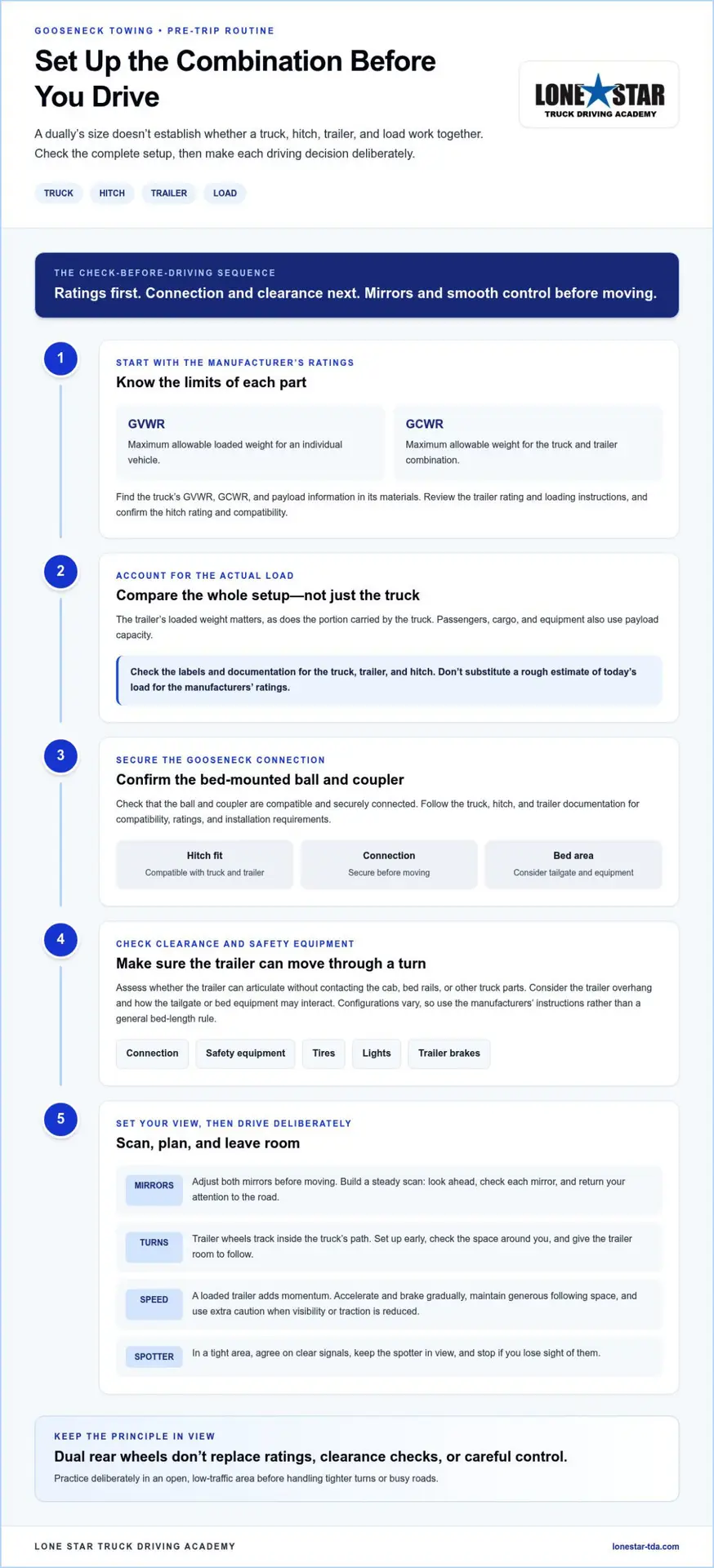
A reliable routine helps catch problems before they become road hazards. Use the sequence below as a learning guide, not a replacement for the truck, hitch, and trailer manufacturers’ instructions. Follow the procedures for your specific equipment, and don’t tow if a connection or safety item is unclear.
- Review the ratings. Check the truck, hitch, and trailer documentation against the planned load and intended use. Confirm the combination fits the documented limits before loading or departing.
- Inspect the equipment. Look over the hitch components, coupler, safety chains, electrical connector, tires, lights, and trailer brakes. Check for visible damage or wear, and follow the manufacturers’ instructions for any required inspection or adjustment.
- Connect the trailer. Position the truck and trailer carefully, engage the coupler with the hitch as directed, and secure the connection. Attach the safety chains and connect the electrical plug according to the equipment instructions.
- Verify before moving. Confirm the hitch is engaged and secured, the chains are attached, and the electrical connection is seated. Check that the lights work and that the trailer brakes respond as intended, using the method specified for your setup.
- Move deliberately. Begin with a controlled check of the combination’s response. Use smooth steering, acceleration, and braking, and stop if you notice an unusual sound, movement, warning, or connection issue.
Driving a dually with a gooseneck trailer safely also means knowing when to pause. A rushed departure can turn a missed connection or equipment concern into a more serious problem. If conditions change or something doesn’t feel right, find a safe place to stop and reassess rather than continuing by guesswork.
Practice backing and low-speed maneuvers
Choose a spacious, controlled area away from traffic and obstacles. Start with low-speed movements and small steering corrections. The trailer responds differently from the truck alone, and overcorrecting can make positioning harder. Pause to reassess whenever you lose a clear view or feel uncertain. A spotter can help in tight spaces, but keep them in sight and stop if you can’t.
Check Texas and federal requirements for your use
Licensing questions can depend on vehicle ratings, the complete combination, and whether the driving is personal or commercial. Don’t make a decision based only on the truck’s appearance. Review current guidance from the Texas Department of Public Safety and the Federal Motor Carrier Safety Administration for your specific circumstances. For structured commercial-driver preparation, Class A CDL training at Lone Star Truck Driving Academy builds practical driving skills.
Rules and interpretations can change, so rely on official sources rather than a general rule of thumb. Keep the ratings and intended use of your combination in view as you determine which requirements apply.
Commercial driver preparation can include permit study, practical driving skills, and an understanding of the requirements that apply to the work you’re considering.
Build Confidence with Gooseneck Driving Skills and the Right Training
Experience grows through steady practice and clear goals. Commercial drivers need sound habits, an understanding of the requirements that apply to their plans, and a clear sense of where they need more preparation. Personal towing experience can be useful, but it doesn’t cover every skill involved in commercial driving.
Structured training provides a way to develop driving skills and prepare for next steps without promising a particular licensing or career outcome. Start by identifying the kind of vehicle and work you’re considering, then focus your learning accordingly.
Choose preparation that matches your driving goal
If you’re pursuing commercial driving, Class A CDL training may fit your goals; CDL B training may suit a different vehicle or career path. Lone Star Truck Driving Academy provides ELDT theory certification and permit preparation. As you plan, consider whether the work you want involves a manual transmission or endorsements, and review current requirements for your situation.
For drivers exploring hot shot work, the academy provides hot shot driver training. Authorized on-site third-party testing is also available. These options support commercial driving preparation and help you plan possible next steps. Career opportunities and licensing outcomes depend on individual circumstances and applicable requirements. “The Ultimate Guide to CDL A Training Programs in 2026” can also help you think through your training path.
Take the next step toward practical driver preparation
Before choosing a direction, take stock of your experience and the type of driving you hope to do. You may be comfortable on the road but want more experience with a commercial vehicle, or you may need to begin with permit preparation and theory.
Lone Star Truck Driving Academy serves learners in Dallas, Mansfield, Fort Worth, Arlington, Denton, Greensboro, High Point, Winston-Salem, and Burlington. Training focuses on practical skills and preparation for understanding applicable requirements. It does not guarantee a license or a particular job. Choose a path that fits your goals and gives you room to develop as a safe, professional driver.
Training options include Class A and Class B programs, refresher courses, permit preparation, and specialized driver training.
Take Your Next Step with a Clear Plan
Your next step starts with a decision: what do you want to do with your driving skills? You may be preparing for occasional personal hauling or considering a future in commercial driving. Naming that goal can help you focus your time and choose a direction that makes sense for you.
If you’re weighing your options, write down the questions you want answered and the experience you hope to gain. Driving a dually with a gooseneck trailer can be one part of a larger driving goal. You can work toward that goal one step at a time.
Build your skills with a clear plan, steady practice, and attention to safe, professional driving.
Frequently Asked Questions
Is a dually safer for towing a gooseneck trailer?
Not automatically. A dually may suit some towing applications, but the number of rear tires alone can’t tell you how a particular setup will behave. Consider your familiarity with the truck, trailer, and route, including tight parking areas or narrow access roads. If you’re new to the combination, practice in a low-pressure setting before taking on a trip with little room to adjust.
Can any dually pickup tow any gooseneck trailer?
No. A dually isn’t a universal match for every gooseneck. The exact truck configuration and hitch installation matter, and clearances vary with the truck and trailer. Before buying or borrowing equipment, identify the truck’s exact model and configuration and the hitch installed in its bed. This gives you a useful starting point for checking fit, beyond the model name or the truck’s appearance.
Do you need a CDL to drive a dually with a gooseneck trailer in Texas?
It depends on the circumstances, so don’t decide based only on the truck’s appearance or the fact that it has a gooseneck hitch. Before reviewing current Texas DPS and FMCSA guidance, write down how the vehicle will be used, where you’ll operate, and the equipment information available to you. Those details can help you identify guidance that applies to your situation.
Is backing a gooseneck trailer harder than backing a bumper-pull trailer?
It can feel different, and the difficulty varies with the equipment and maneuver. Make practice useful by setting a clear target and boundary with visible markers. Work on lining up with the target before attempting a tighter approach. Use the same truck and trailer during early practice when possible, so you learn how your combination responds instead of relying on assumptions from another setup.
How should I set tire pressure when towing a gooseneck trailer?
Use the pressure guidance provided for the specific tires and load rather than copying a setting from another vehicle. A reliable gauge can help you check each tire consistently. Note any tire that reads differently from the others and inspect it for visible damage or unusual wear. If the manufacturer’s pressure guidance doesn’t make sense for your load or tire setup, resolve the question before departing.
What should I inspect before connecting a gooseneck trailer?
Before coupling, look over the hitch and trailer coupler for visible damage, debris, or anything that could interfere with engagement. Keep your hands clear of pinch points while positioning the truck and trailer, and follow the equipment instructions for coupling. Once connected, check that the latch is secured as directed. If a part looks damaged or doesn’t operate as expected, stop and address it before towing.
Article by
Lone Star Truck Driving Academy Training Team
Lone Star Truck Driving Academy provides CDL training for students throughout Texas and North Carolina. Our training team specializes in Class A CDL training, Class B CDL training, CDL refresher programs, automatic restriction removal, third-party testing support, and workforce development partnerships designed to help students build successful careers in the transportation industry.
Training Information Notice
The information provided in this article is for general educational purposes only. Program availability, tuition, licensing requirements, testing procedures, endorsement requirements, and regulatory standards may change over time. Prospective students should contact Lone Star Truck Driving Academy directly to verify current program details, admissions requirements, and state-specific CDL regulations.