What if your first year in a commercial vehicle didn’t involve a restrictive contract or a low training wage that barely covers your bills? Many people think the only way to break into the industry is by signing away their freedom to a mega-carrier for twelve months. It’s a common concern, and it’s one we hear every day from students looking for entry level trucking jobs in the Dallas-Fort Worth area and Greensboro. You want a stable career with real growth potential, but the confusion over ELDT requirements and the fear of being stuck in a low-paying seat can make the process feel overwhelming.
In this guide, you’ll discover the diverse landscape of starting roles and the exact steps to secure your first position without getting locked into a bad deal. We will explain the 2026 federal training standards and how to navigate the CDL testing process in Mansfield or Greensboro efficiently. Whether you’re interested in local delivery, regional routes, or specialized Hot Shot work, you’ll learn how to get licensed and on the road with confidence. At Lone Star Truck Driving Academy, we believe in preparing you for a long term career, not just a single job, by focusing on hands-on mastery and professional independence.
Key Takeaways
- Learn how the 2026 market shift toward local and last-mile delivery is creating more opportunities for drivers with less than a year of experience.
- Compare the benefits of Class A, Class B, and Hot Shot careers to identify the best entry level trucking jobs for your specific lifestyle and earning goals.
- Understand why private CDL training allows you to own your license and choose your employer instead of being locked into a restrictive multi-year contract.
- Follow a clear roadmap for meeting federal ELDT standards, from passing your DOT physical to completing mandatory behind-the-wheel training.
- Find out how on-site third-party testing in Mansfield and Greensboro simplifies the licensing process and helps you enter the workforce with less anxiety.
What Qualifies as an Entry-Level Trucking Job in 2026?
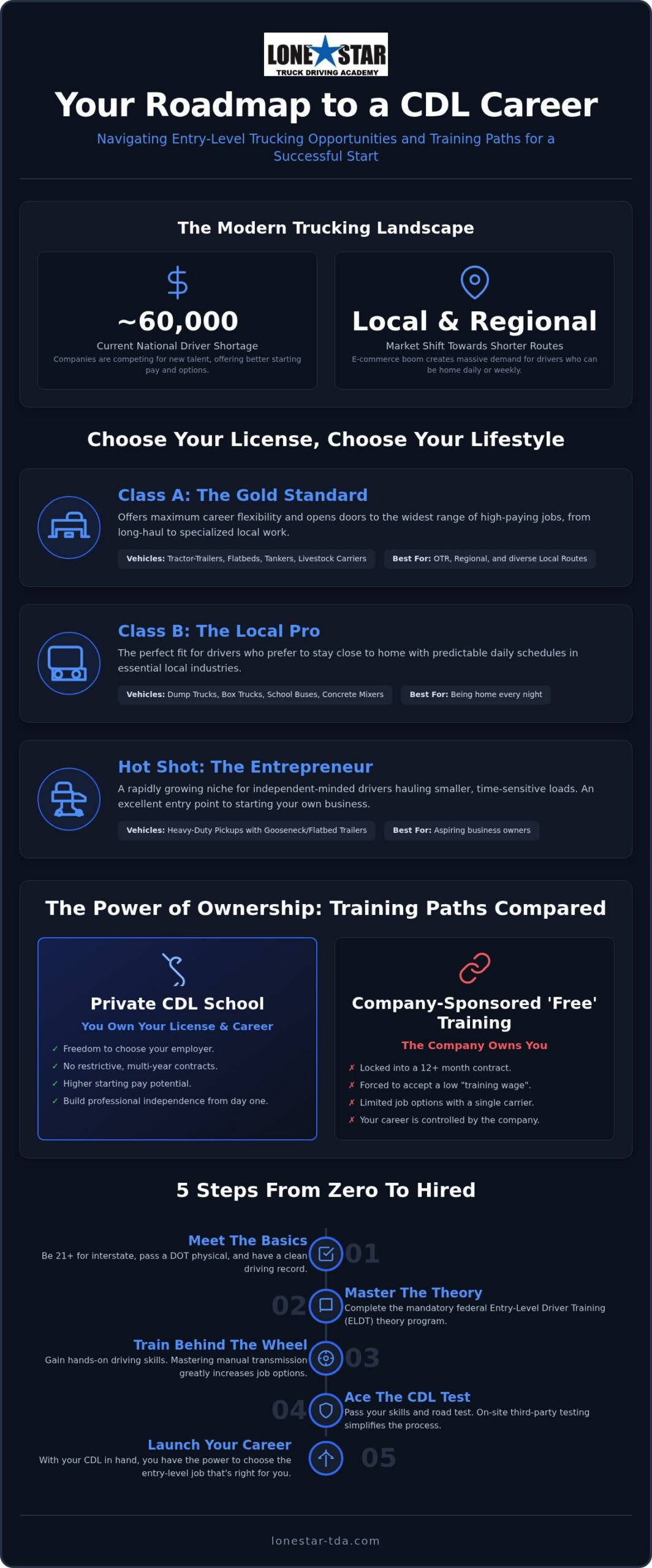
In the trucking industry, “entry-level” is a term used for drivers with less than 12 months of professional experience behind the wheel. Traditionally, these roles were viewed as a stepping stone where you “paid your dues” through long hauls and lower pay. However, the 2026 market has shifted significantly. With a national driver shortage of approximately 60,000 professionals, companies are competing for talent. This means entry level trucking jobs now offer better starting pay and more diverse options than ever before. To start this journey, you must first earn your Commercial Driver’s License (CDL) by meeting strict federal training standards.
The Shift Toward Local and Regional Roles
The rise of e-commerce has fundamentally changed how freight moves. In major logistics hubs like Dallas, Fort Worth, and Greensboro, there’s a massive demand for “last-mile” and local delivery. You don’t have to spend weeks away from home to find a good position. Many new drivers are finding success in regional routes that allow them to be home every night or every weekend. Local vocational driving, such as construction or food service delivery, offers a steady rhythm that Over-the-Road (OTR) work often lacks. At Lone Star Truck Driving Academy, we help students prepare for these specific local opportunities through our Dallas-area training programs.
Essential Requirements for All New Drivers
Before you can get hired, you have to meet several baseline criteria. Most companies require you to be at least 21 years old for interstate travel, though you can drive within Texas or North Carolina at 18. You’ll also need to pass a DOT physical to ensure you’re fit for the demands of the road. Insurance companies are strict about your history, so a clean driving record is vital for securing the best entry level trucking jobs. The FMCSA’s ELDT mandate serves as the mandatory industry gatekeeper and standard for all 2026 licensure. This ensures every new driver has completed a registered ELDT theory program and hands-on training before they ever take their road test. Meeting these requirements early makes the hiring process much smoother.
Exploring Diverse Paths: Class A, Class B, and Hot Shot Careers
Not every driver wants to be away from home for weeks at a time. The beauty of the modern industry is that entry level trucking jobs aren’t one-size-fits-all. Your choice of license class determines the equipment you’ll handle, your earning potential, and, most importantly, your daily schedule. By understanding the differences between Class A, Class B, and Hot Shot roles, you can build a career that fits your personal life instead of the other way around.
The Class A Advantage: More Than Just Long Hauls
Class A is often called the “Gold Standard” because it allows you to operate almost any combination of vehicles with a gross weight rating over 26,001 pounds. While many people associate this with long-haul dry van work, it also opens doors to refrigerated freight and flatbed sectors. Completing Class A CDL training at Lone Star TDA provides the maximum amount of career flexibility. According to the Federal Motor Carrier Safety Administration (FMCSA), these standards ensure you are prepared for the complexities of heavy-vehicle operation. One often overlooked benefit is mastering a manual transmission. If you test in an automatic, you’ll have a restriction on your license that limits your job options. Removing that restriction early in your career can significantly increase your marketability to top-tier carriers.
Class B and Hot Shot: Alternative Entry Points
If you prefer staying local within Dallas or Greensboro, a Class B license might be the right fit. This path typically leads to roles driving dump trucks, large delivery box trucks, or even school buses. These positions often involve more physical activity, like loading and unloading, but they almost always guarantee you’ll be home for dinner. For those with an entrepreneurial spirit, Hot Shot driver training is a rapidly growing niche. Hot Shotting involves using a heavy-duty pickup truck and a trailer to haul time-sensitive, smaller loads. It’s an excellent entry point for anyone wanting to start their own small business without the massive overhead of a full-sized tractor-trailer. Whether you want the power of a Class A rig or the agility of a Hot Shot setup, our team is here to help you weigh your options. You can reach out to an advisor today to discuss which path matches your goals and helps you find the best entry level trucking jobs for your lifestyle.
Private CDL Schools vs. Company-Sponsored ‘Free’ Training
Many large carriers lure new drivers with the promise of paid training. While it sounds like a shortcut to entry level trucking jobs, it’s actually a long term financial commitment. These “free” programs typically come with a contract requiring you to drive for that company for 12 to 24 months. If you leave early for a better opportunity, you’ll likely owe the full cost of the training immediately. This often traps new drivers in low paying roles with less than ideal routes because they can’t afford to quit. Choosing a private school allows you to bypass these restrictions entirely.
Resources like Careers in Trucking highlight the vast demand for drivers, which means you have leverage, but only if you aren’t tied to a single carrier. When you attend a private academy, you own your license from day one. You also become eligible for tuition reimbursement. Many top tier carriers will pay back your private school costs in monthly installments without forcing you into a restrictive multi year contract. This path gives you the best of both worlds: professional training and the power to leave if a better offer comes along.
The Freedom to Choose Your Employer
As a graduate of a private academy, you’re a “free agent.” This status often leads to a better starting CPM (cents per mile) because you can shop around for the highest bidder. In major logistics hubs like Dallas, Fort Worth, and Greensboro, competition for safe drivers is fierce. You should evaluate every carrier’s benefits, home time policies, and equipment quality before signing on. Training at a facility that offers on-site testing in Mansfield or Greensboro also reduces the stress of the final exam. You get to test on the same equipment and range where you practiced, which builds the confidence needed for a successful first day on the job.
Investing in Yourself: The Long-Term ROI
While private training requires an upfront investment, the return is usually much higher than a company sponsored path. Contract drivers often earn significantly less per mile during their commitment period. When you calculate those lost wages over a year or two, the private school tuition pays for itself quickly. For working adults, weekend CDL classes provide a way to transition into entry level trucking jobs without quitting your current job. Private instruction focuses on mastery and safety. We don’t just teach you to pass a test; we prepare you for the real world challenges of the road.
Step-by-Step: From No Experience to Your First Paycheck
Transitioning into a new career can feel like a mountain of paperwork and technical hurdles. However, the path to securing entry level trucking jobs is actually a straightforward five step process when you have the right guidance. It begins with your physical health and basic knowledge before moving into the hands-on skills that define a professional driver. By following this roadmap, you can move from a curious applicant to a licensed professional in a matter of weeks, provided you stay focused on the details of each requirement.
Mastering the CDL Permit and Theory
The first hurdle is obtaining your Commercial Learner’s Permit (CLP) and passing a DOT physical. In Texas, the CLP fee is $25, while North Carolina applicants pay $25.50. This initial stage requires you to study the official state CDL manual and pass several written exams. Completing ELDT theory certification is now a mandatory federal requirement before you can sit for your skills test. This permit preparation sets the foundation for all safe driving by ensuring you understand traffic laws, cargo safety, and emergency protocols before you ever put a truck in gear. We recommend focusing on one section of the manual at a time to avoid feeling overwhelmed by the technical specifications of air brakes or combination vehicles.
The Road Test: Why On-Site Testing Matters
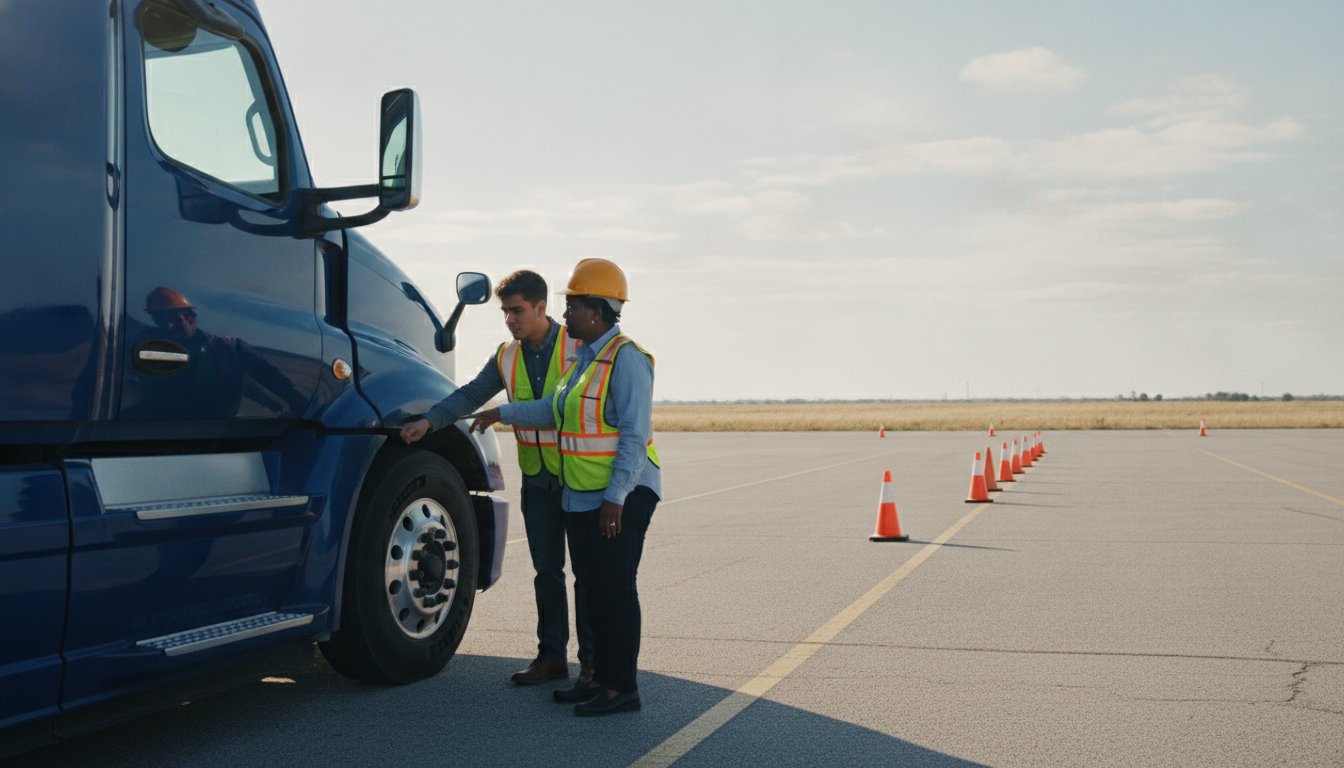
Once you have your permit, you’ll move to the range to master backing maneuvers and the all-important pre-trip inspection. You must be able to identify every major component of the tractor and trailer, explaining its function and condition to an examiner. This is often the most stressful part for students. Utilizing third-party testing at your training school significantly reduces this anxiety. Instead of driving to a crowded state facility in Dallas or Fort Worth, you can test at our authorized sites in Mansfield or Greensboro. Testing on the same equipment and the same lot where you practiced gives you a distinct home-field advantage. Examiners look for steady control, situational awareness, and a commitment to safety during both the backing maneuvers and the road portion of the exam.
After you pass the skills test, your state will issue your newly minted CDL. This is the moment you become eligible for thousands of entry level trucking jobs across the country. You’ll begin applying to carriers, many of whom are eager to hire graduates from reputable private academies. Your focus should be on finding a company that offers a solid orientation program to help you transition from a student to a solo driver. At Lone Star Truck Driving Academy, we help you prepare your documentation so you’re ready to hit the ground running the moment your license is in hand.
Preparing for Your Career at Lone Star Truck Driving Academy
Choosing the right training environment is the most critical decision you’ll make when pursuing entry level trucking jobs. At Lone Star Truck Driving Academy, we combine professional authority with a student-centric approach that prioritizes your individual success. Our instructors aren’t just teachers; they’re seasoned industry veterans who understand the nuances of the road from years of experience. Local drivers in Mansfield, Dallas, and Greensboro trust our team because we provide the practical, real-world skills needed to handle a commercial vehicle safely. We focus on mastery from day one, ensuring you feel prepared for the responsibilities of your new career.
Hands-on training is the cornerstone of our curriculum. You won’t just spend time in a classroom; you’ll get behind the wheel in actual DFW traffic conditions. Navigating the busy corridors of North Texas or the I-85 corridor in Greensboro requires more than theoretical knowledge. It demands split-second decision-making and precise vehicle control. For those who have been away from the industry, our CDL refresher course offers a way to brush up on skills and stay current with 2026 regulations. This ensures that every driver we train, whether new or returning, meets the highest standards of professionalism and safety.
A Mentor-Driven Training Environment
We believe in moving students from broad career goals to specific practical skills in weeks, not months. Our “friendly guide” persona is designed to help you overcome the natural anxiety that comes with the CDL testing process. By fostering a supportive and patient atmosphere, we allow you to focus on the mechanics of backing and road safety without feeling overwhelmed. Learning from instructors with decades of industry experience gives you an edge in the job market. They share the practical wisdom you won’t find in a manual, preparing you for the real-world challenges of entry level trucking jobs across the country.
Next Steps: Joining the Lone Star Community
Transitioning into a professional driving career requires a shift in your mindset. You’re no longer just a driver; you’re a professional responsible for valuable freight and the safety of everyone on the road. We encourage you to visit our facilities to see our training range and meet the staff in person. You can schedule a tour of our Mansfield training site or our Greensboro location to get a feel for our community. Taking this first step is about more than just earning a license; it’s about building a foundation for a stable, long-term career.
Ready to start? Contact Lone Star Truck Driving Academy today to discuss your career path.
Take Control of Your Future on the Road
The path to a stable and rewarding career is clearer than ever. You now understand that entry level trucking jobs in 2026 offer more than just long-haul routes. By choosing private training, you maintain the freedom to select the best employer for your lifestyle without being trapped in a multi-year contract. Whether you’re aiming for a Class A license in Mansfield or a Class B role in Greensboro, the right preparation makes all the difference.
We’ve designed our programs to handle the heavy lifting of compliance for you. With comprehensive ELDT theory and permit prep, you’ll build a solid foundation before ever touching the wheel. Our authorized on-site third-party testing at our Texas and North Carolina campus locations removes the stress of visiting a government facility. You’ve seen the steps required to move from a learner’s permit to a professional paycheck. Now is the time to put that knowledge into action and start your journey toward professional mastery.
Your new career is waiting just over the horizon. We’re ready to help you navigate every mile of the process with confidence and expert support.
Frequently Asked Questions
Can I get a trucking job with no experience?
Yes, you can absolutely secure entry level trucking jobs with no prior professional experience. These roles are specifically structured to accommodate new CDL holders who have completed their mandatory training. Carriers across the Dallas-Fort Worth metroplex and the Greensboro area actively recruit fresh graduates. While some companies have their own finishing programs, having your license from a private academy gives you the flexibility to choose your own path immediately.
How much do entry-level truck drivers make in Texas?
The earning potential for new drivers in Texas is strong. According to the Bureau of Labor Statistics, the median annual wage for heavy truck drivers in the Dallas-Fort Worth area was approximately $59,530 as of May 2025. Some entry-level roles in the region may start higher or lower depending on whether you choose local delivery or regional routes. Your specific pay will often depend on the type of freight and the carrier’s pay structure.
Do I have to go to a mega-carrier for my first trucking job?
You aren’t required to start your career with a mega-carrier. While large national companies often have robust recruiting, many smaller local and regional fleets in Mansfield and Greensboro hire new drivers. By attending a private school, you avoid the long-term contracts that mega-carriers typically demand. This allows you to shop for the best benefits and home-time options right after you pass your skills test at our facility.
What is the difference between Class A and Class B entry-level jobs?
The primary difference lies in the weight and type of vehicle you can operate. A Class A license is the gold standard, allowing you to drive tractor-trailers and combination vehicles. Class B entry level trucking jobs usually involve single vehicles like dump trucks, large delivery vans, or school buses. Class A offers the most flexibility for your career, while Class B is excellent for those who prefer staying strictly local with home-daily routes.
How long does it take to get a CDL and start working?
Most students can complete their training and start working within a matter of weeks. The process involves getting your permit, completing ELDT theory, and finishing behind-the-wheel training. At Lone Star Truck Driving Academy, we streamline this by offering on-site third-party testing in Mansfield and Greensboro. This means you don’t have to wait for a state appointment, helping you transition from the classroom to a professional paycheck as quickly as possible.
Is there a demand for Hot Shot drivers in 2026?
Demand for Hot Shot drivers remains high in 2026. This niche involves hauling smaller, time-sensitive loads using medium-duty trucks and trailers. It’s a popular choice for those in the DFW and Greensboro logistics hubs who want to operate as owner-operators or work for smaller, specialized fleets. Our Hot Shot driver training program is specifically designed to help you master the skills needed for this unique and growing segment of the industry.
Will a manual transmission restriction limit my job options?
Having a manual transmission restriction on your license will limit your employment options. Many specialized fleets and older regional rigs still utilize manual transmissions. If you test in an automatic, you’ll be restricted to driving only automatic vehicles. We offer an automatic restriction removal service to help you gain full Class A or B privileges. This simple upgrade makes you a much more versatile candidate for top-tier trucking companies.
What are the requirements for entry-level driver training (ELDT)?
The Entry-Level Driver Training (ELDT) mandate requires all new applicants to complete a standardized curriculum. This training must be provided by an entity listed on the FMCSA’s Training Provider Registry. It includes both theory instruction and behind-the-wheel practice on a range and public roads. We provide the full ELDT theory certification and practical training at our campuses, ensuring you meet all federal requirements to sit for your CDL exam in Texas or North Carolina.
Article by
Lone Star Truck Driving Academy Training Team
Lone Star Truck Driving Academy provides CDL training for students throughout Texas and North Carolina. Our training team specializes in Class A CDL training, Class B CDL training, CDL refresher programs, automatic restriction removal, third-party testing support, and workforce development partnerships designed to help students build successful careers in the transportation industry.
Training Information Notice
The information provided in this article is for general educational purposes only. Program availability, tuition, licensing requirements, testing procedures, endorsement requirements, and regulatory standards may change over time. Prospective students should contact Lone Star Truck Driving Academy directly to verify current program details, admissions requirements, and state-specific CDL regulations.