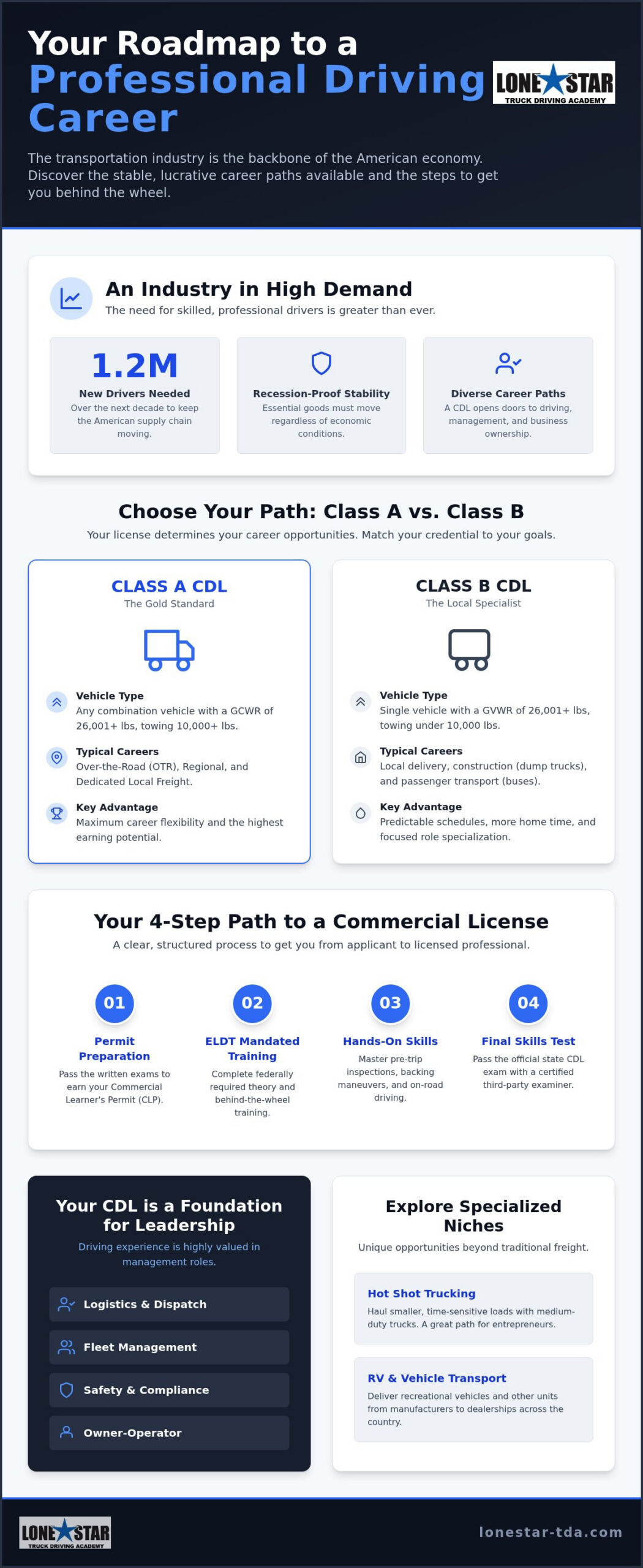
While headlines often claim that robots are taking over the road, the reality is that the American economy needs to recruit 1.2 million new drivers over the next decade to keep moving. If you’re feeling stuck in a dead-end job, the idea of entering the trucking world might feel intimidating, especially with the confusion surrounding federal ELDT mandates and modern licensing requirements. It’s natural to worry about stability, but the truth is that transportation industry careers have never been more vital or more accessible for those with the right guidance.
In this guide, we’ll show you the exact path to a lucrative future in the DFW or Greensboro markets without the guesswork. You’ll learn the specific steps to earn your Class A or B license, clear up any confusion about permit preparation, and discover why specialized niches like hot shot driving are booming in 2026. We’ll also look at how Lone Star Truck Driving Academy provides the hands-on training you need to move from the classroom to a professional seat. It’s time to stop wondering about your next move and start building a career foundation that offers real financial stability.
Key Takeaways
- Identify the most stable transportation industry careers in 2026 and why the demand for drivers continues to outpace the available workforce.
- Compare Class A and Class B license paths to determine which commercial credential aligns with your long-term professional goals.
- Discover how specialized niches like Hot Shot trucking and RV delivery offer unique opportunities for those who prefer smaller equipment or entrepreneurial roles.
- Navigate the mandatory ELDT requirements and permit preparation process with a clear, step-by-step roadmap to your commercial license.
- Learn why DFW and Greensboro are critical hubs for the global supply chain and how to position yourself for success in these local markets.
What are the Top Transportation Industry Careers in 2026?
Transportation is the invisible backbone keeping the global supply chain moving every single day. Every item in your home, from the device you’re holding to the food in your fridge, spent time on a truck or in a distribution center. In 2026, we’ve seen a significant shift in how these goods move. There’s a massive push toward specialized, local, and regional roles that allow drivers to stay closer to home while earning a great living. For anyone exploring transportation industry careers in North Texas or the Piedmont Triad, the timing couldn’t be better. The Dallas-Fort Worth region, including Mansfield and Fort Worth, continues to expand as a premier logistics hub, while Greensboro serves as a vital artery for East Coast freight.
Why Transportation is a Recession-Proof Career Choice
Economic cycles often disrupt corporate office jobs, but they rarely stop the flow of essential goods. Transport professionals earned their “essential worker” status by keeping the country running during tough times, and that reality hasn’t changed. Freight movement is a non-negotiable requirement for modern life. Whether the economy is booming or cooling, people still need fuel, medicine, and groceries delivered on time. This constant demand creates a level of career stability that is hard to find elsewhere. In today’s market, many carriers are providing enhanced benefits and performance bonuses to retain reliable talent. Choosing a path in transport means you’re building a future in an industry that doesn’t just disappear when the market shifts.
The Diversity of Roles: Beyond the Steering Wheel
Don’t make the mistake of thinking a career in transport starts and ends with driving a truck. Obtaining a Commercial Driver’s License (CDL) is actually the ultimate foundation for a wide variety of leadership roles. Many of the most successful logistics managers, dispatchers, and safety directors started their journey behind the wheel. This hands-on experience is exactly what top employers look for when hiring for high-level operations positions. At Lone Star Truck Driving Academy, we focus on providing the CDL training programs that open these doors. Your license is a professional tool that allows you to master the industry from the ground up. Common career paths that benefit from driving experience include:
- Logistics Coordination and Freight Brokering
- Dispatch Operations and Fleet Management
- Safety and Compliance Directing
- Owner-Operator Entrepreneurship in specialized niches
Whether you choose to stay on the road or eventually move into a management office, your commercial credentials serve as a stackable asset. This flexibility is why so many working adults are looking at the transport sector as their next big move. It’s not just about a job; it’s about securing a specialized skill set that the economy cannot function without.
The CDL Advantage: Choosing Your Professional Path
Deciding which commercial license to pursue is the most critical choice you’ll make when starting your journey. It isn’t just about passing a skills test; it’s about matching your credentials to the specific lifestyle and income goals you have in mind. While some people want the adventure of the open road, others prefer the predictability of a local route that gets them home for dinner in Mansfield or Fort Worth. Your license class determines which doors open and which stay closed as you explore transportation industry careers.
Class A CDL: The Heavyweight Champion of Careers
The Class A license is widely considered the gold standard for professional drivers. It grants you the legal authority to operate any combination of vehicles with a gross combination weight rating (GCWR) of 26,001 pounds or more, provided the towed vehicle is heavier than 10,000 pounds. This includes the massive tractor-trailers you see moving freight across the DFW metroplex and through the Greensboro Triad. The Lone Star CDL A training program is designed to give you the versatility to handle these heavy rigs safely.
One of the biggest draws of a Class A license is the earning potential and job variety. You can choose between over-the-road (OTR) positions that take you across the country or regional routes that keep you within a specific area of Texas or North Carolina. According to the U.S. Bureau of Labor Statistics, the job outlook for truck drivers remains strong as the industry strives to fill the gap left by retiring professionals. In Dallas, regional drivers can see average annual earnings around $75,380, making it a highly lucrative path for those willing to master the big rigs.
Class B CDL: Local Stability and Vocational Roles
If your priority is staying local and maintaining a consistent schedule, a Class B license might be the perfect fit. This credential allows you to operate straight trucks, large delivery vehicles, cement mixers, and even buses. Many Class B roles are vocational, meaning they’re tied to specific industries like construction or local food distribution. Our Class B CDL training focuses on these high-demand local roles. The primary benefit here is the “home every night” lifestyle, which is ideal for working adults with family commitments in the Dallas or Greensboro areas.
Manual vs. Automatic: Why Restriction Removal Matters
Many students today choose to train on automatic transmissions because they’re easier to learn. However, if you take your skills test in an automatic vehicle, the DMV will place an “E” restriction on your license. This restriction legally prevents you from driving any commercial vehicle with a manual transmission. While many modern fleets are switching to automatics, a significant portion of specialized rigs and older fleets still rely on manuals. To keep your options fully open, we recommend our automatic restriction removal service. It’s a simple way to ensure you’re never turned away from a high-paying job just because the truck has a gear shifter. If you aren’t sure which path is right for your goals, you can always reach out to one of our advisors for personalized guidance.
Specialized Driving Niches: Hot Shot and RV Careers
If the idea of driving a massive Class 8 tractor-trailer feels like too much, but you still want the independence of the road, specialized niches offer a perfect middle ground. These transportation industry careers often have a lower barrier to entry regarding equipment costs, making them a favorite for those with an entrepreneurial spirit. In 2026, we’re seeing more drivers in the Dallas-Fort Worth area and the Piedmont Triad move toward these flexible, high-demand roles that prioritize autonomy over traditional long-haul freight.
Hot Shot Trucking: The Entrepreneurial Path
Hot Shot trucking involves using medium-duty trucks, such as a one-ton diesel pickup, to pull a flatbed trailer. This niche is built on speed and precision. You aren’t hauling massive loads of generic retail goods; instead, you’re delivering “expedited” cargo that needs to be on-site immediately. This might include construction equipment for a project in Mansfield or urgent machinery parts for a facility in Greensboro. Because you’re often operating as an owner-operator, the potential for profit is significant. Experienced operators in this field can see a net income between $6,000 and $10,000 per month depending on their efficiency and load sourcing. Our hot shot driver training helps business-minded students master the logistics, load securing, and safety requirements needed to run a successful operation.
RV Transport: Turning Travel into a Career
The RV industry relies heavily on professional drivers to move travel trailers, fifth wheels, and motorhomes from manufacturers to dealerships across the country. It’s a unique lifestyle that appeals to those who enjoy the journey as much as the destination. You get to experience the open road without the stress of managing a 53-foot box trailer. However, don’t let the smaller size fool you. Towing high-profile RVs requires specialized safety training to handle wind resistance, sway, and complex weight distribution. When you examine the broader Transportation Career Outlook, it’s clear that these specialized roles provide a level of flexibility that traditional OTR driving sometimes lacks. Whether you’re based in Fort Worth or Dallas, these niches allow you to build a professional identity on your own terms while staying connected to the massive logistics infrastructure of North Texas.
Navigating the Licensing Process in Texas and NC
Entering transportation industry careers requires more than just a desire to drive. Since February 2022, the FMCSA has mandated Entry-Level Driver Training (ELDT) for anyone seeking a Class A or B license. This isn’t a suggestion; it’s a federal law. You must complete your training with a provider listed on the Training Provider Registry before you can even schedule a skills test. Whether you’re in Dallas or Greensboro, your first critical step is obtaining your ELDT theory certification. This ensures you have the foundational knowledge to move on to the actual equipment and safely manage a commercial vehicle.
Step 1: Permit Preparation and ELDT Theory
The written permit exams cover a wide range of technical topics, including air brakes, combination vehicles, and general safety rules. In Texas, as of June 1, 2026, all knowledge exams are administered in English only. This change makes professional permit prep even more essential for success. We don’t just want you to memorize answers; we want you to understand the mechanics and regulations behind the questions. Mastering the theory early sets the tone for your entire career and significantly increases your chances of passing the written tests on your first attempt at the DMV.
Step 2: Hands-On Skills and Road Testing
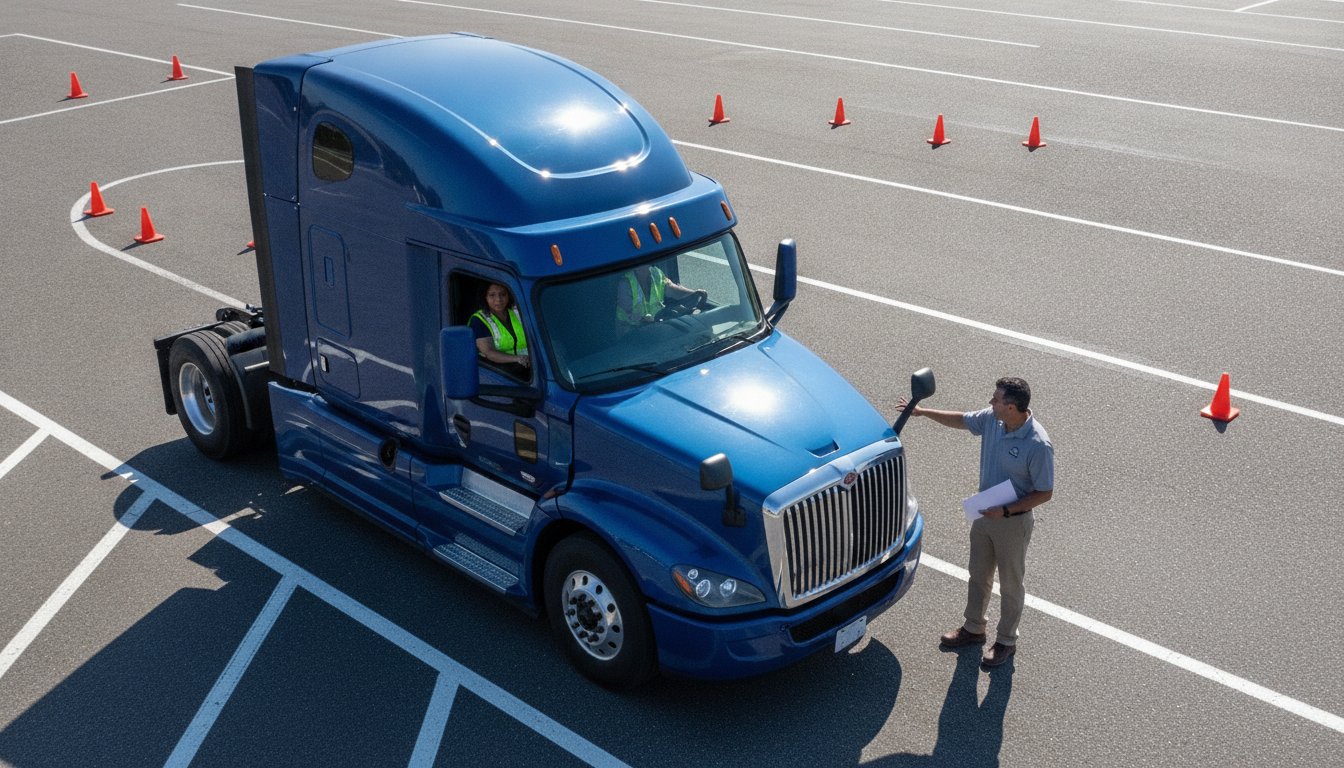
Once you have your permit in hand, the real work begins on the training yard. You’ll need to master three specific areas: the pre-trip inspection, basic vehicle control maneuvers like backing, and the on-road skills test. These aren’t just hurdles to clear. They’re the practical skills that keep you and everyone else safe on the road. The pre-trip inspection is especially vital. It teaches you how to ensure your rig is roadworthy before you ever put it in gear, protecting your equipment and your professional reputation.
One major advantage we provide at Lone Star Truck Driving Academy is authorized third-party testing at our own facilities. Instead of waiting weeks for a slot at a crowded state DMV office, you can test on the same equipment and in the same environment where you practiced. This on-site testing significantly reduces student anxiety and eliminates the scheduling delays that often stall new transportation industry careers. We’ve seen how much it helps students in Mansfield and Fort Worth to test in a familiar setting with instructors who have mentored them throughout the process.
Speak with a training advisor about your license today
Launching Your Career in the DFW and Greensboro Markets
The Dallas-Fort Worth (DFW) metroplex isn’t just a collection of cities; it’s a top five logistics hub in the United States. For those pursuing transportation industry careers, this region offers an unparalleled volume of freight movement and opportunity. Similarly, the Greensboro and Piedmont Triad area serves as a critical East Coast transit point, connecting major manufacturing centers to global markets. At Lone Star Truck Driving Academy, we bridge the gap between classroom theory and the local hiring market. We understand that many students are transitioning from other fields, which is why we offer weekend CDL classes to fit your current work schedule while you prepare for your new path.
The Texas Advantage: Mansfield, Dallas, and Fort Worth
The DFW region is home to massive distribution centers and major fleet headquarters that are constantly seeking qualified talent. Areas like Mansfield and Arlington have seen a surge in local delivery and regional freight needs as the population continues to climb. Whether it’s the AllianceTexas development or the industrial parks in south Fort Worth, the demand for Class A and B drivers is steady. Enrolling in CDL training in Dallas provides you with the specific hands-on preparation required to handle these high-traffic environments. It’s a career-changing opportunity that places you right in the middle of one of the busiest freight corridors in the world.
The North Carolina Connection: Greensboro and High Point
Greensboro is often called a transportation gateway for a reason. Situated at the intersection of several major interstates, it’s the heart of North Carolina’s logistics network. The local manufacturing and furniture industries rely heavily on a steady supply of local drivers to move products through the Piedmont Triad. This regional focus often means more opportunities for drivers to stay within the state while building a solid career. Our Greensboro CDL training is designed to meet these specific East Coast market needs, focusing on professional safety and the technical skills required for this unique landscape.
Staying Current: Refresher Courses for Returning Drivers
If you already have a CDL but haven’t been behind the wheel for a few years, you’ll likely find that most carriers require a skills update before they’ll put you on their insurance. The industry changes quickly, and safety standards are more rigorous than ever. A CDL refresher course is the fastest way to polish your backing maneuvers and road skills. It shows potential employers that you’re committed to professional standards and that your technical knowledge is up to date with 2026 regulations. This small investment in your skills can be the key to a quick career restart in the competitive DFW or Triad markets.
Take Control of Your Professional Future
You’ve seen how the right commercial credentials can transform your life from a dead-end job into a high-demand profession. Whether you choose the hauling power of a Class A tractor-trailer or the local flexibility of a Class B vocational role, the opportunities in 2026 are vast. By mastering the mandatory ELDT requirements and exploring specialized niches like Hot Shot trucking, you’re positioning yourself at the center of the global supply chain. Building a future in transportation industry careers is about more than just driving; it’s about securing a specialized skill set that the economy cannot function without.
Lone Star Truck Driving Academy is ready to be your steady partner in this transition. With locations in both Texas and North Carolina, we provide comprehensive ELDT theory and hands-on skills training designed for working adults. Our status as an authorized third-party testing site means you can finish your journey in a familiar environment, avoiding the typical DMV scheduling delays. We’re here to help you move forward with confidence and clarity.
Start your transportation career with Lone Star Truck Driving Academy today!
Your new professional identity starts with a single step. We look forward to seeing you on the training yard and helping you reach your goals.
Frequently Asked Questions
What are the most in-demand transportation industry careers in 2026?
In 2026, the most in-demand transportation industry careers are focused on regional and local freight delivery. The Dallas-Fort Worth metroplex and the Piedmont Triad are currently seeing a massive need for Class A tractor-trailer drivers and Class B vocational operators for construction and delivery. Specialized roles like Hot Shot trucking and RV transport are also growing as businesses seek faster, more flexible shipping solutions to bypass traditional logistics bottlenecks.
How long does it take to get a CDL and start a new career?
Most students complete their training and secure a license in three to six weeks, depending on their chosen program and schedule. The process begins with ELDT theory and permit preparation, followed by hands-on skills training on the yard. At Lone Star Truck Driving Academy, we offer authorized on-site third-party testing, which helps you avoid long wait times at the DMV and get you on the road faster.
Do I need a Class A or Class B license for local delivery jobs?
It depends on the size of the vehicle you intend to operate. A Class B license is typically sufficient for local delivery jobs involving straight trucks, cement mixers, or buses. However, many local distribution hubs in Mansfield and Fort Worth prefer Class A drivers because the license allows you to pull heavier trailers. Having a Class A license provides more career flexibility and ensures you aren’t limited if a local job requires a larger rig.
What is Hot Shot trucking, and does it require a CDL?
Hot Shot trucking involves using medium-duty trucks, like a one-ton pickup, to pull expedited freight on a flatbed trailer. While you can technically operate smaller loads without a CDL, most profitable Hot Shot opportunities require a Class A license. This is because the Gross Combination Weight Rating (GCWR) of the truck and trailer often exceeds 26,001 pounds. Having your commercial credentials allows you to haul heavier, higher-paying loads across Texas and North Carolina.
Can I get my CDL training while working a full-time job?
Yes, you can train for a new career without quitting your current job. We understand that many working adults in the Dallas and Greensboro areas have financial commitments that require a steady income. That’s why we offer flexible weekend CDL classes. These programs allow you to master the required skills and complete your ELDT theory on a schedule that fits your life, making the transition into the industry manageable and stress-free.
How much does CDL training cost in Texas or North Carolina?
The total cost of obtaining a commercial license depends on several factors, including the license class and any specific endorsements you need. While tuition varies across the industry, it’s important to consider the value of hands-on instruction and on-site testing. We suggest reaching out to our team for a detailed breakdown of our current training programs. This allows us to provide accurate information tailored to your specific career goals in Texas or North Carolina.
What is the ELDT requirement and how does it affect my licensing?
The Entry-Level Driver Training (ELDT) rule is a federal mandate that requires all new CDL applicants to complete a standardized training curriculum. This training must be provided by an entity listed on the FMCSA’s Training Provider Registry. It covers both theory and behind-the-wheel skills. Without proof of ELDT completion, the DMV will not allow you to take your skills test. We include ELDT theory certification and permit prep in all our core programs.
How do I remove an automatic transmission restriction from my CDL?
If your license has an “E” restriction, you must pass a specialized skills test in a commercial vehicle equipped with a manual transmission. This process doesn’t require you to retake the entire CDL exam. We offer a specific automatic restriction removal service that provides the equipment and instruction needed to master gear shifting. Removing this restriction is a smart move that opens up a wider variety of transportation industry careers and fleet options.
Article by
Lone Star Truck Driving Academy Training Team
Lone Star Truck Driving Academy provides CDL training for students throughout Texas and North Carolina. Our training team specializes in Class A CDL training, Class B CDL training, CDL refresher programs, automatic restriction removal, third-party testing support, and workforce development partnerships designed to help students build successful careers in the transportation industry.
Training Information Notice
The information provided in this article is for general educational purposes only. Program availability, tuition, licensing requirements, testing procedures, endorsement requirements, and regulatory standards may change over time. Prospective students should contact Lone Star Truck Driving Academy directly to verify current program details, admissions requirements, and state-specific CDL regulations.