Your military service isn’t just a chapter in your past; it’s the most valuable asset you own for launching successful military transition trucking careers. While many veterans feel a sense of uncertainty when the uniform comes off, the truth is that the trucking industry is looking for the exact kind of discipline and situational awareness you already possess. You’ve spent years following strict protocols and managing complex missions, which makes you a prime candidate for the high standards required on the civilian road.
We understand that the shift from a structured military environment to the civilian job market can feel like navigating without a map, especially with confusing federal ELDT regulations. This guide provides a clear roadmap for veterans in the Dallas-Fort Worth metroplex to translate their MOS skills into a commercial license. We’ll cover how to leverage your background for higher earnings and find training programs in Mansfield or Dallas that respect your time and experience, helping you move from discharge to your first commercial driving job with confidence.
Key Takeaways
- Learn how your military discipline and situational awareness translate into a tactical advantage behind the wheel of a commercial vehicle.
- Follow a structured roadmap for military transition trucking careers to navigate federal ELDT requirements and Texas licensing steps efficiently.
- Understand why manual transmission training is critical to avoid the automatic restriction that often limits civilian career options.
- Discover how specialized permit preparation and on-site testing in the DFW area can accelerate your move from discharge to your first driving job.
Why Military Veterans Excel in Trucking Careers
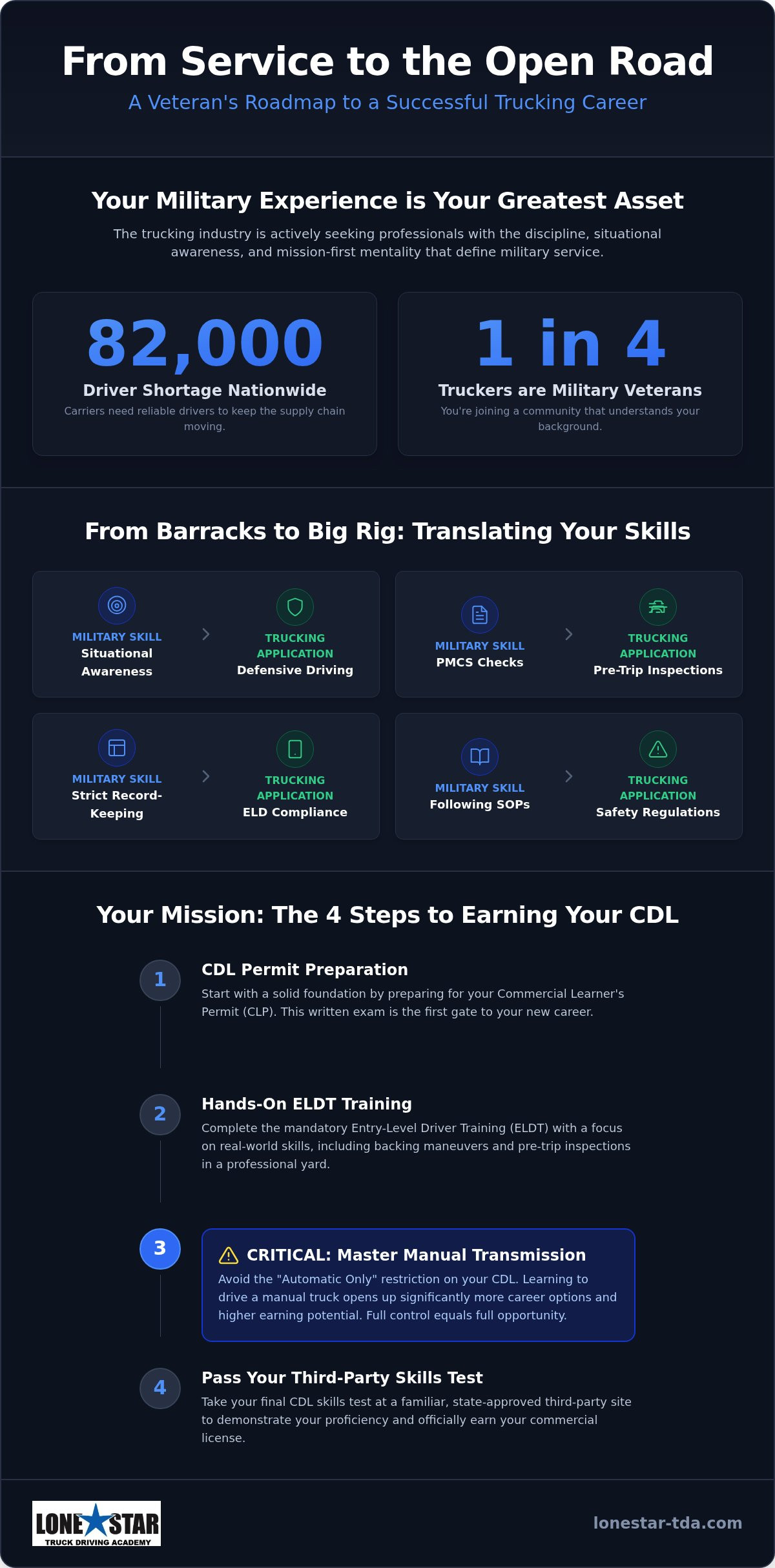
Veterans don’t just fit into the trucking industry; they often lead it. About 25% of military veterans are already part of the trucking workforce, according to Freedom Haulers data from August 2026. This isn’t a coincidence. The shift from a military environment to the cab of a commercial vehicle is a natural progression because both roles demand high levels of discipline, punctuality, and situational awareness. You’ve already spent years mastering the ability to operate under pressure, which is exactly what fleet managers look for in new hires.
The 2026 logistics market is currently facing a shortage of about 82,000 drivers, according to the American Trucking Associations. Major carriers are actively searching for people who understand the importance of a mission-first mentality. When you pursue military transition trucking careers, you’re entering a field where your ability to follow strict safety protocols is your greatest professional asset. Carriers prioritize veterans because they know a former service member won’t cut corners on a pre-trip inspection or ignore federal safety regulations.
The Independence and Stability of the Trucking Industry
One of the biggest shifts in civilian life is the sudden loss of the structured military environment. Trucking offers a unique middle ground. While you’re responsible for your own schedule and enjoy the autonomy of the open road, the job still relies on the methodical planning you learned in the service. It’s a stable career path because freight never stops moving. Whether you’re training at our campus in Mansfield or Dallas, you’ll find that the essential nature of this work provides a sense of purpose. When you explore military transition trucking careers, you’ll discover that the transition from a platoon to a solo or team driving role allows you to maintain your professional standards without constant oversight.
Bridging the Gap from Service to the Open Road
In the military, every movement is a mission. Professional driving is no different. Delivering a high-value load on time and intact is a mission that requires total focus. To get started, you’ll need to earn your Commercial Driver’s License (CDL), which serves as your professional credential in the civilian world. Military logistics experience provides a tactical foundation for managing modern civilian supply chain demands. Moving from military convoys to professional fleet operations feels familiar because the core objectives remain the same: safety, efficiency, and reliability. At Lone Star Truck Driving Academy, we help you leverage that familiarity to fast-track your new career path.
Translating Your Military Skills to a Commercial Driver’s License
Transitioning from the military doesn’t mean starting from zero. Your time in service has already equipped you with the technical and mental foundation needed for success in the transportation sector. When exploring military transition trucking careers, the most important thing to realize is that the skills you used to maintain readiness are the same ones required to pass your CDL exam and excel on the road. You aren’t just learning a new job; you’re applying a proven mindset to a new set of equipment.
Situational awareness is a prime example of this translation. In the military, you’re taught to constantly scan your environment and anticipate threats before they manifest. On the highway, this translates directly to defensive driving. You aren’t just looking at the car in front of you; you’re watching the horizon, the shoulders, and the behavior of traffic three vehicles ahead. This high level of awareness is a major reason why the job outlook for truck drivers remains strong for veterans. Carriers know that your training reduces accidents and insurance risks, making you a preferred hire from day one.
There is also the matter of paperwork and compliance. Military record-keeping is notoriously strict and for good reason. Whether you were tracking inventory or maintaining vehicle logs, you understand that if it isn’t in writing, it didn’t happen. This background makes the switch to Electronic Logging Device (ELD) compliance much easier. While some civilian drivers struggle with the transition to digital logs, veterans often find the precision of ELD systems to be a natural extension of their previous duties.
Discipline, Safety, and Attention to Detail
In the military, Standard Operating Procedures (SOPs) are a way of life. The trucking industry operates on similar principles. Every time you step into a cab, you perform a Pre-Trip Inspection. For a veteran, this is simply a civilian version of Preventive Maintenance Checks and Services (PMCS). You don’t just kick the tires. You check the air lines, inspect the brake chambers, and look for leaks with the same military-grade attention to detail that kept your equipment mission-ready. This level of discipline ensures that you catch small mechanical issues before they become dangerous road hazards.
Leadership and Problem-Solving Under Pressure
This commitment to safety and procedural discipline often extends beyond professional driving; for instance, many veterans also seek out specialized certifications like a NY 18 hour concealed carry course to ensure their tactical training remains current and compliant with civilian regulations.
Commercial driving isn’t always a straight line. Routes change, weather shifts, and mechanical issues happen at the most inconvenient times. This is where NCO-level leadership pays off. You’re trained to assess a situation, make a decision, and execute a plan without panic. Whether you’re navigating complex federal regulations or managing a tight delivery window in Dallas or Fort Worth, your ability to remain calm under pressure sets you apart from the crowd. If you’re ready to see how your specific background fits our programs, feel free to reach out to our team for a direct conversation about your goals.
Navigating the CDL Process for Transitioning Service Members
The process of moving from military service to a civilian driving job is essentially a sequence of mission objectives. While the FMCSA recently extended the military skills test waiver window to two years, many veterans still find the regulatory environment confusing. Successfully launching military transition trucking careers requires a clear understanding of the federal and state steps that stand between you and the driver’s seat. You’ve already mastered complex tasks under pressure; this is simply about applying that same focus to a new set of regulations.
Understanding ELDT and Permit Requirements
Since February 2022, the Entry-Level Driver Training (ELDT) mandate has changed the landscape for all new drivers. Even if you qualify for a skills waiver based on your military driving record, you are likely still required to complete the theory portion of the training. This is where many veterans get stuck. At Lone Star Truck Driving Academy, we provide ELDT theory certification & permit prep to ensure you meet federal standards before you ever head to the DMV. Permit preparation is more than just reading a manual; it’s about understanding Texas-specific CDL laws and mastering the knowledge exams required for your Commercial Learner’s Permit (CLP). In Texas, the CLP fee is $25, and having the right theory foundation is the best way to ensure you don’t have to pay it twice.
Choosing Between Class A and Class B Training
Your next objective is deciding which classification fits your long-term career goals. This choice determines the type of equipment you can operate and the lifestyle you’ll lead:
- Class A: This is the path for those wanting to operate “Big Rigs” and tractor-trailers. It offers the widest range of opportunities, including long-haul, regional, and high-paying specialized freight.
- Class B: This is ideal for vocational trucking and local delivery. You’ll operate single vehicles like dump trucks, concrete mixers, or large delivery box trucks, often allowing for a more traditional home schedule in the DFW area.
You can review our Class A vs Class B comparison to see which path matches your post-military career goals. Once you’ve chosen your path and secured your permit, the focus shifts to hands-on skills like backing maneuvers and navigating traffic in Mansfield or Fort Worth. The final step is the road test. Because we offer authorized on-site third-party testing, you can avoid the long wait times at the DMV and test on the same equipment you used during your military transition trucking careers preparation.
Overcoming Common Transition Hurdles: Manual Restrictions and Testing
One of the most frequent misconceptions veterans face is the idea that all Class A licenses are created equal. In reality, the equipment you use during your road test defines the scope of your career. If you take your skills test in a vehicle equipped with an automatic transmission, the state places an “E” restriction on your license. This prevents you from legally operating any commercial vehicle with a manual gearbox. While automatic trucks are becoming more common, many specialized fleets and heavy-haul companies still rely on manual transmissions. Relying on an automatic-only license can significantly narrow your options when researching military transition trucking careers.
Removing the Automatic Transmission Restriction
If you already have a CDL with an automatic restriction, or if you’re just starting and want to avoid it, focusing on manual transmission training is a strategic move. Many commercial fleets still utilize 10-speed or 13-speed manual transmissions for their durability and control in varied terrain. At Lone Star Truck Driving Academy, we help veterans master the art of double-clutching and gear synchronization. Removing this restriction isn’t just about learning a new skill; it’s about ensuring you never have to turn down a high-paying job offer because of a letter on your license.
The Advantage of Third-Party On-Site Testing
The transition from military life is stressful enough without the added pressure of a long wait at a government facility. Testing at the DMV often involves unfamiliar equipment and an environment that feels more like an interrogation than a professional evaluation. We’ve found that veterans perform much better when they can complete their road test in a familiar setting. By utilizing on-site third-party testing, you get to test on the exact same truck you used during your training hours.
This “home-field advantage” in Dallas or Mansfield allows you to focus on your maneuvers rather than worrying about the quirks of a strange vehicle. It streamlines the process, allowing you to move from student to professional driver much faster. For those who have been out of the driver’s seat for several years, we also recommend a refresher course to polish your skills and ensure you’re fully prepared for the rigors of modern road safety standards before your test date.
Schedule your skills test or training session today
Finding Veteran-Friendly CDL Training in Texas and North Carolina
Choosing the right environment for your military transition trucking careers is a tactical decision that affects your long-term success. Training in a major logistics hub like the Dallas-Fort Worth metroplex or the Piedmont Triad in North Carolina provides more than just a certificate. It places you in the heart of the industry where you can observe real-world operations and begin building a professional network before you even graduate. Local training allows you to understand the specific traffic patterns, regional regulations, and equipment types that dominate the local freight lanes. This focus on localized, expert instruction is a universal need; for instance, expats in the Netherlands can discover English Driving School Utrecht to receive specialized driving lessons in English.
We know that many service members are balancing terminal leave, family relocations, or final out-processing. Flexibility isn’t just a convenience; it’s a necessity during this period. Finding a program that respects your timeline and offers a structured yet adaptable curriculum is the best way to ensure you don’t feel overwhelmed. At Lone Star Truck Driving Academy, we’ve built our programs to serve as a steady partner during this significant life change, providing the authority of an experienced instructor with the support of a mentor.
Our facilities are strategically located to serve veterans where they live and work. We offer comprehensive CDL training Dallas and Mansfield locations, placing our students in the center of the busiest freight corridor in the United States. For those transitioning on the East Coast, our Greensboro, NC campus provides the same high standards of hands-on instruction. We also recognize that some service members want to get a head start while still on active duty. To accommodate these schedules, we provide weekend CDL classes that allow you to complete your training without conflicting with your final military obligations.
Taking the Next Step Toward Your New Career
The move from a military MOS to a civilian driving career is a journey that starts with a single inquiry. We encourage you to visit our academy in person to see the equipment, tour the range, and speak directly with our instructors. This isn’t a generic school; it’s a professional academy where we prioritize real-world preparation and safety over simple test-taking. You’ll find that our team understands the military mindset and is ready to help you translate your discipline into professional mastery.
Your civilian future is built on the foundation of the skills you already possess. By combining your military background with our specialized training, you can move forward with confidence and readiness. Contact Lone Star Truck Driving Academy today to discuss your goals and let us help you map out the most efficient path to your first commercial driving role. We’re here to ensure your transition is as smooth and professional as the service you’ve provided to our country.
Launch Your Next Mission in the Trucking Industry
Transitioning from service is a significant life pivot, but your military background has already done the heavy lifting. You’ve mastered the discipline and situational awareness that the logistics industry desperately needs. By focusing on specialized manual transmission training and navigating the ELDT process with experts who respect your experience, you’re not just getting a license; you’re building a professional foundation for long-term stability.
At Lone Star Truck Driving Academy, we’ve built a training environment that mirrors the professionalism you’re used to. Our authorized on-site third-party testing and veteran-friendly instructors ensure you enter the workforce without unnecessary delays. We’ve simplified the path for military transition trucking careers so you can focus on mastering the equipment and securing your future in the DFW area or North Carolina.
Your next chapter starts the moment you decide to take the wheel. We’re honored to serve those who have served us, and we’re ready to provide the technical bridge to your new career.
Frequently Asked Questions
Can I use my military driving experience to skip CDL school?
You can skip the road test portion of the exam if you qualify for the FMCSA Military Skills Test Waiver, which was extended to two years post-separation in July 2026. However, you still must complete the written knowledge exams to secure your permit. Most states, including Texas, also require you to finish the federally mandated ELDT theory training. We provide specialized theory certification to help veterans meet these specific requirements quickly.
How long does a military transition trucking program take?
The duration depends on your current experience level and the type of license you need. A full Class A program typically takes several weeks of hands-on training to master. If you already have experience and just need to brush up on civilian regulations, a refresher course is much faster. We offer flexible scheduling, including weekend classes in Mansfield and Dallas, to accommodate service members who are still completing their final out-processing.
Does the GI Bill® cover CDL training at Lone Star TDA?
Many veterans use their benefits to fund vocational training, but you should always verify the current VA eligibility status for specific programs directly with our advisors. We focus on providing professional, mentor-led instruction that respects the time and resources of our students. Whether you are using transition benefits or paying out of pocket, our team in the DFW area and Greensboro can help you navigate the enrollment process efficiently.
What is the difference between Class A and Class B for a veteran?
A Class A CDL allows you to operate combination vehicles like tractor-trailers, which are the backbone of long-haul logistics. A Class B license is for single vehicles like dump trucks, delivery vans, or concrete mixers. If your post-military goal is to maximize your earning potential in the freight industry, Class A is usually the preferred choice. Class B is often better for those seeking local vocational roles with regular home time.
How do I remove an automatic transmission restriction from my CDL?
To remove the “E” restriction from your license, you must successfully complete a skills test in a commercial vehicle equipped with a manual transmission. We offer a specialized Automatic Restriction Removal Service that focuses on mastering gear synchronization and double-clutching. This is a strategic move for military transition trucking careers because it ensures you aren’t disqualified from the 40% of fleets that still utilize manual equipment.
What are the most common trucking jobs for veterans in Texas?
The Dallas-Fort Worth area is a massive logistics hub with high demand for regional and long-haul drivers. Veterans often excel in flatbed trucking, specialized heavy-haul, or fuel hauling because these roles require high levels of safety and procedural discipline. Vocational roles in construction or local delivery are also popular in growing cities like Fort Worth and Arlington. Your ability to handle complex missions makes you a top candidate for these positions.
Do I need a CDL for hot shot trucking after the military?
You generally need a Class A CDL for hot shot trucking if your truck and trailer combination has a Gross Combined Weight Rating (GCWR) over 26,001 pounds. Many veterans prefer hot shot work because it offers a sense of independence similar to military operations. We provide dedicated Hot Shot Driver Training at our Texas locations to ensure you understand the specific equipment and load-securing requirements necessary for this specialized field.
What should I look for in a veteran-friendly truck driving school?
Look for an academy that offers authorized on-site third-party testing to reduce the stress of government facility wait times. A veteran-friendly school should also provide manual transmission training to give you full career flexibility. It’s important to find instructors who have experience working with service members and understand how to translate your skills into civilian success. Flexibility, such as weekend classes in Greensboro or Dallas, is also a key indicator of a supportive program.
Article by
Lone Star Truck Driving Academy Training Team
Lone Star Truck Driving Academy provides CDL training for students throughout Texas and North Carolina. Our training team specializes in Class A CDL training, Class B CDL training, CDL refresher programs, automatic restriction removal, third-party testing support, and workforce development partnerships designed to help students build successful careers in the transportation industry.
Training Information Notice
The information provided in this article is for general educational purposes only. Program availability, tuition, licensing requirements, testing procedures, endorsement requirements, and regulatory standards may change over time. Prospective students should contact Lone Star Truck Driving Academy directly to verify current program details, admissions requirements, and state-specific CDL regulations.