
Transitioning out of the military shouldn’t feel like starting from zero, especially when you have earned benefits designed to bridge that gap. Using Chapter 33 benefits for CDL training is one of the most effective ways to launch a high-paying career in the Texas trucking industry without touching your savings. Many veterans hesitate because they worry about the complexity of VA paperwork or feel anxious about staying financially stable during a four week course. You might even fear burning your entitlement on a short program, but the reality is that the Post-9/11 GI Bill is a strategic tool for professional advancement.
We understand that you need more than just a tuition waiver; you need a clear path to a stable paycheck in the DFW area. This guide explains exactly how to leverage your Chapter 33 benefits to cover 100 percent of your training costs while securing a Monthly Housing Allowance (MHA) to support your family while you learn. At Lone Star Truck Driving Academy, we help veterans in Dallas, Mansfield, and Fort Worth navigate these requirements every day. We will walk you through the steps to secure your Class A license, handle the ELDT requirements, and transition into the driver’s seat of a rewarding new career.
Key Takeaways
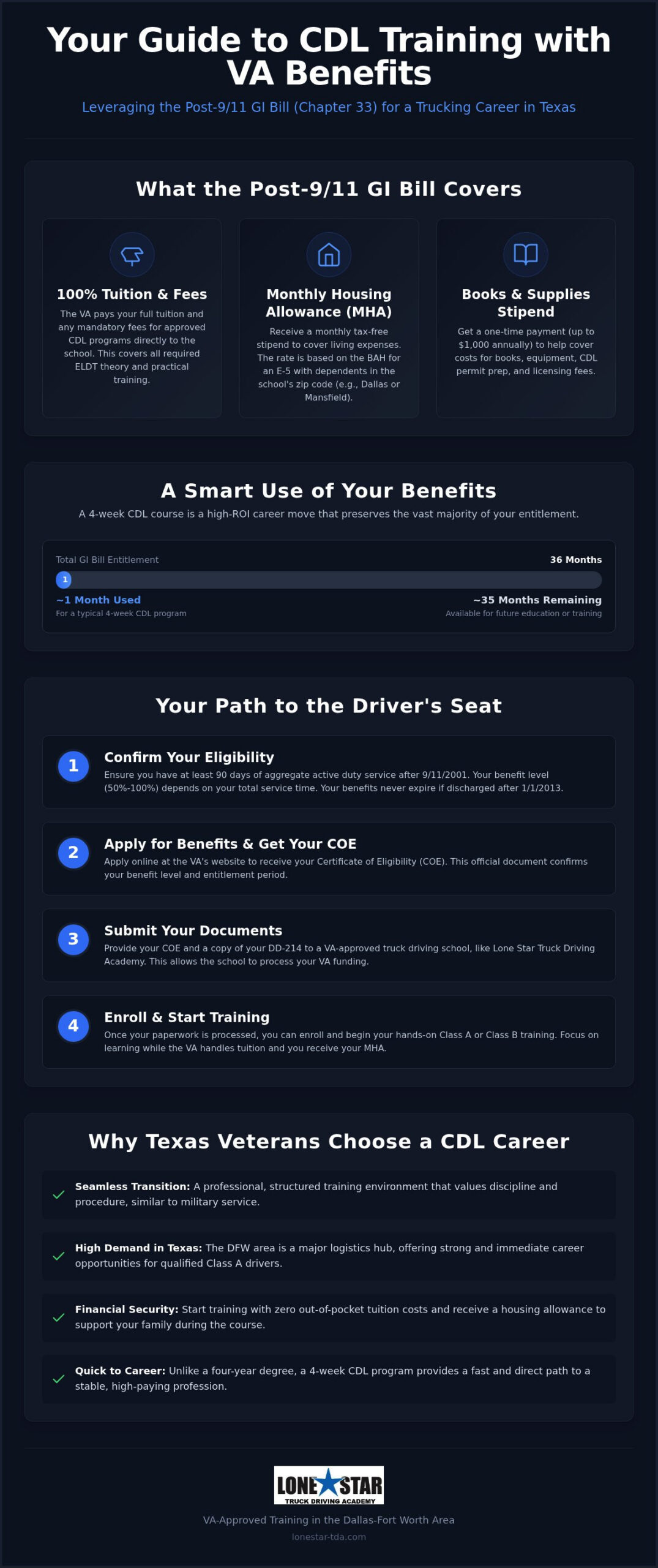
- Learn how you can achieve 100 percent tuition coverage for Class A or B training by using Chapter 33 benefits for CDL training at an approved institution.
- Understand how the Monthly Housing Allowance (MHA) provides financial stability by paying you a stipend based on our Mansfield or Dallas campus zip codes while you study.
- Discover why a 4-week CDL course is a high-ROI move that only uses roughly one month of your 36-month GI Bill entitlement.
- Get a clear, step-by-step checklist for submitting your Certificate of Eligibility (COE) and DD-214 to start your training without out-of-pocket costs.
- See how Lone Star Truck Driving Academy’s professional, military-style environment helps Texas veterans transition quickly into high-demand trucking roles.
Can You Use Chapter 33 Benefits for CDL Training?
The Department of Veterans Affairs (VA) recognizes commercial driver training as a valid and high-value career path. Using Chapter 33 benefits for CDL training falls under the “Non-College Degree” (NCD) category, which explicitly covers vocational programs. This is a massive win for veterans who want to trade their combat boots for a steering wheel without spending four years in a traditional classroom. In 2026, the demand for Class A drivers remains strong; choosing a short, intensive vocational course is often a more efficient use of your hard-earned benefits than a general degree program.
You can’t just pick any school on the map, though. The facility must be VA-approved and listed in the WEAMS (Web Enabled Approval Management System) database to accept your funding. Lone Star Truck Driving Academy is proud to serve veterans at our Mansfield and Dallas locations, ensuring your benefits are applied correctly from day one. Unlike the Montgomery GI Bill (Chapter 30), which sends a monthly check directly to you to cover all costs, Chapter 33 is more comprehensive. It covers your tuition upfront and provides a separate housing allowance, which is usually the smarter financial choice for full-time trucking students.
What the Post-9/11 GI Bill Covers
The Post-9/11 GI Bill is designed to remove the financial friction of starting a new career. When you enroll in Class A CDL training, the VA pays your full tuition and mandatory fees directly to the academy. This means you don’t have to worry about out-of-pocket costs or student loans. You also receive a one-time stipend for books and supplies, which many of our students use to cover their CDL permit preparation and licensing fees. The most significant advantage is the Monthly Housing Allowance (MHA). This stipend helps cover your living expenses while you are in class, allowing you to focus entirely on mastering the equipment.
Eligibility Basics for Transitioning Service Members
To qualify for these benefits, you generally need at least 90 days of aggregate active duty service after September 10, 2001. Your specific benefit level, ranging from 50 percent to 100 percent, depends on your total time in uniform. If you were discharged after January 1, 2013, the “Forever GI Bill” rules apply, meaning your benefits never expire. This flexibility is vital for veterans who took a few years to decide on their next move before pursuing a career in the DFW trucking industry. Understanding your percentage of eligibility is the first step toward a debt-free transition into a professional driving role.
How the Post-9/11 GI Bill Pays for Truck Driving School
The financial structure of the Post-9/11 GI Bill is designed to provide a clean transition into the workforce. When you’re using Chapter 33 benefits for CDL training, the VA handles the heavy lifting by paying the school directly for your tuition and mandatory fees. This eliminates the need for high-interest student loans or large out-of-pocket payments that often cause anxiety during a career change. Because the trucking industry now requires strict ELDT compliance, Lone Star Truck Driving Academy bundles the theory and practical training into one cohesive program that the VA recognizes and covers in full.
Tuition and Fee Breakdown
Your benefits cover the comprehensive CDL training programs required to get you on the road. This includes permit preparation and the critical on-site third-party testing that saves you a long wait at the DPS. If your Certificate of Eligibility shows that your eligibility is less than 100 percent, the VA will pay their designated portion of the tuition directly to us. We then work with you to handle any remaining balance through clear, manageable steps. It’s a transparent system. You will know exactly where you stand before you ever climb into a cab.
The Monthly Housing Allowance (MHA) Explained
Receiving the Monthly Housing Allowance (MHA) is often the key to a stress-free transition for DFW-based veterans. This stipend is calculated based on the Basic Allowance for Housing (BAH) for an E-5 with dependents, using the zip code of the training facility. Whether you’re training at our Dallas or Mansfield locations, these local rates are designed to help cover your rent and living expenses while you focus on mastering a new trade.
To receive this stipend, you must be enrolled at a rate that the VA considers more than “half-time.” Since our Class A and Class B CDL training programs are full-time, intensive courses, our students typically qualify for the full MHA without issue. The VA pro-rates the payment based on the exact length of your course, ensuring you are supported from the first day of class until your final exam. If you’re unsure how your specific discharge status or service time affects these payments, contact us to discuss your Certificate of Eligibility with our team.
Entitlement Burn: How Much GI Bill Does CDL Training Use?
One of the most common concerns veterans have is whether a short course will “waste” their hard-earned education benefits. Using Chapter 33 benefits for CDL training is a tactical decision that prioritizes speed and security. Unlike a traditional college semester that consumes four months of entitlement regardless of the credit load, vocational training is pro-rated based on the actual time you spend in class. This precision ensures you aren’t overpaying in “time” for a high-value skill.
Choosing a CDL program is a high-ROI move for your professional future. While a four-year degree might lead to a career eventually, it burns through all 36 months of your benefits. A Class A training course at our Mansfield or Dallas facilities typically lasts four weeks, meaning you only use about one month of your entitlement to enter a high-demand industry. You preserve the vast majority of your benefits for future use while securing immediate career stability in the Texas trucking market.
Vocational vs. Academic Entitlement Calculation
The VA calculates “days of entitlement” by looking at the start and end dates of your specific program. For a standard four-week course, the reduction in your balance is exactly the number of calendar days the course runs. Entitlement burn is the actual reduction in your total VA education balance. If you choose weekend CDL classes to balance current work commitments, the burn rate remains proportional to your training schedule. This allows you to plan your education with confidence, knowing exactly how much time you have left for other pursuits.
Maximizing Your Remaining 35 Months
After earning your Class A license, you will likely have 35 months of eligibility remaining. This balance is a powerful asset that can be used strategically later in your career. You might return for CDL refresher courses if you take a break from driving or use it for specialized endorsements that make you more competitive. Stacking these certifications while your Monthly Housing Allowance is active is a smart way to increase your professional value without dipping into your personal savings. You can easily check your exact remaining balance through the VA.gov portal to ensure you are making the most of every day you earned during your service.
Steps to Using Your VA Benefits at Lone Star Truck Driving Academy
The process of using Chapter 33 benefits for CDL training is straightforward when you have a clear checklist. We know the transition from active duty to civilian life is a busy time; so we’ve streamlined the enrollment steps at our Dallas and Mansfield locations. Your first mission is to secure your official paperwork from the VA so we can get your tuition and housing stipend processed. Once your documents are in order, you can focus entirely on the hands-on skills needed to master a Class A commercial vehicle.
After you have your paperwork; you’ll need to provide your Certificate of Eligibility (COE) and your DD-214 to our admissions office. We recommend completing your DOT medical card and permit prep as early as possible. This ensures you are ready for the range the moment your benefits are certified. Our team coordinates directly with the VA certifying official to finalize your enrollment, allowing you to start your Class A CDL training and begin your Monthly Housing Allowance cycle without unnecessary delays.
Obtaining Your Certificate of Eligibility (COE)
You must apply for your COE through VA Form 22-1990 on the official VA.gov website. It’s smart to submit this application at least 30 days before your intended start date. VA processing times can vary; so giving yourself a month of lead time prevents a delayed start. If your certificate doesn’t arrive in the mail within three weeks, you can use the “Ask VA” online feature to check your status. For dependents using a Transfer of Entitlement (TOE), ensure the transfer was approved by the Department of Defense before you submit your application to the VA.
Texas-Specific Enrollment Tips
When choosing between our Dallas and Mansfield campuses, consider the local MHA rates. These stipends are tied to the school’s zip code, and while they are similar across the DFW area, small differences can impact your monthly budget. You should also take advantage of our ELDT theory certification which is built into our curriculum to meet federal standards. By scheduling your on-site third-party test through our academy, you can minimize the downtime between finishing your training and receiving your hard copy license.
Contact our veteran admissions team to start your enrollment
Why Texas Veterans Choose Lone Star for Their CDL
Veterans often find that traditional civilian schools lack the structure and discipline they grew used to during their service. At Lone Star Truck Driving Academy, we speak your language. Our training programs mirror military standards of professionalism, making the transition feel like a natural progression rather than a confusing hurdle. Using Chapter 33 benefits for CDL training at a school that respects your background ensures that your learning process is both effective and efficient. We operate out of modern facilities in Mansfield and Dallas, providing the high-quality equipment you need to master the road.
Efficiency is a top priority for transitioning service members. We know you don’t want to waste time sitting in a government lobby for weeks. That’s why we offer authorized third-party testing right on our own range. Instead of waiting for a Texas DPS appointment, you can complete your skills test at our facility as soon as you’re ready. This speed is a major reason why veterans in the Dallas-Fort Worth area choose us. We also provide flexible scheduling options to accommodate those who are still finishing their service or working a current job while they train.
A Supportive Environment for Service Members
We keep our class sizes small to prioritize mastery and safety over speed. This approach ensures that you get the hands-on time required to feel confident behind the wheel of a heavy rig. Our instructors are seasoned professionals who understand the specific challenge of moving from tactical military vehicles to commercial trucks. You aren’t just another student in a classroom here; you’re part of a community. Training alongside fellow veterans who share your career goals creates a supportive atmosphere that makes the technical aspects of the pre-trip inspection and backing maneuvers much easier to tackle.
Ready for the Texas Job Market
The DFW area is a massive hub for freight, construction, and specialized hauling. We focus on preparing you for real-world opportunities in Dallas, Fort Worth, and beyond. While we don’t make guarantees about specific licensing outcomes, we provide the rigorous training that Texas carriers value. Many of our students choose to add automatic restriction removal to their skill set to increase their professional flexibility. You can also leverage your military driving record when talking to potential employers. Many companies recognize the safety and reliability that comes with military service, which can be a significant asset as you launch your new career in the trucking industry.
Start Your Journey Toward Professional Stability
You have earned your benefits through dedicated service. Now is the time to put them to work for your future. By using Chapter 33 benefits for CDL training, you can secure full tuition coverage and a reliable housing stipend while training at our Mansfield or Dallas facilities. Our veteran-led instructional approach ensures you receive the disciplined, high-standard preparation you deserve. We provide authorized VA-approved training and the convenience of on-site third-party testing to remove the common roadblocks that slow down your transition into the Texas workforce. This strategic move preserves the majority of your entitlement while positioning you for immediate success in a high-demand industry.
Our team is standing by to help you navigate the VA paperwork and get you behind the wheel of a modern rig. Your next career is waiting just down the road in the DFW area, and we are honored to be your partner in this transition. We look forward to seeing you on the range.
Frequently Asked Questions
Does Chapter 33 cover the CDL permit fee and DOT medical card?
The VA typically provides a one-time stipend for books and supplies that you can apply toward these initial requirements. While the VA pays your tuition directly to Lone Star Truck Driving Academy, the stipend is sent to you. You’ll need your DOT medical card and permit before hitting the range in Dallas or Mansfield. Having these ready ensures your training stays on schedule and you are compliant with federal standards.
Can I receive the Monthly Housing Allowance (MHA) for online ELDT theory?
You receive the full local MHA rate when your training includes a required in-person component at our Texas or North Carolina facilities. If a course were entirely online, the VA would pay a significantly lower national average rate. Because our programs focus on hands-on mastery in Dallas and Greensboro, our students typically qualify for the higher, location-based housing stipend while completing their theory and practical training together.
How long does it take for the VA to pay the trucking school?
The VA generally issues tuition payments to the school within 14 to 21 days after we certify your enrollment. We handle the certification process once you provide your Certificate of Eligibility and start your course. You don’t need to wait for the VA to pay us before you begin your training. Your housing allowance is usually paid in arrears at the start of the following month after you begin.
What happens if I fail the CDL road test while using VA benefits?
Failing the road test does not require you to pay back your benefits to the VA. Your Chapter 33 entitlement covers the cost of the instructional program itself. If you need a retest, our team in Mansfield or Dallas will work with you to schedule additional time on the range. We offer on-site third-party testing to make the retesting process as stress-free and efficient as possible for our students.
Can I use the GI Bill for a CDL refresher course if I already have a license?
Yes, you can use your remaining entitlement for a CDL refresher course if you’ve been out of the driver’s seat for a while. Using Chapter 33 benefits for CDL training isn’t limited to brand-new drivers. If you already have a license but need to brush up on manual transmission skills or modern safety regulations, the VA can cover the tuition for our specialized refresher programs in DFW or Greensboro.
Is there a difference in MHA between the Dallas and Mansfield locations?
There is often a slight difference in the Monthly Housing Allowance between our Dallas and Mansfield campuses because the VA calculates rates based on specific zip codes. While both locations serve the DFW area, the cost of living adjustments can vary. We recommend checking the current BAH rates for an E-5 with dependents in both zip codes to see which location’s stipend better fits your personal financial needs during training.
Can I use my Chapter 33 benefits for weekend CDL classes?
You can absolutely use your GI Bill benefits for our weekend CDL classes. The VA recognizes that many veterans have full-time jobs or family commitments while they transition to a new career. As long as the program meets the minimum hours required for certification, your tuition and a pro-rated housing allowance will apply. This flexibility allows you to earn your Class A license without sacrificing your current income or family time.
Do I need to be 100% eligible for the GI Bill to attend Lone Star?
You do not need to be at the 100 percent eligibility level to attend our academy. If your service time qualifies you for a lower tier, such as 70 or 80 percent, the VA will pay that portion of the tuition directly to the school. You would then be responsible for the remaining balance. Our admissions team can help you understand the specific out-of-pocket costs based on your official VA Certificate of Eligibility.
Article by
Lone Star Truck Driving Academy Training Team
Lone Star Truck Driving Academy provides CDL training for students throughout Texas and North Carolina. Our training team specializes in Class A CDL training, Class B CDL training, CDL refresher programs, automatic restriction removal, third-party testing support, and workforce development partnerships designed to help students build successful careers in the transportation industry.
Training Information Notice
The information provided in this article is for general educational purposes only. Program availability, tuition, licensing requirements, testing procedures, endorsement requirements, and regulatory standards may change over time. Prospective students should contact Lone Star Truck Driving Academy directly to verify current program details, admissions requirements, and state-specific CDL regulations.